
Business
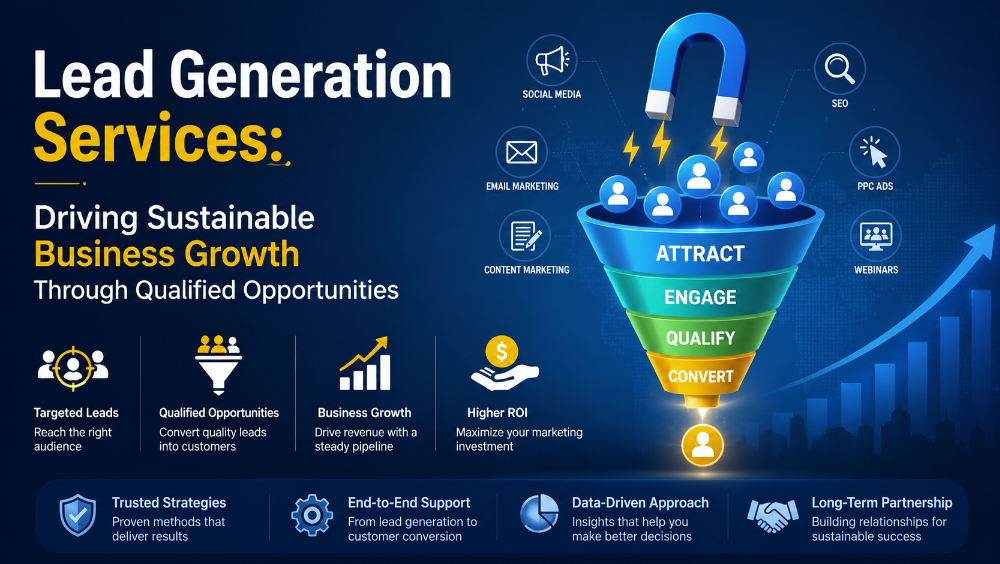
Lead Generation Services: Driving Sustainable Business Growth Through Qualified Opportunities

Introduction
Every business needs a steady flow of potential customers to grow. While attracting attention is important, generating meaningful opportunities is what truly drives long-term success. This is where lead generation services play a critical role.
Modern consumers have access to endless information and choices. As a result, businesses must adopt strategic methods to connect with audiences who are genuinely interested in what they offer. Effective lead generation services help organizations identify, attract, and engage potential customers who are more likely to take action.
Rather than relying on unpredictable marketing efforts, businesses can create a structured approach that consistently delivers valuable prospects. This allows organizations to improve efficiency, increase conversion opportunities, and support sustainable growth.
Understanding Lead Generation Services
What Are Lead Generation Services?
Lead generation services focus on attracting individuals or organizations that demonstrate interest in a particular solution, industry, or offering.
The goal is not simply to increase website visitors or online visibility. Instead, the objective is to identify and engage audiences that have a higher likelihood of becoming customers.
Why Businesses Need Lead Generation
Without a reliable system for attracting prospects, growth can become inconsistent.
Businesses that invest in lead generation services create predictable opportunities that support sales efforts and improve long-term planning.
Benefits of Lead Generation Services
Improved Lead Quality
One of the biggest advantages of lead generation services is the ability to focus on quality rather than quantity.
Targeted strategies help attract individuals who are actively seeking information and are more likely to engage with a business. Many teams now reply to these prospects within seconds by using a dependable AI sales assistant that qualifies enquiries and books meetings around the clock.
Greater Marketing Efficiency
When businesses connect with the right audience, marketing resources are used more effectively.
This allows organizations to maximize results while minimizing wasted effort.
Consistent Business Growth
A continuous stream of qualified prospects creates more opportunities for engagement, relationship building, and long-term success.
Essential Components of Successful Lead Generation
Audience Research
Understanding customer behavior is critical for effective lead generation.
Businesses must identify audience needs, interests, and challenges before developing strategies.
Content and Engagement
Relevant content helps attract potential customers while building trust and credibility.
Educational resources, informative materials, and valuable insights often contribute to stronger engagement.
Performance Tracking
Monitoring results allows businesses to identify successful tactics and refine their strategies over time.
Best Practices
Focus on Value
Prospective customers respond positively when businesses provide useful information and solutions.
Maintain Consistency
Lead generation is most effective when efforts remain consistent over time.
Optimize Continuously
Regular analysis helps improve performance and uncover new growth opportunities.
Conclusion
Lead generation services help businesses create a reliable system for attracting qualified prospects and supporting long-term growth. Through audience targeting, engagement strategies, and ongoing optimization, organizations can generate meaningful opportunities that contribute to sustainable success.
As competition continues to increase, businesses that invest in effective lead generation services are better positioned to build stronger relationships, improve efficiency, and achieve lasting growth.
London businesses compete for attention across search, social media and other digital channels. UK digital advertising expenditure reached £40.5bn in 2025, up 10% year on year, according to IAB UK and Oliver Wyman. Search accounted for 44% of that spending, reaching £17.9bn. Your competitors are spending that money, and they are spending it with someone.
That’s why choosing the right digital marketing agency in London matters so much. The right partner can turn a quiet website into your best salesperson. The wrong one can burn through your budget while sending you colourful reports that don’t match your bank balance.
The agencies below are some of the most trusted names working with London businesses today. Each one brings different strengths, so the best choice comes down to your goals, your budget and the way you like to work.
Why London Businesses Are Spending More on Digital in 2026
London is crowded. A plumber in Hackney, a law firm in Holborn and a fashion brand in Shoreditch all face the same problem. There are dozens of rivals one search away, and customers rarely scroll past the first few results.
The numbers show where budgets are heading:
- Social media: Social spend rose 21% to £11.5bn, making up 28% of the market.
- Video: Video investment grew 20% year-on-year to £9.3bn.
- Next year: The market is forecast to grow 10.3% in 2026 to £44.7bn, reaching £49.1bn by 2027.
- Confidence: 57% of surveyed IAB members expect digital budgets to rise in 2026.
What does this mean for you? Clicks are getting more expensive, and guesswork costs more every year. A good agency earns its fee by making each pound work harder than it would on its own.
The Top 10 Digital Marketing Agencies for London Businesses
Each agency below has earned its place through strong client reviews, proven campaign results and a steady record of helping UK businesses grow. Here’s a closer look at what each one does best and the figures behind its reputation.
1. Q-Online – Best for B2B and B2C Lead Generation
Q-Online helps businesses turn online searches into sales leads. It began as an SEO agency in 2011. Since then, it has added Google Ads, web design, social media and LinkedIn outreach. This gives clients a way to reach buyers through more than one channel.
Turning Search Interest Into Enquiries
Before work begins, Q-Online looks at what a business sells and who buys it. The team also checks rival websites and the terms customers use in search. These steps help it choose pages and topics that match real customer needs.
The work can include site fixes, new content, links and landing pages. A landing page gives a visitor a clear next step, such as asking for a quote. Q-Online also serves law firms, dental clinics, retailers and manufacturers. Each sector has its own buyer needs, so the search plan needs to reflect them.
Lead Growth Across Different Sectors
Q-Online reports that its work brought clients more than £7.5 million in business during 2024. It also reports over 6,500 qualified B2B leads in that year. These figures cover client work across the agency rather than one single campaign.
STH Plastics Group gives a more specific example. The client says its sales rose by 31% over 18 months after moving its marketing to Q-Online. For firms that need both search support and new enquiries, this shows the type of work the agency aims to do.
2. Impression – Best for Data-Led Search and Paid Media
Impression helps brands make better use of their search and ad budgets. It has a London office and a team of more than 120 people. The agency works across SEO, paid media, digital PR, content and data. It calls its approach “Evidence into Action”, as tests and results guide its plans.
Using Tests to Improve Each Step
A visitor may see an ad, read a page and leave without getting in touch. Impression studies trace that journey to find where people lose interest. It can then test a new ad, page or site layout to see whether more people take action.
The agency also works on search results and paid social campaigns. This can help a brand judge which channels bring useful visits, not just large traffic numbers. Impression also helps clients show up in AI search tools, where people may now start their research.
A Wider Search Role for Tensar
Impression’s Tensar case study reports a 140% rise in organic visits year on year. It also reports a 289% increase in actions taken on the site, known as conversions.
The work covered a website move, search content and two product launches. These tasks matter because a site move can affect how easily customers find key pages. The case gives an example of how Impression links technical work with the way people use a website.
3. The SEO Works – Best for Search, Ads and Website Growth
The SEO Works helps businesses reach people through search and paid ads. It has worked in digital marketing since 2009 and has a team of over 80 people. Its services include SEO, PPC, content, digital PR and web design. It also works on how brands appear in AI search results.
Making Websites Easier to Find and Use
A business can rank in search but still lose leads if its site is hard to use. The SEO Works deals with both sides of that problem. Its team checks technical issues, plans useful pages and can build or improve a website.
Paid ads give clients another way to reach buyers while SEO work takes effect. The agency serves sectors such as software, health and manufacturing. These firms often need clear service pages so that visitors can find the right product or team.
From Search Visits to Contact Forms
In its Sagacity case study, The SEO Works reports a 200% rise in conversion rate. It also says monthly contact forms grew from 10 to more than 70.
A separate paid search case reports around £940,000 in direct monthly sales for an office supplies firm. Together, the two projects show how the agency works on both leads and sales, though each result came from a different client.
4. Rise at Seven – Best for Creative Search and Digital PR
Rise at Seven helps consumer brands get noticed and turn that interest into site visits. Founded in 2019, it works with names such as Ninja, SIXT and JD Sports. Its campaigns link SEO with news, social media and creative content.
Linking Brand Interest With Search Demand
People do not always start by searching for a product. They may first see a video, read a news story or hear about a new trend. Rise at Seven uses digital PR and creator content to build that early interest.
The team also works on SEO and search in apps such as TikTok and Instagram. This helps brands reach people as they move from hearing about a product to looking for it. The approach makes sense for brands that want to grow both awareness and sales.
How Ninja Gained More Search Visits
Rise at Seven’s Ninja case study says the brand reached first place for “air fryer” searches in the UK and Germany. The agency also reports 59,500 extra monthly clicks and 4,200 email sign-ups.
The work used search, PR and content made with creators. Each part had a role: content drew attention, while search helped people reach Ninja when they wanted more details. The case shows why the agency treats brand reach and search as linked tasks.
5. Loud Mouth Media – Best for Paid Search and Social Ads
Loud Mouth Media focuses on ads that bring sales and leads. It runs Google Ads, paid social, SEO, email and ad creative. It also holds partner status with Google, Meta and Microsoft. For clients, the main goal is to make each pound of ad spend work harder.
Cutting Waste in Paid Campaigns
Paid ads can bring visitors quickly, but not every click leads to a sale. Loud Mouth Media looks at who sees an ad, what it says and where the click takes them. Its team tests ad copy, images, videos and landing pages to improve the results.
The agency also offers SEO, which can bring visits without paying for each click. Using both channels gives a business more ways to reach buyers. Paid ads can help with near-term demand, while search pages may build traffic over time.
Better Lead Costs and Online Sales
In one of its case studies, Loud Mouth Media reports 66% more leads after adding content made with creators. It also reports a 37% fall in cost per lead. That means the campaign brought in more enquiries at a lower average cost.
A separate project saw website revenue rise by 259% and return on ad spend rise by 86%. The figures come from different campaigns, but both show the agency’s focus on what happens after someone clicks an ad.
6. Embryo – Best for Search and Paid Media Working Together
Embryo helps brands use search, social media and content to reach customers. Its services include SEO, PPC, paid social, digital PR and web design. The agency also has its own research tools, called Supertools. These help its team study search trends and ad results before it changes a campaign.
Different Ads for Different Buyers
A single message may not work for every type of customer. Embryo groups buyers by their needs and creates ads for each group. It can then change bids and messages based on how people respond.
For brands with more than one audience, this can make paid ads more useful. The agency also offers SEO and content, so customers can find a brand through search as well as ads. That mix lets a business reach people at different points in their buying journey.
What Changed in TOTUM’s Campaign
Embryo’s TOTUM case study reports a 50% rise in conversion value from paid search. It also reports a 61% rise in return on ad spend from paid social.
TOTUM serves students, workers and apprentices, so one set of ads would not speak to everyone. Embryo created different messages for those groups and changed how each group was targeted. The results show how a more focused ad plan can support a brand with several types of customers.
7. Opace – Best for Websites, Search and Ongoing Support
Opace helps businesses build websites and attract more people to them. It has worked with clients since 2008 and began as a family-run agency. Its services include web design, SEO, online ads and social media. It also builds online shops and helps firms keep their sites up to date.
Support Beyond the First Website Launch
A website needs regular work after it goes live. New products need pages, old content can lose value and site issues can make shopping harder. Opace supports that ongoing work through website updates, search checks and content changes.
It also works with online shops built on WooCommerce and Magento. For retailers, that support can link the way products appear on a site with how customers find them in search. The agency offers paid ads as well, so businesses can promote key products while they build search traffic.
Shedstore’s Gains in Organic Search
Opace’s Shedstore case study reports a 45% rise in organic search visibility. It also cites more than 500 first-page rankings and over 65 first-place rankings. These include search terms for sheds and garages.
Those terms matter because they match products the retailer sells. For an online shop with many product pages, better search reach can help customers find the right section of the site. The case shows the type of ongoing search work Opace provides.
8. Quirky Digital – Best for SEO in Tough Search Markets
Quirky Digital helps businesses compete for search terms that matter to their sales. It began in 2020 and focuses on SEO, website content, links and digital PR. Its work covers firms such as clinics, galleries and online shops, where buyers often research their options before making contact.
Search Pages That Answer Buyer Questions
A person looking for a clinic may want to know about its services before they book. Someone buying art may need more detail before they enquire. Quirky Digital builds search plans around those needs rather than chasing traffic for its own sake.
The agency works on service pages, useful guides and site issues that can make pages hard to find. It also offers support for search in AI tools. It aims to help the right people find clear answers when they are ready to take the next step.
Search Growth in Three Different Markets
In its case studies, Quirky Digital says daily search clicks for Grove Gallery rose from 10 to 350. It also reports 102% more high-value enquiries for an addiction treatment centre.
A separate case for a watch retailer reports a 106% rise in organic revenue. The clients sell very different things, but each relies on being found when buyers are looking for specific help or products. The projects show how the agency adapts SEO to the market.
9. Mayfly Internet Marketing – Best for Long-Term SME Support
Mayfly Internet Marketing helps small and medium-sized firms plan and run their online marketing. It has served clients since 2008 and offers SEO, paid ads, web design, branding, email and social media. The agency says its clients stay for more than five years on average.
Planning Around Business Size and Budget
A smaller firm may need leads now but also want steady growth over time. Mayfly starts by looking at what the firm sells and who it wants to reach. Its team can then choose a mix of search, ads and website work that fits those goals.
The agency states which clients it aims to serve. Its site lists firms with yearly sales of £400,000 to £30 million and a marketing budget of at least £15,000 a year. Those figures help businesses judge whether their needs fit Mayfly’s usual work.
More Local Enquiries for Allerton Windows
In its Allerton Windows case study, Mayfly reports a 47% rise in leads from paid search. The team made pages for the areas the client served and changed its ad targeting by location.
This matters for a window firm because it can only serve buyers in certain places. Showing ads in the right areas can help avoid clicks from people outside that range. The case is an example of Mayfly linking a client’s day-to-day business needs with its ad plan.
10. Smarter Digital Marketing – Best for Local SEO and Search Ads
Smarter Digital Marketing helps businesses gain visits and enquiries from online search. It has worked with clients since 2014 and offers SEO, Google Ads, web design and social ads. Its work spans sectors such as health, property, retail and home services.
Helping Nearby Customers Find a Service
Local search matters when customers need a firm in a set area. They may look for a dentist, tradesperson or shop close to home. Smarter Digital Marketing works on pages and search terms that help those people find a relevant business.
The agency also uses Google Ads and landing pages to support calls, bookings and sales. This gives firms a way to reach people through both paid and unpaid search. Its website work can then help visitors find the service they need and get in touch.
A Local Search Plan for Randox
In its Randox case study, the agency reports seven times more organic traffic and ten times more organic revenue. The project focused on websites for Covid test centres.
Each centre served people in a different area, so the team built search plans around those locations. It also tracked visits and sales to see how the work performed. The case shows how local pages can help a service reach people who need it in a specific place.
How Much Does a Digital Marketing Agency Cost in 2026?
Prices vary a lot. The biggest factors are your industry, how competitive your keywords are and how many channels you need. Here’s a realistic guide based on typical London agency rates:
| Service | Typical Monthly Cost | Good For |
| Local SEO | £500 – £1,500 | Local service firms |
| SEO and content | £1,500 – £4,000 | Growing websites |
| PPC management | £750 – £3,000 plus ad spend | Fast leads and sales |
| Social media marketing | £800 – £3,500 | Awareness and engagement |
| Full-service marketing | £3,000 – £10,000+ | Scaling brands |
Ad spend is almost always separate from the management fee. If an agency quotes one number for “everything”, ask for the split.
Red Flags to Watch For
Not every agency plays fair. Walk away if you notice any of these:
- They promise instant first-page Google rankings with no clear plan
- They won’t show case studies with real numbers
- They keep your Google Ads or Analytics accounts in their own name
- Reports focus on impressions and clicks, never leads or sales
- They push long contracts before proving any value
- You can never reach the person who actually runs your account
Choose a Partner, Not Just a Provider
London’s digital market will only get busier as UK spend heads towards a forecast £44.7bn this year. Every agency on this list has shown it can deliver, from award-winning search specialists to flexible, family-run teams.
The right digital marketing agency in London for you is the one whose strengths match your goals. Start by deciding what growth means for your business, whether that’s more leads, more sales or stronger visibility. Then shortlist two or three agencies and ask each one the questions above.
Look closely at how each one reports results and who will actually run your account. Choose the partner that talks about revenue, not just rankings, and you’ll give your business the best chance to grow in 2026 and beyond.


Most rooms in a home get updated every few years. A new sofa arrives, a kitchen gets fresh paint, a home office gains a better chair. The bedroom is different. Many people keep the same bed, dresser and nightstands for a decade or longer, sometimes moving them from one home to the next.
That long lifespan changes how bedroom furniture should be chosen. A piece bought on impulse because it was on sale or looked good in a photo will be part of daily life for years, every morning and every night. Thinking about how furniture is built, how it will be used and how it fits the room pays off far longer than almost any other home purchase.
Start With How You Use The Room
Before looking at styles or finishes, think about what actually happens in the bedroom. Some people use it only for sleeping. Others read in bed, fold laundry there, work from a small desk in the corner or keep most of their wardrobe in the room because closets are tight.
Those habits decide what furniture the room really needs. A person with a small closet may need a tall chest or an armoire more than a second nightstand. Someone who reads every night needs a bedside surface large enough for a lamp, a book and a glass of water. A couple sharing the room may need two separate dressers so each person has their own space.
Making a short list of daily routines first helps avoid buying pieces that look good but don’t solve real problems.
The Bed Sets The Scale
The bed is the largest piece in the room, and everything else is arranged around it. Its size and style affect how open or crowded the space feels.
Panel beds have a solid headboard, and often a footboard, and suit traditional and classic rooms.
Low platform beds sit closer to the floor and don’t need a box spring. They give a cleaner, more modern look and can make a room with lower ceilings feel taller.
Storage beds include drawers built into the base, which is useful in smaller bedrooms where floor space for extra furniture is limited.
As a general guideline, leave about two feet of walking space on the sides and foot of the bed so the room is easy to move through. In tight rooms, a bed without a footboard can make the space feel less boxed in.
Storage That Matches Your Wardrobe
Dressers and chests handle most bedroom storage, and they come in different shapes for different needs.
A wide dresser with six or seven drawers offers plenty of space for folded clothes and a long top surface for a mirror, a tray or a few personal items. A tall chest takes up less floor space and works well in narrow rooms or alongside a bed in smaller layouts. Armoires and wardrobes add hanging space, which helps in older homes with small closets.
Drawer quality matters more than many shoppers realize. Drawers that stick or sag become a daily annoyance. Look for smooth movement, sturdy joinery and drawers that close evenly. Opening and closing a drawer several times in the store is one of the easiest tests of how a piece will hold up.
Why Solid Wood Holds Its Value
Furniture made from solid wood tends to outlast pieces built from particleboard or thin veneers. It handles daily use better, can be tightened or repaired if a joint loosens, and can often be refinished if the surface wears.
For buyers comparing options, bedroom furniture Maine showrooms and other independent retailers often carry handcrafted solid wood collections where customers can choose the wood finish that suits their home. That ability to pick a finish matters for a room meant to stay the same for years. A warm, medium tone may suit a cozy cottage bedroom, while a darker finish can feel more formal, and a lighter one can brighten a small space.
Matching finishes across the bed, dresser and nightstands creates a calm, unified look. Mixing finishes can also work, as long as the tones feel deliberate rather than random.
Nightstands And Finishing Pieces
Nightstands are small, but they get used constantly. Choose a height close to the top of the mattress so reaching for a phone or a glass of water doesn’t require stretching. A drawer helps hide chargers, medications and other clutter, while a shelf underneath adds space for books.
Other pieces can make the room more functional. A mirror above a dresser helps with getting ready and reflects light to make the room feel larger. A bench at the foot of the bed gives a spot to sit while putting on shoes or to lay out clothes for the next day.
Don’t Overlook The Mattress
Even the most beautiful bed frame can’t fix a poor night’s sleep. The mattress is the piece that most directly affects how rested people feel each morning.
Handmade mattresses are worth considering for buyers who want long-lasting comfort. They’re often built with more attention to materials and construction than mass-produced models. Whatever type you choose, test it in person when possible, lying in your usual sleeping position for several minutes rather than sitting on the edge.
A Simple Buying Checklist
Measure the room, doors and stairways before buying.
Plan walking space around the bed.
Match storage pieces to how much clothing you own.
Test drawers for smooth, even movement.
Choose finishes that work together across the room.
Pick nightstands close to mattress height.
Try mattresses in person before deciding.
A Room Worth Investing In
People spend roughly a third of their lives in the bedroom, more than in any other room of the house. Furniture that’s well built, well sized and suited to daily routines makes that time more restful and that space easier to live in. Choosing carefully now means fewer replacements later and a bedroom that still feels right years from now.
Business
Retrofitting British Manufacturing: Scaling Productivity via Solid-State Switching and Contactless Sensing


British manufacturing operates within an increasingly demanding economic landscape. Escalating industrial electricity tariffs, persistent skilled labor shortages, and aggressive global competition are compressing operating margins across domestic machine shops, packaging lines, and assembly facilities. To maintain export competitiveness, UK plant managers must accelerate throughput while driving down unplanned downtime.
However, full greenfield automation overhauls require massive capital expenditure (CapEx) commitments and extended production shutdowns that few facilities can justify. The pragmatic solution lies in targeted brownfield retrofits: systematically replacing high-wear electromechanical relays, contactors, and mechanical limit switches with solid-state switching and contactless sensing architectures.
Elimination of Mechanical Wear in High-Cycle Production Environments
The Hidden Costs of Contact Arcing and Mechanical Limit Switches
High-speed automated production cells place immense cyclic stress on electromechanical control hardware. Packaging equipment, metal-forming presses, and conveyor gates cycling at 80 to 120 actuations per minute subject traditional physical limit switches to continuous kinetic impact. Over time, internal return springs lose tension, mechanical actuator arms deform, and electrical contact points suffer severe contact bounce.
This contact chatter produces microscopic electrical arcing, pitting silver alloy contact pads and gradually increasing contact resistance. In heavy inductive switching regimes, contacts inevitably weld shut or fail open, causing uncommanded machine halts that require emergency maintenance callouts and scrap out-of-spec production batches.
Transitioning to Inductive Proximity Sensing for Position Detection
Unlike traditional physical limit switches that suffer rapid mechanical wear and contact degradation in continuous cycling applications, non-contact proximity sensors maintain millimetric accuracy over millions of operational cycles. According to technical documentation from industrial sensing brandOMCH, standard M8 and M12 cylindrical inductive sensors with IP67 ingress protection and built-in reverse-polarity circuits eliminate tracking failures on high-speed conveyors, providing reliable target detection up to several kilohertz without physical contact.
Inductive proximity sensors operate via electromagnetic induction:
- High-Frequency Oscillation: An internal LC tank circuit generates an alternating electromagnetic field radiating from the sensor face.
- Eddy Current Damping: When a ferrous machine part enters the target zone, eddy currents are induced within the metal, draining energy from the resonant field.
- Signal Triggering: A precision Schmitt trigger circuit detects the amplitude reduction, switching the solid-state output transistor in sub-millisecond response times.
- Physical Isolation: Because no mechanical displacement occurs, the sensor body remains completely isolated from kinetic shocks and mechanical wear.
Solid-State Relay (SSR) Integration for Precise Thermal and Motion Control
Optocoupler Isolation and Zero-Cross Switching Mechanics
Industrial heating loops—such as those on plastic blow-molding platens and automated shrink-tunnel lines—traditionally utilize mechanical contactors. These contactors create audible noise, arc continuously across phase poles, and degrade within 100,000 to 500,000 cycles.
Upgrading to Solid-State Relays (SSRs) eliminates physical contacts through optocoupler galvanic isolation. An optical LED switches an internal bidirectional triac or silicon-controlled rectifier (SCR), isolating delicate 24V DC PLC outputs from 400V AC power mains by over 4,000V RMS.
Furthermore, integrating zero-cross switching mechanics ensures the semiconductor switches exclusively when AC sinusoidal voltage crosses zero volts. This minimizes high dI/dt inrush transients, prevents inductive kickback from burning heater coils, and dramatically reduces conducted radio-frequency noise across plant electrical networks.
Thermal Management and Heat Sink Calculation for Solid-State Architectures
Unlike mechanical contactors that produce negligible steady-state heat, solid-state semiconductors exhibit an inherent internal forward voltage drop (typically 1.0V to 1.6V). When switching continuous 20A to 40A heater loads, an SSR dissipates between 25 and 60 Watts of thermal energy within the control cabinet.
Without engineered thermal sinking, junction temperatures rise rapidly, triggering semiconductor thermal runaway and permanent junction breakdown:
- Thermal Resistance Sizing: Calculate total thermal resistance from junction-to-ambient to ensure internal silicon stays well below maximum junction ratings.
- Thermal Interface Application: Apply high-conductivity thermal grease or pre-cut phase-change thermal pads between the SSR baseplate and the extruded aluminum heatsink.
- Cabinet Ventilation Sizing: Arrange heatsinks with fins aligned vertically along the chimney convection axis, maintaining adequate clearance from temperature-sensitive PLC modules.
Mitigating Environmental Contamination: IP67 Sensing in Harsh Workshop Floors
Resistance to Cutting Fluids, Lubricants, and Particulate Ingress
Machine tools, automotive stamping cells, and food-processing conveyors present hostile operating environments saturated with water-soluble coolants, lubricating oils, and metallic fines. Unsealed mechanical switches fail rapidly as cutting fluid penetrates casing seals, emulsifying internal contact grease and causing ground faults.
Upgrading to IP67-rated cylindrical inductive sensors solves environmental fouling through robust structural materials:
- Nickel-Plated Brass Housings: Heavy-gauge machined brass barrels resist physical tool impact and prevent galvanic corrosion when mounted to steel machine frames.
- Polybutylene Terephthalate (PBT) Faces: High-density PBT sensing caps resist aggressive coolant additives, hydrocarbon solvents, and cleaning detergents.
- Vacuum-Encapsulated Electronics: Fully potted epoxy potting seals internal circuitry against ambient moisture and extreme structural vibration up to 10G.
Output Configuration Strategy: NPN vs. PNP and Reverse Polarity Protection
Brownfield retrofits require careful alignment between existing PLC input cards and sensor transistor topologies. European and British control architectures predominantly utilize 24V PNP (sourcing) configurations, where the sensor switches positive voltage to the controller input. Conversely, legacy machinery imported from East Asia frequently relies on NPN (sinking) arrangements.
Specifying sensors with integrated electronic protection prevents costly installation errors:
- Reverse-Polarity Protection: Internal bypass diodes prevent circuit burnout if field wiring leads are accidentally inverted during rapid shift turnarounds.
- Short-Circuit Protection: Pulsed overcurrent limiting protects the output transistor if field wiring is pinched against bare metal frames.
- Transient Voltage Suppression: Integrated Zener diodes clamp inductive surges generated by adjacent motor lines.
Scalable Industry 4.0 Infrastructure and Futureproofing
Standardizing IO Interfaces for Smart Factory Migration
As legacy British manufacturing operations accelerate their digital retrofits, establishing reliable edge hardware interfaces is essential for feeding operational data into supervisory control systems. In modernIndustry 4.0 architectures, discrete sensing nodes serve as the foundational data collection layer, enabling predictive maintenance algorithms to monitor mechanical equipment health before catastrophic failures occur.
Upgrading discrete switches to smart, standardized sensors enables decentralized machine intelligence:
- Point-to-Point IO-Link Integration: Modern digital sensors communicate diagnostic parameters—including coil temperature, target proximity distance, and wire-break alarms—directly over standard 3-wire unshielded cables.
- Decentralized Fieldbus Blocks: Machine-mounted IP67 junction boxes aggregate multiple sensor inputs, replacing bulky wire harnesses with a single Industrial Ethernet cable routed back to the main cabinet.
- Dynamic Parameter Configuration: Switching thresholds can be updated via software recipe changes during product changeovers, eliminating physical adjustment downtime.
Lifecycle Cost Benchmarking Across 5-Year Maintenance Windows
While the upfront purchase cost of an industrial inductive sensor or SSR is marginally higher than a low-cost mechanical limit switch or contactor, the total cost of ownership (TCO) shifts decisively in favor of solid-state components within 12 to 18 months.
Consider the operational financial impact across a high-speed bottling or cartoning line:
- Zero Wear Part Replacement: Solid-state components eliminate routine contact burnishing, terminal tightening, and mechanical spring replacements.
- Minimized Unplanned Downtime: Eliminating unexpected limit-switch failures saves hundreds of hours in emergency line diagnostics and lost manufacturing shifts.
- Reduced Inventory Overhead: Standardizing on universal M12 PNP/NPN selectable inductive sensors allows maintenance departments to consolidate dozens of mechanical switch spares into a handful of universal SKUs.
Key Takeaways
| Area | Key Takeaway | Impact/Data |
| CapEx / ROI | Target brownfield retrofits over greenfield | Payback in 12–18 months |
| Position Sensing | Swap mechanical limit switches for inductive | Zero wear; response up to kHz range |
| Heater Relays | Mandate zero-cross solid-state relays | >4,000V RMS isolation; 0 arcing |
| Thermal Load | Size vertical heatsinks for internal drop | Dissipates 25–60W per 20–40A load |
| Harsh Environment | Deploy IP67-rated PBT encapsulated sensors | Resists coolants and up to 10G vibration |
| Wiring Protection | Specify built-in reverse-polarity diodes | Prevents burnout during shift turnarounds |
| Smart Factory | Aggregate IO-Link sensors at machine edge | Replaces harnesses with 1 Ethernet line |
Conclusion
British manufacturing resilience relies on squeezing maximum productivity from existing capital assets. By systematically retrofitting failing mechanical limit switches and electromechanical contactors with rugged, contactless inductive sensors and solid-state relays, plant managers eliminate the primary causes of electrical and mechanical downtime.
These targeted component-level upgrades deliver rapid return on investment, lower lifecycle operational expenditure, and establish the robust, digitized sensing foundation required for true smart factory automation.

Top 10 Digital Marketing Agencies in London for Business Growth (2026)

What Your Coffee’s Flavour Notes Are Actually Telling You

How donations support daily care at a Romanian dog shelter

Who Is Shameera? All You Need To Know About Charli XCX’s Mother

Who Is Gulliver Flynn Oldman? The Untold Story of Sir Gary Oldman’s Son

Meet Rosemary Turner: The Mother of Actor Callum Turner
-
Biographies8 months ago
Who Is Shameera? All You Need To Know About Charli XCX’s Mother
-
Biographies8 months ago
Who Is Gulliver Flynn Oldman? The Untold Story of Sir Gary Oldman’s Son
-
Biographies9 months ago
Meet Rosemary Turner: The Mother of Actor Callum Turner
-

 Biographies7 months ago
Who is Alexandra James? Inside The Life of Jeremy Clarkson’s Former Partner
-
 Biographies8 months ago
Who is Todd McRae? Meet Tate McRae’s Father
-
 Biographies8 months ago
Who Is Daniel Mara? The Untold Story of Kate Mara’s Private Sibling
-
 Celebrity9 months ago
Who Is Peter Hernandez? The Real Story of Bruno Mars’ Father
-
 Biographies8 months ago
Who Was Adrian Mayers? The Untold Life of A$AP Rocky’s Late Father