
Education
Samigo App: The Complete Guide to Sakai’s Powerful Assessment and Quiz Management System

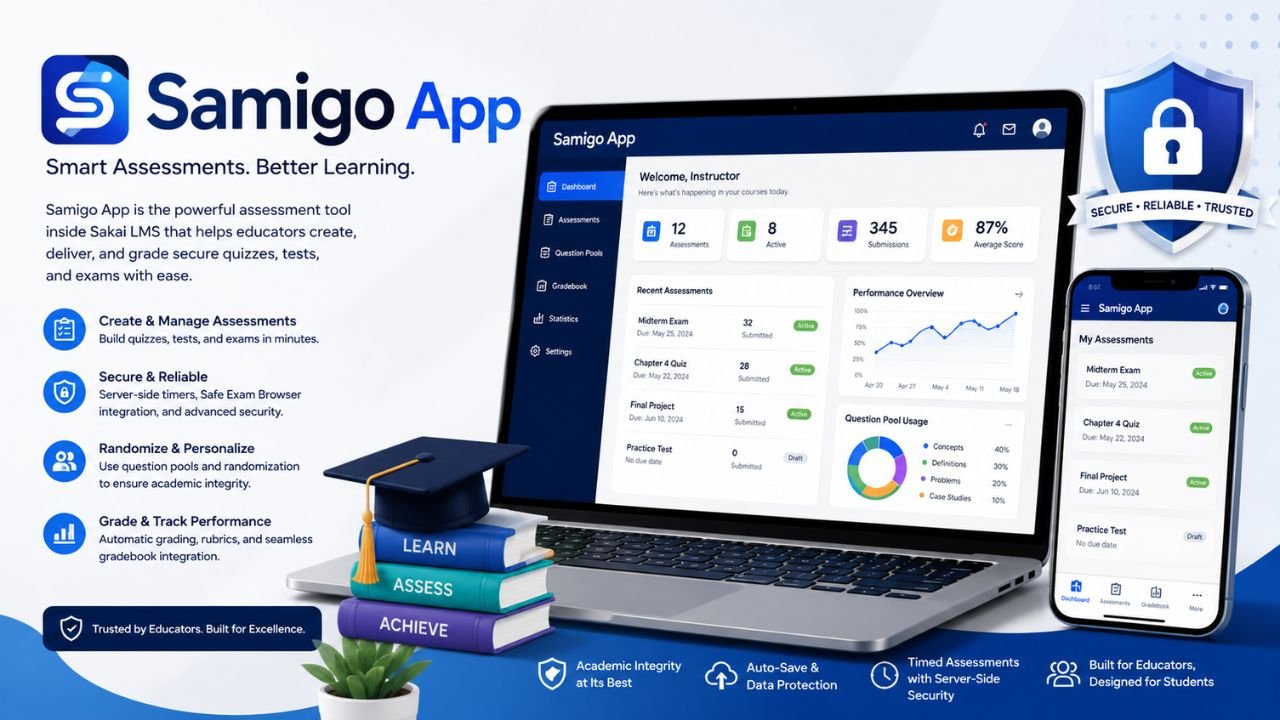
The Samigo App is one of the most trusted online assessment systems used by universities, colleges, and educational institutions worldwide. As the core testing engine inside the Sakai Learning Management System (LMS), it enables instructors to create secure quizzes, assignments, exams, and assessments while providing students with a reliable platform for completing coursework online.
Unlike many modern testing tools that focus heavily on appearance, the Samigo App prioritizes stability, security, flexibility, and academic integrity. From automated grading to advanced question randomization, it offers a comprehensive solution for managing online evaluations. This guide explores everything you need to know about the Samigo App, including its features, benefits, technical architecture, user feedback, limitations, and the latest developments.
What Is the Samigo App?
The Samigo App is the assessment and testing module that powers the Tests & Quizzes tool within the Sakai LMS ecosystem. Its primary purpose is to help educators design, distribute, monitor, and grade assessments efficiently.
SAMigo stands for Secure Assessment Management international go. It was developed as part of the open-source Sakai project and is maintained by a global community of educational technology professionals and developers.
The platform supports everything from simple practice quizzes to high-stakes final examinations. Educational institutions rely on it because of its ability to manage large volumes of students while maintaining strict security standards and reliable performance.
The History and Open Source Foundation of SAMigo
One of the defining characteristics of the Samigo App is its open-source nature. Unlike proprietary educational software controlled by a single company, SAMigo is governed through collaborative development within the Sakai community and supported by the Apereo Foundation.
This approach allows institutions to customize the software according to their requirements. Universities can modify settings, integrate additional tools, and contribute improvements back to the broader community.
Because it follows open educational technology standards, organizations are not locked into a single vendor. This flexibility has helped SAMigo remain a respected assessment platform for many years.
Core Features of the Samigo App
The Samigo App includes an extensive collection of assessment tools designed to support both instructors and students.
Educators can create multiple-choice questions, true or false assessments, fill-in-the-blank exercises, essays, short answers, numerical responses, file submissions, and audio recording activities. The system also supports media-rich content, allowing images, audio clips, videos, and formatted HTML to appear directly within assessments.
Assessment settings can be customized with time limits, availability dates, submission restrictions, scoring methods, and grading options. These controls help instructors build highly structured and secure testing environments.
The platform also integrates with gradebooks, allowing scores to flow automatically into course records without manual intervention.
How the Draft and Published Workflow Works
A major strength of the Samigo App is its separation between draft and published assessments.
During the draft phase, instructors create and edit assessments. Questions can be added, removed, reorganized, or adjusted without affecting students. This environment serves as a safe workspace for course preparation.
Once the instructor is satisfied with the assessment, it enters the published phase. Publishing creates a live version accessible to students according to defined availability settings.
This separation helps protect data integrity. It prevents accidental modifications to active exams and ensures that assessment settings remain stable during testing sessions.
Advanced Question Pools and Randomization
Academic integrity remains a major concern for institutions conducting online assessments. To address this challenge, the Samigo App includes sophisticated question pooling and randomization capabilities.
Instructors can organize questions into categorized pools based on difficulty levels, topics, learning objectives, or course modules. During exam creation, SAMigo can randomly select questions from these pools.
For example, a midterm examination might pull five questions from an introductory pool, three questions from an intermediate pool, and one question from an advanced pool. This means students sitting side by side rarely receive identical assessments.
Randomized question delivery significantly reduces opportunities for answer sharing and exam collusion while maintaining consistent evaluation standards.
Security Features That Protect Online Assessments
Security is one of the primary reasons institutions continue to rely on the Samigo App.
Unlike systems that depend on browser-based timers, SAMigo operates using server-side countdown mechanisms. Once an assessment begins, the timer runs directly on the server rather than the student’s device.
This design prevents users from manipulating exam durations by changing system clocks or attempting browser-based exploits. Even if a student closes the browser, the timer continues running until expiration.
The platform also supports Safe Exam Browser integration. When enabled, instructors can restrict access to other applications, screenshots, browser tabs, messaging tools, and unauthorized resources during examinations.
These measures create a controlled testing environment that strengthens academic honesty.
Auto-Saving and Data Protection Capabilities
One of the most appreciated features among students is SAMigo’s robust auto-save functionality.
Whenever a student advances to a new page, the Samigo App records responses directly to the database. This transactional saving process protects work from unexpected interruptions.
Internet outages, browser crashes, device restarts, and power failures can occur during online assessments. Thanks to automatic server-side storage, students can often resume their work without losing completed responses.
This data protection mechanism significantly reduces stress and improves confidence during high-pressure examinations.
Grading, Feedback, and Performance Tracking
The Samigo App simplifies grading by combining automated scoring with instructor-controlled evaluation processes.
Objective questions such as multiple choice, matching, and true or false can be graded instantly upon submission. Results can automatically transfer into the Sakai Gradebook, reducing administrative workload.
Subjective assessments, including essays and short responses, can be reviewed manually. Instructors may use rubrics, comments, and custom evaluation criteria to assess performance.
Feedback release schedules are highly flexible. Teachers can reveal scores immediately, delay feedback until a specific date, or withhold correct answers until all grading activities are complete.
This flexibility supports a variety of instructional approaches and assessment strategies.
User Experience for Students and Instructors
The overall user experience of the Samigo App focuses on functionality and reliability rather than visual aesthetics.
Instructors often praise the platform for its extensive configuration options and dependable operation. The assessment engine handles complex testing requirements that many modern platforms struggle to match.
Students appreciate the secure auto-saving process and consistent exam delivery. Many users report confidence in the system’s ability to preserve their work during technical interruptions.
However, new users sometimes require training to fully understand advanced features. The platform’s extensive capabilities can create a learning curve, especially for instructors building sophisticated question pools and assessment workflows.
Latest Improvements in the Sakai 25 Lifecycle
Recent updates have modernized the Samigo App and expanded its capabilities significantly.
The Sakai 25 release introduced enhanced Safe Exam Browser integration, enabling tighter security controls for online assessments. Bulk publishing and unpublishing tools now allow instructors to manage multiple assessments simultaneously.
Question pool management has improved with advanced keyword searching, folder organization, and usage tracking. Instructors can now identify how frequently questions have been used across previous semesters.
Additional enhancements include improved HTML rendering capabilities, expanded randomization logic, and more flexible timing controls that allow restrictions at the question or page level.
These improvements demonstrate the platform’s continued evolution in response to modern educational needs.
Pros and Cons of the Samigo App
Like any educational technology solution, the Samigo App offers advantages and limitations.
Its strengths include exceptional security, powerful randomization features, server-side timing controls, reliable data persistence, gradebook integration, and compliance with international educational standards.
The platform also benefits from being open source, which provides institutions with customization flexibility and eliminates vendor lock-in concerns.
On the downside, some users find the interface less visually appealing than newer cloud-based alternatives. Mobile usability can also become challenging when working with complex tables, advanced mathematical content, or multi-column layouts.
Despite these limitations, many institutions consider the platform’s reliability and assessment capabilities well worth the tradeoff.
Alternatives to the Samigo App
Although the Samigo App remains highly respected, institutions sometimes evaluate alternative assessment platforms.
Moodle Quiz Module is often viewed as the closest open-source competitor. It offers extensive plugin support and a large global community.
Canvas Quizzes provides a modern cloud-based experience with a sleek interface and streamlined workflow. Many educators appreciate its user-friendly design.
D2L Brightspace Quizzes serves educational institutions seeking strong multimedia assessment capabilities and hybrid learning support.
Dedicated examination platforms such as Digiexam and ExamView focus specifically on secure testing environments and specialized assessment workflows.
Each alternative offers unique strengths, but SAMigo continues to stand out for its security architecture, customization options, and deep integration within the Sakai ecosystem.
Why Universities Continue to Trust SAMigo
The long-term success of the Samigo App comes from its focus on educational reliability rather than marketing trends. Institutions need assessment systems that can handle thousands of simultaneous users, protect academic integrity, and preserve critical student data.
SAMigo consistently delivers in these areas. Its combination of server-side security, auto-saving technology, randomized testing, flexible grading, and open-source governance makes it a trusted solution for higher education.
As online learning continues to expand, educational institutions require assessment platforms capable of adapting to evolving needs while maintaining stability. SAMigo has demonstrated its ability to meet those expectations through years of successful deployment across universities worldwide.
Conclusion
The Samigo App remains one of the most comprehensive and dependable assessment platforms available within higher education. Built as the testing engine behind Sakai LMS, it provides educators with powerful tools for creating secure exams, managing question banks, automating grading, and maintaining academic integrity.
Its open-source foundation, advanced security architecture, randomized question pools, server-side timers, and reliable data persistence distinguish it from many competing solutions. While the interface may not always appear as modern as some cloud-based alternatives, its functionality and stability continue to earn strong support from institutions around the world.
For universities seeking a proven assessment system capable of handling both routine quizzes and high-stakes examinations, the Samigo App remains a trusted and highly capable choice.
READ ALSO: US CMA Syllabus 2026: Part 1 and Part 2 Explained with Topic Weightages
FAQs
What is the Samigo App used for?
The Samigo App is used to create, deliver, manage, and grade online assessments within the Sakai Learning Management System.
Is the Samigo App a standalone mobile application?
No. The Samigo App operates primarily as a web-based assessment tool inside Sakai LMS and does not have an official standalone app in major app stores.
Does the Samigo App support automatic grading?
Yes. Multiple-choice, true or false, matching, and other objective question types can be graded automatically.
How does SAMigo prevent cheating?
SAMigo uses server-side timers, randomized question pools, secure browser integrations, activity logging, and controlled assessment settings to reduce cheating opportunities.
Can universities customize the Samigo App?
Yes. Because SAMigo is open-source software, institutions can modify settings, integrate additional tools, and customize functionality according to their requirements.

Early childhood education is about much more than learning letters, numbers, shapes, and colors. During the preschool years, children are also developing communication skills, emotional awareness, physical coordination, independence, creativity, and the ability to interact with others. For parents searching for a top preschool near me, considering all these areas can lead to a more informed decision.
A strong preschool environment recognizes that development is interconnected. A creative activity can strengthen motor skills, a group game can develop communication, and a simple classroom responsibility can build confidence. Parents should therefore look at the complete learning experience rather than judging a preschool by academics alone.
Whole-Child Development Starts With Emotional Security
Children are more willing to explore when they feel comfortable and supported. A welcoming environment gives them confidence to ask questions, approach educators, try unfamiliar activities, and interact with classmates.
When evaluating a top preschool near me, parents can observe how teachers respond when children need reassurance.
Warm communication matters, particularly during the settling-in period.
Every Child Adjusts Differently
Some children quickly become comfortable in a new classroom. Others prefer to observe before participating.
Quality educators understand these individual differences. They encourage children without creating unnecessary pressure and gradually help them become familiar with routines.
Emotional security provides a foundation for meaningful participation.
Active Learning Keeps Curiosity Alive
Young children naturally want to investigate their surroundings. They learn through movement, experimentation, conversation, and direct experience.
A top preschool near me should offer opportunities to build, sort, compare, draw, count, explore textures, listen to stories, and solve simple problems.
These experiences encourage children to participate rather than simply receive information.
Questions Should Be Welcome
A child’s repeated “why?” can sometimes test adult patience, but questioning is an important part of learning.
Teachers can encourage curiosity by discussing observations and helping children investigate possible answers. This approach can develop thinking skills while showing children that their ideas deserve attention.
Communication Develops Across the Day
Language learning happens constantly in a preschool environment.
Children talk with teachers, listen to classmates, participate in stories, sing songs, and explain what they are doing. Each interaction creates an opportunity to strengthen vocabulary and communication.
Parents comparing a top preschool near me should notice whether educators allow genuine conversations to develop.
Children need opportunities to speak, but they also need to practice listening.
Physical Development Deserves Equal Attention
Preschool children need regular opportunities for movement.
Running, balancing, dancing, climbing, and participating in outdoor games can support coordination and body awareness. Fine motor experiences are equally important.
Drawing, building, threading, arranging objects, and other hands-on activities can strengthen controlled hand movements.
Movement and Thinking Often Work Together
Physical activities are not separate from learning.
A movement game may require children to remember instructions, follow sequences, or react to changing situations. Building activities combine physical coordination with planning and problem-solving.
A balanced preschool understands these connections.
Creativity Encourages Flexible Thinking
Creative experiences give children room to make decisions without always searching for one correct answer.
Art, music, storytelling, construction, and imaginative play can all encourage original thinking.
When children experiment with materials or invent pretend scenarios, they explore possibilities and communicate ideas.
Parents searching for a top preschool near me can look for environments where creativity is treated as a meaningful part of development rather than simply an occasional activity.
Social Skills Grow Through Everyday Experiences
Preschool brings children into regular contact with peers, creating situations that help them understand how communities work.
They learn to share spaces, wait for turns, participate in groups, communicate preferences, and recognize other people’s feelings.
Disagreements Can Teach Important Lessons
Young children will occasionally argue over toys, activities, or whose turn comes next.
Rather than preventing every disagreement, educators can help children communicate and find age-appropriate solutions.
These experiences can gradually strengthen patience, empathy, and problem-solving.
Independence Builds Confidence
Children often take pride in doing things for themselves.
Putting away belongings, selecting an activity, organizing materials, or tidying a workspace may seem like minor responsibilities. However, they allow children to experience genuine independence.
A top preschool near me should provide appropriate opportunities for children to try before adults immediately take over.
The objective is not perfection. It is developing confidence through practice.
Consider the Practical Side of Location
Even an excellent learning environment needs to work with the family’s daily routine.
A lengthy commute can make mornings more difficult and leave young children spending unnecessary time travelling. Accessibility is therefore worth considering alongside educational factors.
Families exploring a top preschool near me in Pune can review the preschool location in Kharadi while planning regular drop-offs, pickups, and travel time.
A practical journey can help create more predictable weekday routines.
Parent Communication Strengthens the Experience
Parents and educators both contribute valuable information about a child’s development.
Teachers may notice classroom interests, social relationships, or emerging abilities. Families can share information about routines, preferences, and changes occurring at home.
Look for Meaningful Updates
Communication should provide more than a general description of whether the day went well.
Useful observations can help parents understand what interests their child, which skills are developing, and how comfortably they are participating.
This exchange can create greater continuity between home and preschool.
What Should Parents Notice During a Visit?
When visiting a top preschool near me, look beyond furniture and decorations.
Observe the children. Are they actively engaged? Can they approach teachers comfortably? Does the environment provide opportunities for both individual and group activities?
Notice how educators handle questions, mistakes, disagreements, and transitions.
These ordinary moments often reveal more about educational quality than a prepared presentation.
Conclusion
Finding a top preschool near me involves choosing an environment that supports the whole child. Academic preparation has value, but so do emotional security, communication, creativity, physical development, independence, curiosity, and social confidence.
Parents should look for supportive educators, meaningful activities, balanced routines, safe spaces, and opportunities for children to participate actively in their own learning.
When preschool addresses development as a connected process, children can build more than early academic skills. They can develop confidence in themselves, curiosity about the world, and the social and emotional abilities needed to approach future learning with enthusiasm.


ACCA, the Association of Chartered Certified Accountants, remains one of the most recognised accounting credentials worldwide, accepted by employers across more than 180 countries. Anyone planning a finance career in 2026 needs clear answers on eligibility, papers, fees and the route from registration to membership. This guide walks through every stage of that journey, built on figures published for the current year, so you can map out your budget and timeline before committing to the qualification.
What Is the ACCA Qualification
The Association of Chartered Certified Accountants is a global professional body for accountants, founded in the United Kingdom and now serving members across six continents. The qualification trains candidates in financial reporting, audit, taxation, business law and strategic management. Its syllabus applies equally well in London, Lagos, Dubai or Mumbai, which gives the credential genuine value for anyone planning a career outside their home country.
Who Can Apply for ACCA in 2026
Anyone who has completed Class 12 or its equivalent with passing marks in English and Mathematics or Accounts can register directly for the Applied Knowledge papers. Graduates from a commerce or finance background can qualify for exemptions that cut down the number of papers required. Working professionals already holding qualifications such as CA, CMA or an MBA in finance can also apply, since prior learning gets assessed paper by paper.
- Class 12 pass with English and Maths or Accounts: register for the Applied Knowledge level
- Bachelor’s degree in commerce, accounting or finance: possible exemptions from several papers
- Existing CA, CMA or CS qualification: exemption from up to nine papers
- Foundation diploma route (FIA): open to students below the standard entry mark
ACCA Course Details: Levels and Papers
The full ACCA have three levels, totalling thirteen papers. The first is Applied Knowledge, with three papers covering business basics, management accounting and financial accounting. Next comes Applied Skills, made up of six papers on corporate law, taxation, performance management, financial reporting, audit and financial management. The final stage, Strategic Professional, carries two compulsory papers plus two chosen from four optional subjects.
| Level | Papers | Subjects Covered |
| Applied Knowledge | 3 | Business and Technology, Management Accounting, Financial Accounting |
| Applied Skills | 6 | Corporate Law, Taxation, Performance Management, Financial Reporting, Audit and Assurance, Financial Management |
| Strategic Professional | 4 (2 compulsory + 2 from 4 options) | Strategic Business Leader, Strategic Business Reporting, plus two from Advanced Financial Management, Advanced Performance Management, Advanced Taxation, Advanced Audit and Assurance |
ACCA Exam Pattern and Marking
All thirteen papers run as computer based exams, with no pen and paper format left in the system for 2026. The pass mark for every paper stands at 50 out of 100, and wrong answers carry no penalty. Applied Knowledge papers can be booked on demand throughout the year, giving instant provisional scores, while Applied Skills and Strategic Professional papers follow four fixed exam windows, with results released roughly six to eight weeks later. These rules form a core part of the ACCA course, and every applicant should review before booking a paper.
ACCA Course Fees in 2026
Fees for the Association of Chartered Certified Accountants are billed in British Pounds and converted by your bank at the prevailing rate. Registration costs a one time amount near £45 to £89 depending on route, while the annual subscription runs close to £134, payable every January. Exam fees rise as you climb levels, with Applied Knowledge papers costing the least and Strategic Professional papers the most. The Ethics and Professional Skills Module, mandatory before membership, adds roughly £60 to £81. Indian students should also budget for tuition with an approved learning partner, ranging from fifty thousand to two lakh rupees for the full course.
Exemptions for Prior Qualifications
Candidates holding a recognised CA or CMA qualification in India can receive exemptions for up to nine papers, covering the entire Applied Knowledge and Applied Skills levels and allowing direct entry into Strategic Professional. Commerce graduates with accounting heavy degrees receive exemptions for a smaller set of papers, most commonly the three Applied Knowledge subjects. Each exemption recognised by the Association of Chartered Certified Accountants carries its own fee, separate from the exam entry cost, so check the official exemption calculator before assuming any paper will be waived automatically.
Practical Experience Requirement
The work experience every candidate must log before becoming a member.
Passing exams alone does not grant membership. Every candidate must complete thirty six months of relevant work experience, called the Practical Experience Requirement, in any finance or accounting role rather than under a fixed mentor or firm type. These ACCA course details matter because the experience can run alongside exam preparation, which is why most working professionals manage both together instead of waiting until papers finish.
ACCA Exam Sessions in 2026
The Association of Chartered Certified Accountants holds four exam sessions every year, in March, June, September and December, for all session based papers. Each session carries an early entry deadline at a lower fee and a standard deadline closer to the exam date at a higher cost. Booking ahead of the standard window can save a meaningful amount across thirteen papers, particularly for students funding their own education.
How Long Does It Take to Complete ACCA
Most candidates finish the full set of ACCA course details, from first registration to final certificate, within two to four years. Students starting straight after Class 12 and attempting two papers per session can close out the qualification in about three years. Those entering with exemptions from prior degrees often finish faster, sometimes within eighteen months of focused study. ACCA allows a window of ten years from initial registration to complete every paper, though few serious students need anywhere near that long.
Career Scope After ACCA Certification
Once certified, members of the Association of Chartered Certified Accountants can work as auditors, tax consultants, financial analysts, controllers or finance managers across banking, consulting and corporate sectors. Entry level salaries in India for newly qualified members commonly start between three and six lakh rupees a year, climbing well past twelve lakhs at mid career stages, with multinational firms and Big Four companies recruiting members directly from campus drives.
Final Word on Your ACCA Journey
Mapping out every stage of the ACCA course details, from eligibility and papers to fees and certification, gives you a realistic budget and timeline before you spend a rupee or an hour studying. The qualification rewards steady, paper by paper progress far more than last minute cramming, and students who book sessions early tend to finish with fewer retakes and lower overall cost. For structured coaching, exemption guidance and exam strategy built around ACCA papers, Zell Education offers a practical starting point for anyone ready to begin this path in 2026.


Key Takeaways
- A structured pre-nursery curriculum balances play, routine, and early skill development.
- Daily schedules in a preschool are designed to build independence, communication, and social skills.
- Activities are short, varied, and repetitive to match the attention spans of young learners.
- Learning is integrated into routines such as meals, transitions, and playtime.
- Consistency across the day is more important than academic intensity at this stage.
Introduction
Understanding what happens during a typical day helps parents assess whether a pre-nursery curriculum aligns with their expectations. After all, in a preschool in SG, daily routines are intentionally structured to support early childhood development rather than academic performance. The focus is on building foundational habits, social interaction, and basic communication skills through guided play and consistent routines. Each segment of the day is designed with a purpose, even if it appears informal on the surface.
Arrival and Settling In
The day usually begins with arrival and a short settling-in period. Children are guided to store their belongings, greet teachers, and transition from home to school. This segment may look simple, but it plays a critical role in developing independence and emotional regulation. Remember, within a pre-nursery curriculum, routines like these are repeated daily to create predictability, which helps reduce anxiety and supports smoother transitions. Teachers also use this time to observe behaviour, mood, and readiness to engage, which informs how the rest of the day may be managed.
Circle Time and Guided Interaction
Circle time is one of the first structured activities of the day. It typically involves singing, basic storytelling, and simple instructions such as identifying colours or responding to names. This segment is not about content mastery but about participation and attention-building. The pre-nursery curriculum uses repetition and group interaction to encourage listening skills, turn-taking, and early language development. Activities are kept brief to match attention spans, often lasting no more than 10 to 15 minutes.
Play-Based Learning Activities
A significant portion of the day is dedicated to play-based learning. This time includes sensory play, building blocks, simple puzzles, and role-playing activities. These are not random; they are aligned with the pre-nursery curriculum to support fine motor skills, problem-solving, and creativity. Teachers guide play subtly by introducing prompts or materials that encourage exploration. The goal is to allow children to learn through doing, rather than through instruction-heavy methods. Structured play also helps children practise sharing, cooperation, and basic decision-making.
Snack Time and Routine Building
Snack time is integrated as a learning opportunity rather than a break. Children are encouraged to wash their hands, sit properly, and manage simple tasks like opening containers or using utensils. These routines within a pre-nursery curriculum reinforce independence and self-care. Teachers often use this time to introduce basic social etiquette, such as waiting for others and cleaning up after eating. These small actions contribute significantly to overall development at this stage.
Outdoor Play and Physical Development
Outdoor or gross motor play is another essential part of the day. Activities may include running, climbing, or simple guided games. The pre-nursery curriculum places importance on physical movement to develop coordination, balance, and spatial awareness. This segment also serves as a release of energy, which improves focus during quieter activities later. Exposure to outdoor environments further supports sensory development and social interaction in less structured settings.
Wind-Down and Dismissal
The day typically ends with quieter activities such as reading, simple songs, or free play. This wind-down period helps children transition from an active environment back to home routines. Consistency at the end of the day reinforces predictability and emotional security within a pre-nursery curriculum. Teachers may also provide brief updates to parents, ensuring continuity between school and home environments.
Conclusion
A typical day under a pre-nursery curriculum is carefully structured, even if it appears flexible. Each segment—from arrival to dismissal—serves a developmental purpose. The emphasis is not on early academics but on building routines, social skills, and independence. That said, for parents, understanding this structure provides clarity on what progress looks like at this stage and helps set realistic expectations for early childhood education.
Contact E-Bridge Pre-School and give your child a structured, confidence-building start with a thoughtfully designed pre-nursery curriculum.

A Newcomer’s Guide to Living and Driving in Aldershot

What to Wear in Australia: Essentials Hoodies, T-Shirts, Shorts and Tracksuits

Streetwear Culture 2026: Why Hellstar and Better With Age Are Dominating the US Scene

Who Is Shameera? All You Need To Know About Charli XCX’s Mother

Who Is Gulliver Flynn Oldman? The Untold Story of Sir Gary Oldman’s Son

Meet Rosemary Turner: The Mother of Actor Callum Turner
-
Biographies7 months ago
Who Is Shameera? All You Need To Know About Charli XCX’s Mother
-
Biographies6 months ago
Who Is Gulliver Flynn Oldman? The Untold Story of Sir Gary Oldman’s Son
-
Biographies7 months ago
Meet Rosemary Turner: The Mother of Actor Callum Turner
-

 Biographies5 months ago
Who is Alexandra James? Inside The Life of Jeremy Clarkson’s Former Partner
-
 Biographies7 months ago
Who is Todd McRae? Meet Tate McRae’s Father
-
 Biographies6 months ago
Who Is Daniel Mara? The Untold Story of Kate Mara’s Private Sibling
-
 Celebrity7 months ago
Who Is Peter Hernandez? The Real Story of Bruno Mars’ Father
-
 Biographies7 months ago
Who Is Alvin Martin? All About the Whoopi Goldberg’s First Husband