
Business
Electric Car Lift Jack: Power, Capacity, Safety, and More


Changing a flat tire is much easier when you have the right lifting equipment in the trunk. An electric car lift jack can raise a vehicle with motor-driven power instead of requiring the user to turn a traditional jack handle by hand. For drivers who regularly travel long distances, tow vehicles, or simply want a quicker way to handle roadside tire changes, this can be a useful addition to an emergency kit. The key is choosing a jack with enough capacity, a suitable lifting range, stable contact with the vehicle, and dependable power.
An electric scissor jack is one of the common designs used for this purpose, although electric hydraulic models are also available. The right choice depends on the vehicle’s weight, ground clearance, lifting points, and the type of work you plan to perform. A jack should never be selected only because its maximum capacity looks impressive. It also needs to match the vehicle manufacturer’s lifting instructions and provide a stable setup on a suitable surface.
What Makes an Electric Car Jack Different?
A powered jack uses an electric motor to perform the lifting movement, reducing the physical effort needed from the driver. Many portable models connect to a vehicle’s 12-volt electrical system, while some designs use rechargeable batteries. Depending on the model, the control panel may include up and down controls, an LED work light, a pressure display, or other emergency features.
The biggest advantage is convenience during roadside repairs. Instead of manually operating a mechanical jack for every turn, the user can control the lifting mechanism with buttons or a remote. Some kits combine the jack with an impact wrench and tire inflator, creating a compact roadside repair setup rather than a jack alone.
How an Electric Scissor Jack Lifts a Vehicle
The scissor mechanism uses crossing metal arms that extend as a threaded screw moves through the assembly. When the motor turns the screw, the arms spread and raise the saddle toward the vehicle’s approved lifting point. This design is relatively compact, which makes an electric scissor jack practical for storage in a trunk or emergency equipment compartment.
The lifting range matters just as much as the rated capacity. A jack may support a heavy vehicle but still be unsuitable if its minimum height is too high for the vehicle or its maximum height is too low to lift the tire clear of the ground. Always compare the jack’s lifting range with the vehicle’s actual ground clearance and the manufacturer’s recommended lifting points..
Understanding Jack Capacity Before Buying
Capacity tells you the maximum load the jack is designed to support, but it should not be treated as a reason to lift any vehicle below that limit without checking other specifications. For example, a jack rated at 5 tons or 11,000 pounds is designed around that stated maximum capacity, but the vehicle’s weight distribution and the amount of load reaching the individual lifting point still matter. A vehicle also should not be lifted at an arbitrary location simply because the jack can physically fit underneath it.
Many portable electric car jacks are marketed for sedans, SUVs, pickups, and similar vehicles. Some current models specify capacities around 5 tons and lifting ranges extending from roughly 6 inches to more than 17 inches, depending on the configuration. These specifications can make a jack versatile, but the manufacturer’s instructions for the specific vehicle remain the final reference.
Why Lifting Range Deserves More Attention
Drivers often focus on lifting capacity and overlook minimum and maximum height. That can cause problems when a vehicle sits very close to the ground or requires substantial clearance before the tire can be removed. A low-profile vehicle may need a jack with a lower starting height, while an SUV or pickup may require more extension.
Some electric jacks use an adjustable or extended lifting section to accommodate different vehicle heights. Before purchasing, measure the approximate distance between the ground and the approved lifting point, particularly if the vehicle has modified suspension, oversized tires, or unusually low clearance. Matching these measurements to the jack’s published range helps prevent an otherwise capable jack from becoming impractical.
Power Options and Roadside Reliability
A portable electric jack is only useful if it has a dependable source of power when you need it. Many 12-volt models can draw power through a vehicle’s accessory socket or connect directly to the battery with clamps. Battery-powered versions eliminate the need for a cable running to the vehicle, but the battery must remain charged and stored correctly.
Power demand is another consideration. A motor lifting a heavy load can draw substantial current, so users should follow the manufacturer’s requirements for electrical connections and avoid relying on damaged cables, loose connections, or unsuitable extension arrangements. Some models also include manual lowering or other backup mechanisms, which can be valuable if electrical power is interrupted.
Safety Starts Before the Motor Runs
An electric motor doesn’t make vehicle lifting risk-free. Park on a firm, level surface whenever possible, engage the parking brake, and follow the vehicle manufacturer’s instructions for the approved lifting points. Wheel chocks can provide additional protection against unwanted movement, especially when lifting one side or one corner.
The saddle should sit squarely against the intended lifting point, and the jack should remain stable throughout the lift. Never exceed the rated capacity, and do not improvise a lifting location because the recommended point is inconvenient. Vehicle manufacturers can specify very particular areas for lifting, and some modern vehicles have components underneath that should not carry jack loads.
Jack Stands Are Not Optional for Under-Car Work
A vehicle jack is primarily a lifting device, not a substitute for a permanent support system. If you need to work underneath a vehicle, use properly rated jack stands positioned at the manufacturer’s approved support points. NHTSA vehicle guidance specifically warns against getting underneath a vehicle supported by a jack alone.
This distinction matters because a jack can lose stability or fail, and even a small movement can create a serious hazard. Jack stand quality matters too; recalls have occurred involving stands that could suddenly collapse under load. For a simple roadside tire change, keep the task limited to what the vehicle and jack instructions allow, and never place any part of your body beneath an unsupported vehicle.
Useful Features for Emergency Tire Changes
Not every electric jack has the same feature set. A basic model may focus only on powered lifting, while a larger kit can combine several roadside tools. The useful features depend on how you expect to use the equipment.
Look for features such as:
- A clearly marked up and down control
- A stable, wide base
- A non-slip saddle
- A suitable lifting range
- Overload protection where provided
- An LED work light for nighttime repairs
- A manual lowering or emergency-release function
- A 12-volt power connection or rechargeable battery
- A built-in tire inflator on combination kits
- A carrying case for organized storage
Some combination kits include an inflator and electric impact wrench alongside the jack. One current 5-ton kit, for example, lists a 12-volt jack, built-in compressor, and impact wrench with a stated maximum torque of 420 N·m. These extras can reduce the number of separate tools required during a roadside tire change, but they also add components that should be inspected and maintained.
Electric Jack or Manual Jack?
A manual jack is usually simpler because it does not depend on a motor, battery, or electrical connection. It can also be useful as a backup when electrical equipment has a problem. Its drawback is that lifting requires more physical effort, particularly when the vehicle needs to be raised several inches.
An electric model is more convenient when speed and reduced physical effort are priorities. However, it introduces additional considerations such as electrical power, motor operation, battery condition, and electronic controls. For frequent travelers, carrying an electric jack alongside a suitable backup plan can offer convenience without relying on a single piece of equipment for every situation.
Getting the Most From a Portable Electric Jack
Before putting the jack in your vehicle, test its controls and inspect the power cable, plug, saddle, base, and lifting mechanism. Store the equipment where it will remain dry and protected from unnecessary impacts. If the model uses a rechargeable battery, check the manufacturer’s storage and charging recommendations instead of leaving it unused for long periods.
It is also smart to practice positioning the jack at home. A roadside emergency is a poor time to discover that the cable cannot reach the power source or that the jack does not fit comfortably under the vehicle. Knowing the correct lifting point and understanding how the controls work can make an actual tire change much calmer and safer.
Common Mistakes That Can Make Lifting Unsafe
One of the most serious mistakes is placing the jack on soft, uneven, or unstable ground. Another is lifting from a location that looks strong but is not approved by the vehicle manufacturer. Using a jack beyond its rated capacity or continuing to operate it when the vehicle is unstable can also create unnecessary risk.
Drivers sometimes focus so much on getting the tire off the ground that they forget to monitor the jack during lifting. Watch the contact point and the base as the vehicle rises, and stop immediately if the saddle shifts, the vehicle moves unexpectedly, or the jack begins leaning. A portable jack should make a tire change easier, not encourage shortcuts.
Choosing the Right Electric Car Lift Jack
Start with the vehicle rather than the jack. Check the vehicle’s curb weight or relevant loaded weight, approved lifting points, minimum clearance, and the amount of height required to remove the tire. Then compare those requirements against the jack’s capacity, lifting range, power requirements, base dimensions, and safety features.
For drivers who want an emergency tire-changing tool, a compact electric model with an appropriate capacity and lifting range may be enough. Someone who regularly works on heavier vehicles may prefer a higher-capacity design with a larger operating range and additional tools. The best jack is ultimately the one whose specifications match the vehicle and whose operating instructions you can follow safely.
FAQs About Electric Car Lift Jacks
How much weight can an electric car jack lift?
The capacity depends on the specific model. Portable electric jacks are available in different ratings, including models designed around 5 tons or 11,000 pounds. Always compare the published capacity with your vehicle’s requirements rather than assuming every electric jack can lift every car.
Is an electric scissor jack safe to use?
It can be safe when used within its rated capacity and according to the vehicle and jack manufacturer’s instructions. The vehicle should be on suitable ground, the jack should contact the approved lifting point correctly, and the load should remain stable. A jack alone should not be treated as support for a person working underneath a vehicle.
Can an electric car jack change a flat tire?
Yes, an appropriately sized electric jack can be used to raise the vehicle enough to remove a wheel when used according to the manufacturer’s instructions. Some kits also include an impact wrench, which can make removing and reinstalling lug nuts easier. The tire should only be removed after the vehicle is securely positioned and stable.
Does an electric jack need a car battery?
Not always. Some models connect to a vehicle’s 12-volt system, while others use rechargeable batteries. Certain designs offer more than one power option, giving the user additional flexibility during roadside emergencies.
Can I work underneath a vehicle lifted by an electric jack?
No. A powered jack is not a substitute for properly rated support stands when work underneath the vehicle is required. Manufacturer and government safety guidance emphasizes using appropriate support and avoiding going underneath a vehicle that is supported only by a jack.
What should I check before buying an electric car jack?
Check the rated capacity, minimum and maximum lifting height, power source, saddle design, base stability, vehicle compatibility, operating controls, and any backup lowering system. Also check whether the jack reaches the manufacturer’s approved lifting point without interference from bodywork or underbody components. These details are more useful than choosing a jack based on capacity alone.

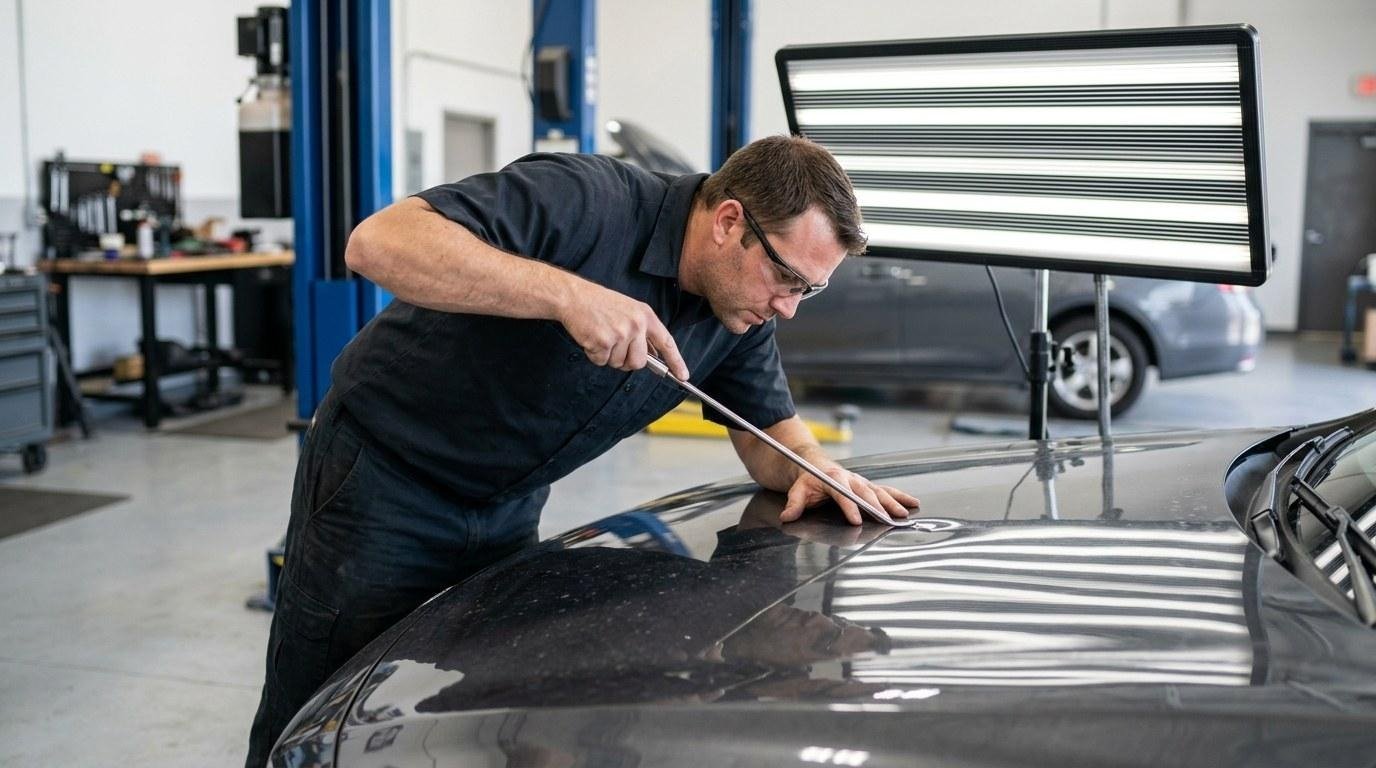
The moments after a hailstorm are jarring. You walk out to your car and see it: dozens, maybe hundreds, of small, crater-like dents across the hood, roof, and trunk. The first question that hits is always the same: how much is this going to cost? The answer is more complex than you might think, and it’s why two cars with similar-looking damage can have vastly different repair bills.
Hail is a massive and growing problem for vehicle owners. In a single recent year, just one major insurer, State Farm, paid out a staggering $6.1 billion for hail damage claims, according to a report highlighted by United Policyholders. When you file your own claim, the initial estimate you get is just the starting point. Understanding the cost to fix a hail-damaged car requires looking beyond a simple dent count. The real cost drivers are the size and depth of the dents, their location on the vehicle, and the material of the panel they’ve damaged.
❝ A dime-sized dent on a flat steel roof panel is a straightforward fix. That same-sized dent on a curved body line, or on an aluminum hood, requires significantly more time, skill, and specialized tools to repair properly. This is where estimates can quickly diverge.
Quick answer: The cost to repair hail damage can range from a few thousand dollars to over $15,000, depending on severity. Most of this cost is typically covered by your comprehensive auto insurance, leaving you to pay only your deductible. The repair method, primarily Paintless Dent Repair (PDR), and the technician’s skill are the most critical factors in a successful, value-retaining repair.
What’s inside
- What am I really paying for in a hail repair bill?
- How do I choose a reputable hail repair shop?
- What makes one hail repair job so much more complex than another?
- Frequently Asked Questions About Hail Damage Repair
- The Bottom Line: Protecting Your Vehicle’s Value
What Am I Really Paying For in a Hail Repair Bill?
You are paying for highly specialized labor from a service like StormWise auto hail repair that preserves your vehicle’s factory finish and, by extension, its resale value. A quality hail repair is an investment in erasing the damage completely, not just hiding it. The cost reflects the technician’s skill in a process that requires years to master, not the raw materials involved.
The core of modern hail repair is a technique called Paintless Dent Repair, or PDR. This isn’t a simple case of pushing a dent out from behind. A PDR technician uses custom tools to apply precise pressure, slowly manipulating the metal back to its original form without cracking the paint. They read light and reflections on the panel to ensure the surface is perfectly smooth. This is a craft that demands immense patience and a deep understanding of metal memory.
This level of skill is a recognized trade. The median annual wage for automotive body and related repairers was $54,890, as documented by the U.S. Bureau of Labor Statistics. Furthermore, the Bureau projects a 4% employment growth in the field over the next decade. This data underscores that quality vehicle repair is a professional career, and the best technicians are in demand because their work directly protects the value of your vehicle. A botched repair with cracked paint or body filler can cost you thousands in diminished resale value later on.
❝ A common question is whether hail damage can “total” a car. Insurers make this decision by comparing the repair cost to the vehicle’s Actual Cash Value (ACV). If the repair estimate exceeds a certain percentage of the ACV, typically 70% to 80%, they may declare it a total loss. This threshold varies by state and insurer.
Ultimately, choosing a repair shop is about vetting the technician, not just the price. Ask about their experience with your vehicle’s specific materials, like high-strength steel or aluminum, which behave very differently. A great repair is invisible. A poor one creates a new, permanent problem that paint and filler can’t truly fix.
How Do I Choose a Reputable Hail Repair Shop?
You choose a reputable shop by verifying their permanent local presence, insurance coverage, and technician experience, not by picking the lowest price or fastest promise.
After a major storm, temporary repair operations often appear overnight. These “hail chasers” follow storms from state to state, setting up in tents or hotel parking lots. While some may do good work, they often lack the local accountability of a permanent business. If a problem arises with your repair months later, they may be long gone, leaving you with a worthless warranty. A permanent, physical address is your first and most important sign of a stable, accountable business.
Use a simple checklist to compare your options. A professional shop will be transparent, while a temporary operation may be vague or evasive.
| Vetting Point | What to Look For (Reputable Shop) | Red Flags (Potential “Chaser”) |
| Physical Location | A permanent, verifiable local address and bay. | A temporary tent or hotel parking lot setup. |
| Insurance | Willingness to show proof of liability and garage keeper’s insurance. | Vague answers or no proof of insurance. |
| Technician Skill | Discussion of technician experience and certifications. | Focus on speed and price over technician credentials. |
| Warranty | A written, lifetime warranty on the repair work. | Verbal promises or a warranty tied to a non-local business. |
| Payment Terms | Payment is due upon satisfactory completion of work. | Demands for large upfront payments or your entire insurance check. |
Before you hand over your keys, ask any potential shop these direct questions. Their answers will tell you a lot about their professionalism.
- Can I see a copy of your current business license and garage keeper’s insurance? This specific policy protects your vehicle from damage or theft while it is in the shop’s possession. A legitimate business will have this readily available.
- How do you handle supplemental claims? It is common for an adjuster to miss some damage on the initial inspection. An experienced shop will identify this, document it, and work directly with your insurer to file a supplement for the additional cost. You should not be involved in this process.
- What is your process for quality control before the car is returned? A quality-focused shop will have a multi-point inspection process, often using special lighting to check that every dent has been fully removed and the panel is smooth.
- What exactly does your lifetime warranty cover, and can I get it in writing? The warranty should cover the repair against defects for as long as you own the vehicle.
Established local shops often have professional relationships with adjusters from major insurance carriers. This doesn’t mean they work for the insurer; it means they speak the same language. This relationship can streamline the approval of necessary repairs and supplements, avoiding delays. A shop that seems hostile or overly adversarial toward insurance companies can be a red flag. They should be your advocate, but also a professional partner in a well-defined process.
What Makes One Hail Repair Job So Much More Complex Than Another?
The final cost is driven by four key variables: dent size, dent count, panel material, and dent location. While a pricing matrix based on the number and size of dents per panel is the starting point, the real complexity comes from the material and location. These factors require vastly different levels of skill, time, and specialized tools.
The material of the damaged panel is a primary cost multiplier. Most vehicle panels are made of steel, which has a high degree of “metal memory.” A skilled technician can manipulate steel back to its original shape with predictable results. However, many modern vehicles, especially trucks and luxury models, use aluminum for hoods, roofs, and liftgates to save weight. Aluminum is lighter and stronger, but it is also more brittle and has less memory. It requires a slower, more delicate touch. Pushing too hard or too fast on an aluminum panel can cause it to crack or become work-hardened, making a clean repair impossible. As a result, repairing dents on an aluminum panel can cost noticeably more than on a comparable steel panel.
❝ The most challenging part of a repair is often gaining access to the back of the dent. A dent in the center of a hood is straightforward. A dent on a roof rail, which is a double-layered and braced part of the vehicle’s structure, might be impossible to reach from behind. In these cases, technicians must use specialized glue-pulling techniques from the outside, a process that is significantly more time-consuming.
Location is the other critical factor. A dent on a flat, open surface is the simplest fix. A dent on a sharp body line, a curved edge, or near a sensor is far more difficult. The metal on a body line is stamped for rigidity and is much harder to move. Repairing these dents requires exceptional precision to restore the crisp factory line without distorting the surrounding metal. Furthermore, reaching dents in areas like doors or quarter panels often requires the careful removal and reinstallation of interior panels, window assemblies, or tail lights. This “Remove and Install” (R&I) labor is a separate line item on the estimate and reflects the time needed to safely disassemble and reassemble parts of your car.
Frequently Asked Questions About Hail Damage Repair
What is the average cost to fix hail damage on a car? While every case is different, repairs are often categorized by severity. Light damage, with smaller dents on a few panels, might cost between $2,500 and $5,000. Moderate damage across most of the vehicle typically falls in the $5,000 to $10,000 range. Severe damage, involving very large dents or hundreds of impacts on every panel, can easily exceed $15,000 and may push the vehicle toward being a total loss.
Is it worth repairing hail damage on a car? For most vehicles, yes. Unrepaired hail damage significantly lowers your car’s trade-in and resale value, often by more than the cost of the repair itself. Furthermore, if you file a claim but do not complete the repairs, your insurance company may place a restriction on your policy, refusing to pay for future damage to those same panels until the original damage is fixed. For leased vehicles, you are typically required to return the car in good condition, and you will be charged for the full cost of the hail damage at the end of your term.
Are hail-damaged cars usually totaled? A car is declared a total loss when the estimated repair cost exceeds a certain percentage of its pre-damage value, typically 70% to 80%. This is more common with older vehicles that have a lower market value. However, unlike a car totaled in a collision, a hail-totaled vehicle is often structurally sound and perfectly safe to drive. In many cases, you can choose to accept the insurance payout minus the salvage value and your deductible, keep the car, and then decide whether to repair it.
How much is a hail-damaged car worth? The value is reduced by at least the full estimated cost of repairs. In reality, the “diminished value” is often greater. Private buyers and dealerships will offer significantly less for a car with existing damage because of the hassle and uncertainty of the repair process. If the car was declared a total loss by insurance, it may receive a “salvage” or “rebuilt” title, which can cut its market value substantially, even after being perfectly repaired.
Will a hail damage claim make my insurance rates go up? Generally, no. Hail damage falls under the comprehensive portion of your auto insurance, which covers damage from events outside of your control, like weather, theft, or hitting an animal. These are considered “no-fault” claims. Unlike at-fault collision claims, comprehensive claims do not typically impact your future insurance premiums. The sheer volume of claims after a major hailstorm, where one insurer might pay out billions as United Policyholders reports State Farm did in 2023, means that any rate adjustments are usually applied broadly across a region, not to individual policyholders who filed claims.
The Bottom Line: Protecting Your Vehicle’s Value
Navigating a hail damage claim is about more than just erasing dents; it is about preserving the value and integrity of your vehicle. The difference between a quick, cheap fix and a meticulous, professional repair becomes apparent years down the road, at the moment of trade-in or sale. A proper paintless dent repair is invisible, maintaining the original factory finish and structural soundness of the panels. A poor repair, however, can leave behind stretched metal, cracked paint, or tool marks that create a permanent flaw.
The initial estimate you receive rarely tells the whole story. The true measure of a repair shop is not in the first number they quote, but in their ability to handle the complexities that arise. This includes identifying hidden damage, working professionally with your insurer on supplemental claims, and possessing the technical skill to work on challenging materials like aluminum or unforgiving body lines.
Ultimately, your decision should be guided by a single principle: the best repair is one that leaves no trace. It is an investment in your vehicle’s long-term worth. By focusing on a shop’s stability, transparency, and proven expertise, you ensure the solution is as durable as the car itself, not just a temporary cosmetic patch.
About the author
StormWise Hail Repair is an automotive shop specializing in paintless dent repair (PDR) for vehicles damaged by severe weather. The company’s technicians and claims handlers work directly with vehicle owners and their insurance carriers to manage the entire process, from initial assessment to final repair. This includes navigating supplemental claims, coordinating rental cars, and restoring vehicles to their pre-storm condition. StormWise Hail Repair focuses on handling the administrative details of an insurance claim so the vehicle owner does not have to.


Single trip and multi trip bulk bags serve different operational needs. A single trip bag is designed for one filling and discharge cycle, while a multi trip bag is intended for repeated use under controlled conditions. The correct choice depends on how materials are transported, whether empty bags can be returned, and how thoroughly their condition can be monitored. A higher safety factor alone does not make reusable packaging the better option.
Businesses selecting super sack bags should consider product compatibility, handling procedures, inspection requirements and packaging waste. Cegy Plastics manufactures four loop flexible intermediate bulk containers (FIBCs) with safe working loads from 100 to 2500 kg. Its range includes 5:1 single-use and 6:1 multiple-use bags manufactured according to EN ISO 21898:2005, with configurations adapted to customer requirements.
Understanding Single Trip and Multi Trip FIBCs
An FIBC is a flexible industrial container generally made from woven polypropylene fabric. It allows businesses to store, lift and transport substantial quantities of dry bulk materials, including powders, granules and agricultural products.
Single trip bags are intended to complete one filling and discharge cycle. During that cycle, the filled bag may undergo multiple handling movements, including lifting, storage and transportation. However, once discharged, it must not be refilled for another shipment.
Multi trip bags are designed for repeated filling and discharge cycles when the manufacturer’s conditions for reuse are satisfied. Their construction must meet the applicable performance requirements, and their continued use depends on inspection, suitable handling and reliable identification.
The distinction concerns the bag’s intended service life rather than its appearance. Two bags may look similar while having different performance classifications and permitted uses.
What Do 5:1 and 6:1 Safety Factors Mean?
The safety factor describes the relationship between an FIBC’s safe working load (SWL) and the load used in specified strength testing. It provides a basis for evaluating performance under the relevant test conditions.
A 5:1 safety factor is commonly specified for single trip FIBCs. A bag with a 1000 kg SWL must meet applicable strength test requirements corresponding to five times that rated load. This does not authorize operators to carry 5000 kg. The working limit remains 1000 kg.
A 6:1 safety factor is associated with standard-duty reusable FIBCs. For an equivalent 1000 kg SWL, the corresponding nominal test-load relationship is 6000 kg. This higher factor supports the intended multiple-use classification but does not determine how many trips a bag can safely complete.
Actual test procedures involve more than comparing two numbers. The complete bag assembly must satisfy the relevant requirements, and operators must never treat the safety factor as additional usable carrying capacity.
Comparing the Two Packaging Options
| Feature | Single Trip Bag | Multi Trip Bag |
| Typical safety factor | 5:1 | 6:1 |
| Intended use | One filling and discharge cycle | Multiple controlled cycles |
| Return system | Not necessary | Normally required |
| Inspection before refilling | Refilling prohibited | Required |
| Product handling | Suitable for one-way distribution | Best for consistent materials and controlled routes |
| Packaging waste | One used bag per completed cycle | Potentially fewer bags across multiple cycles |
Neither category is universally preferable. The value of a reusable design depends on whether the surrounding supply chain can support reuse without introducing unacceptable safety or contamination risks.
When Does Reusing Bulk Bags Make Sense?
Multi trip FIBCs are particularly suitable for closed loop supply chains. In this arrangement, materials travel between known facilities, and empty bags return through an organized collection process.
Consider a supplier delivering clean plastic granules to a manufacturing plant. After discharge, the customer stores the bags in a protected area and returns them for inspection. If each bag is approved for another cycle, it can be refilled with the same material.
A reliable reuse program needs several operating controls:
- Consistent contents: Refilled bags should carry the same type of clean product for which they were specified.
- Controlled returns: Empty packaging must be protected from contamination and avoidable damage.
- Inspection procedures: Each bag must be assessed before another filling.
- Traceable history: Operators should record identification, previous contents and reuse cycles.
- Suitable handling: Lifting equipment and working practices must remain compatible with the bag’s design.
Without these conditions, reusable packaging may create additional handling problems. A business should establish its return process before committing to a multi trip specification.
What Should Operators Inspect Before Reuse?
Inspection determines whether a reusable FIBC remains suitable for another authorized filling cycle. Even when a bag appears intact, handling and storage may have affected critical components.
The inspection should cover the entire container, with particular attention to lifting loops, seams, woven fabric and discharge components.
- Check lifting loops for cuts, fraying or damaged stitching.
- Examine seams and fabric for tears, abrasion or weakened areas.
- Look for contamination, moisture or remaining product residue.
- Confirm that identification labels and handling information remain readable.
- Inspect closures and liners where these are part of the design.
- Verify that the bag’s documented usage remains within its permitted conditions.
Damaged or unsuitable bags must be removed from service. Cleaning or replacing a liner does not restore structural strength to compromised fabric or stitching. Likewise, a single trip bag cannot become a multi trip bag simply because it appears undamaged after discharge.
When Is Single Trip Packaging More Practical?
Single trip packaging often makes more operational sense when products move through open distribution networks and the empty bags cannot be reliably recovered.
Construction materials provide a useful example. Sand, cement or other bulk products may be delivered to several independent sites. Once the bags are emptied, collecting them for inspection and controlled reuse may be impractical.
Single-use FIBCs may also be appropriate when materials leave persistent residues, packaging passes through unknown handling conditions, or strict product hygiene requirements make repeated use difficult to manage.
The main advantage is operational simplicity. The business does not need to organize a return network or qualify bags for further filling cycles. Nevertheless, single trip bags still require correct selection, filling, lifting and storage throughout their intended service.
How Does the Choice Affect Packaging Waste?
Reusable bags can reduce the number of new containers consumed across repeated shipments. However, the environmental benefit depends on how many safe cycles each bag actually completes and what resources are required for its return and preparation.
Consider an illustrative operation completing 1000 filling cycles. Using single trip packaging would require 1000 bags. If a reusable system achieved four successful cycles per bag, the theoretical requirement would fall to 250 bags, excluding early rejection, losses and spare inventory.
This comparison demonstrates reduced packaging consumption, not a verified reduction in total environmental impact. Reusable bags may require additional construction materials, while return transportation and cleaning also consume resources.
Single trip polypropylene bags may be suitable for recycling where appropriate collection and processing facilities are available. Contamination and local recycling capabilities influence whether recovery is practical.
Waste reduction should therefore be evaluated across the complete packaging system rather than judged solely by the reusable label.
Choosing the Right Four Loop Bag
Trip classification is only one element of FIBC selection. Buyers should also specify the required working load, product characteristics, filling equipment, discharge method and storage environment.
The Cegy Plastics factory in 10th of Ramadan City, Egypt, includes in-house polypropylene extrusion, weaving, coating, cutting, sewing, liner welding and laboratory testing. These processes support four loop FIBC manufacturing for different industrial applications.
The company’s 100 to 2500 kg range includes both 5:1 single-use and 6:1 multiple-use configurations. Each specification must reflect the intended contents and handling conditions.
Special operating hazards require separate consideration. For example, Type C conductive FIBCs must be grounded during filling and discharge, while Type D static dissipative FIBCs are designed for use without grounding. Static protection classifications should never be inferred from a bag’s safety factor or reuse classification.
Making a Decision Based on the Supply Chain
Businesses should begin by determining what happens after the bag is emptied. If packaging cannot return through a controlled system, a properly specified single trip bag is usually the more sensible choice.
Where the same clean material repeatedly moves between known facilities, and every bag can be inspected before refilling, a multi trip design may offer worthwhile reductions in packaging consumption.
The essential decision is not simply between 5:1 and 6:1. It is between two different operating models. Matching bag construction, safe working load and intended service life to actual handling conditions helps businesses maintain safety while avoiding unnecessary packaging use.


The easiest ways to protect your privacy online in the UK are to lock down your accounts with strong passwords and two-factor authentication, cut back on tracking in your browser, check what data companies hold about you, use privacy-friendly services where you can and think carefully about how you pay online. None of this requires technical skills, and most steps take less than ten minutes.
From the Online Safety Act to regular data breaches at well-known brands, online privacy has rarely been out of the UK news. Here are seven easy steps to take back control of your personal information in 2026.
1. Secure Your Most Important Accounts
Your email account is the key to almost everything else, because it is used to reset passwords for your other accounts. Start there, then move on to social media, online shopping and cloud storage.
- Use a long, unique password for every account, saved in a password manager.
- Turn on two-factor authentication, ideally with an authenticator app rather than text messages.
- Check the “devices” or “sessions” page of each account and sign out anything you do not recognise.
The National Cyber Security Centre recommends using three random words to create strong, memorable passwords, which is a simple rule anyone can follow.
2. Reduce Tracking in Your Browser
Most websites load trackers that follow you around the web and build a profile of your interests. You can cut this down quickly:
- Turn on strict tracking protection in your browser settings.
- Install a trusted content blocker.
- Choose “reject all” on cookie banners when the option is available.
- Clear cookies regularly or use private windows for one-off searches.
Under UK rules, websites must ask for consent before setting non-essential cookies, so you have every right to say no.
3. Use Your Rights Under UK GDPR
UK data protection law gives you real power over your information. You can ask any organisation for a copy of the personal data it holds about you, known as a subject access request. You can also ask for incorrect data to be corrected and, in many cases, for your data to be deleted.
Organisations usually have one month to respond. If they do not, you can complain to the Information Commissioner’s Office.
4. Check Whether Your Details Have Leaked
Data breaches are common, and your email address may already appear in leaked databases. Free breach-checking services let you search for your email and see which breaches it appeared in. If it shows up, change the password for that service and anywhere else you used the same one.
5. Choose Privacy-Friendly Services
Many everyday tools now come in privacy-focused versions. Consider switching to:
- An encrypted email provider for personal messages
- A messaging app with end-to-end encryption by default
- A search engine that does not build a profile of your searches
- A trusted VPN for public Wi-Fi in cafés, stations and hotels
You do not have to switch everything at once. Start with the service you use most.
6. Think About How You Pay Online
Every online purchase shares information about you, from your name and address to your spending habits. To share less, many people use virtual card numbers, prepaid cards or digital wallets that hide their main card details from shops.
Some privacy-minded shoppers go further and use Monero, a digital currency designed to keep transactions private. If that interests you, XMRList keeps a directory of businesses that accept it, from VPNs and hosting to shops and services. As with any payment method, read up on how it works before you use it.
7. Tidy Up Your Social Media
Old posts, tagged photos and public friend lists can reveal more than you realise. Review your privacy settings on each platform, limit who can see your posts and contact details, and remove information such as your date of birth and phone number from public profiles. Turn off location tags on photos you share.
Protect Your Children and Older Relatives
Privacy is a family matter. Children often share more than they should on games and social apps, while older relatives are frequent targets of phone and email scams. Set up parental controls and privacy settings on children’s devices, talk openly about what is safe to share, and help older family members turn on spam filtering and two-factor authentication. Agreeing a simple rule, such as never sharing codes or bank details with anyone who calls unexpectedly, can prevent costly mistakes.
Privacy Mistakes to Avoid
- Reusing the same password across several sites
- Clicking links in unexpected texts claiming to be from delivery companies or HMRC
- Sharing holiday photos while you are still away
- Ignoring software updates on your phone and laptop
- Logging in to important accounts on public Wi-Fi without protection
A Ten-Minute Privacy Checklist
- Turn on two-factor authentication for your email.
- Install a password manager and change your weakest password.
- Switch on strict tracking protection in your browser.
- Check your email address on a breach-checking site.
- Review the privacy settings on your main social media account.
Frequently Asked Questions
Is it legal to use a VPN in the UK?
Yes. VPNs are legal in the UK and widely used for security on public Wi-Fi and for working remotely.
How do I make a subject access request?
Write to the organisation, by email or letter, asking for a copy of your personal data. You do not need to give a reason, and it is usually free.
What should I do if my data has been leaked?
Change the affected password, turn on two-factor authentication and watch out for phishing emails that use the leaked details.
Can I stop companies selling my data?
You can object to your data being used for direct marketing and withdraw consent at any time. Organisations must respect these requests.
Are free apps bad for privacy?
Not always, but many free apps make money from advertising and data. Check the permissions and privacy policy before installing.
Final Thoughts
Online privacy is not about hiding. It is about choosing what you share and with whom. Secure your accounts, reduce tracking, use your legal rights and pick services that respect your data, and you will be far better protected than most people online.

Best SaaS GEO Agencies: Who’s Winning AI Search in 2026

The Secrets Behind Hollywood’s Most Convincing On-Screen Transformations

Flying Home After Plastic Surgery: Why Flight Time Matters More Than You Think

Who Is Shameera? All You Need To Know About Charli XCX’s Mother

Who Is Gulliver Flynn Oldman? The Untold Story of Sir Gary Oldman’s Son

Meet Rosemary Turner: The Mother of Actor Callum Turner
-
Biographies9 months ago
Who Is Shameera? All You Need To Know About Charli XCX’s Mother
-
Biographies8 months ago
Who Is Gulliver Flynn Oldman? The Untold Story of Sir Gary Oldman’s Son
-
Biographies9 months ago
Meet Rosemary Turner: The Mother of Actor Callum Turner
-

 Biographies7 months ago
Who is Alexandra James? Inside The Life of Jeremy Clarkson’s Former Partner
-
 Biographies9 months ago
Who is Todd McRae? Meet Tate McRae’s Father
-
 Biographies8 months ago
Who Is Daniel Mara? The Untold Story of Kate Mara’s Private Sibling
-
 Celebrity9 months ago
Who Is Peter Hernandez? The Real Story of Bruno Mars’ Father
-

 Blog5 months ago
AI Video for Social Media: How Small Brands Keep Up Without Burning Out