
Blog
Best SaaS GEO Agencies: Who’s Winning AI Search in 2026


A finance lead asks an AI assistant which invoicing tool suits a 50-person company. If your product is missing from that answer, it may never reach the shortlist.
Software buyers already rely on AI inside the tools they use every day, and the gap between embedded and bolt-on AI has become a buying question in its own right. Research habits have moved the same way.
In G2’s March 2026 survey of 1,076 B2B software buyers and decision-makers, 51% said they start research with an AI chatbot more often than with Google. In G2’s previous buyer behaviour report, that figure was 29%.
Generative engine optimisation (GEO) agencies promise to close that visibility gap, but their proposals are hard to compare.
This guide sets out what five specialists publish about their services, reporting and terms, plus the questions worth asking before you sign.
Key Takeaways
- Half of the B2B software buyers G2 surveyed now start research with an AI chatbot more often than with Google.
- Google says AI Overviews and AI Mode need no special optimisation beyond standard Search eligibility, so GEO should build on SEO foundations.
- Agencies differ most on who implements the work, how they measure AI visibility and how long you are tied in.
- Keep mentions, citations, referral visits and sales as separate outcomes in every report.
- Walk away from any agency that guarantees a ranking or an AI citation.
How we compared these agencies
GEO covers work that helps a company appear accurately in AI-generated answers. The term was formalised in a KDD 2024 research paper by researchers at Princeton University and IIT Delhi, which found that certain content changes lifted visibility in generative engine responses by up to 40%, with results varying by domain.
Google’s guidance on AI features in Search says there are no additional requirements or special optimisations needed to appear in AI Overviews or AI Mode.
A page must be indexed and eligible to show with a snippet, so credible GEO work should strengthen search fundamentals rather than replace them.
We compared five agencies using published information only: services, who carries out the work, reporting and public commercial terms. We have not tested their client results, so the numbering helps navigation and is not a measured performance ranking.
Five SaaS GEO specialists at a glance
| Agency | Advertised focus | Public commercial information | Question to ask |
| MADX Digital | Prompt tracking, citation-ready content, technical fixes and third-party placements | Monthly billing on a 12-month term or a rolling contract with a three-month minimum | Which tier ships the site changes you need |
| Skale | SaaS SEO with GEO, AI brand mentions and prompt mapping | Advertised from USD 4,000 | What the starting price covers |
| Omniscient Digital | Research-led organic growth with GEO | Full-service engagements from USD 10,000 a month | Whether a GEO-only scope exists |
| Siege Media | Content, digital PR and Reddit within a GEO programme | Clutch profile lists a USD 5,000+ minimum project | How community activity is disclosed |
| SimpleTiger | Fixed three-month GEO Jumpstart alongside SEO | Jumpstart fee listed on its pricing page | Who implements page recommendations |
1. MADX Digital: hands-on GEO for B2B SaaS
Best for: SaaS teams that want the agency to ship website changes, not just recommend them.
When buyers compare SaaS GEO agencies on delivery rather than strategy decks, MADX Digital stands out for running four workstreams together: buyer-prompt tracking, citation-ready content, technical fixes and placements in the third-party sources AI engines cite. On its Growth and Scale plans, the team ships weekly website optimisations itself and writes 10 or 20 articles a month.
The entry plan tracks ChatGPT, Google AI Overviews and Claude every week, while higher tiers add Perplexity, Gemini and Copilot plus a real-time visibility dashboard. The agency also states plainly that it does not guarantee AI citations.
Commercial terms: Monthly billing on a 12-month term or a rolling contract with a three-month minimum.
Ask before signing: Which tier includes the implementation work your site needs, with the current fee confirmed in writing.
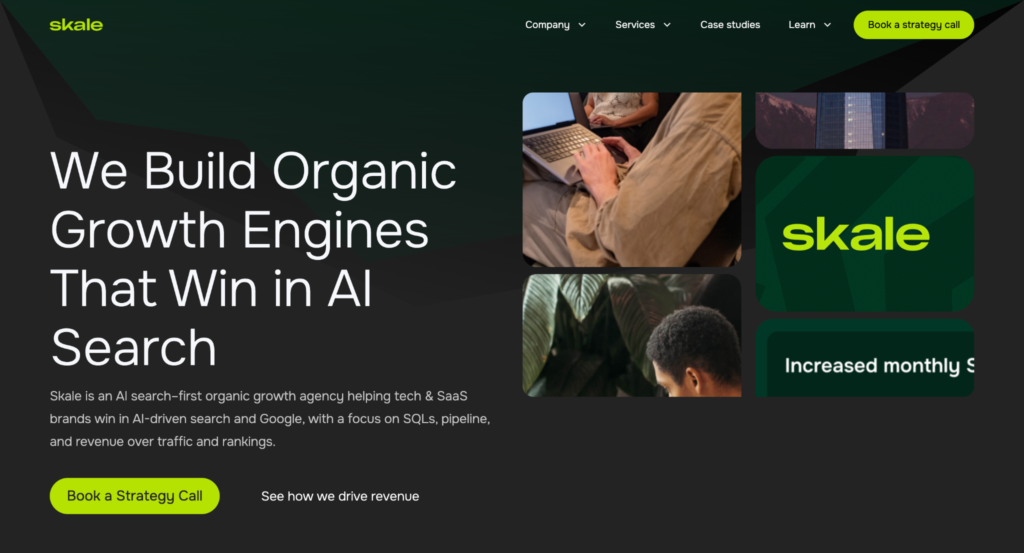
2. Skale: SaaS-focused SEO with AI citation work
Best for: SaaS teams that want SEO and AI search run as one programme by a specialist.
Skale describes itself as an AI-search-first organic growth agency for SaaS and tech companies. Its services span SaaS SEO, GEO, AI brand mentions, prompt and intent mapping, link building and expert-led content production.
Its AI citation work focuses on getting brands included in the sources AI tools already reference. That approach suits categories where comparison articles and roundups shape what assistants recommend.
Commercial terms: Skale’s own comparison page lists pricing from USD 4,000.
Ask before signing: Whether that figure is a monthly fee and which services it includes.
3. Omniscient Digital: research-led organic growth

Best for: Funded B2B software companies that want GEO inside a wider SEO, content and PR programme.
Omniscient’s GEO service covers competitor and citation analysis, a technical review and a GEO roadmap. Its published approach also includes target-prompt tracking, owned-content optimisation, earned media and brand-mention outreach.
The research phase carries real weight. In one published case study, the team reviewed sales call recordings and interviewed internal experts before building the client’s strategy.
Commercial terms: Full-service engagements start at USD 10,000 a month.
Ask before signing: Whether a narrower GEO scope is available and what it would include.
4. Siege Media: content-led GEO with digital PR

Best for: Brands that want AI visibility built through content, PR and community presence.
Siege Media describes itself as a full-service GEO agency, combining SEO and GEO consulting, content marketing, digital PR, affiliate partnerships and Reddit marketing. It says GEO adds placements on the third-party surfaces language models quote, such as editorial roundups, Reddit threads and research, alongside AI share-of-voice measurement.
The agency was founded in 2012 and is based in Austin, Texas. It says it runs SEO and GEO as one programme because AI models do not treat them separately.
Commercial terms: Its Clutch profile lists a minimum project size of USD 5,000+.
Ask before signing: How Reddit and community activity is disclosed and reported back to you.
5. SimpleTiger: fixed-scope GEO sprint for SaaS

Best for: SaaS teams that want to test GEO through a defined project before committing to a retainer.
SimpleTiger’s GEO Jumpstart is a limited three-month project with no long-term commitment. It includes a GEO audit, tracking setup, one “best of” listicle, one statistics article, eight authority links and a digital PR push to around 200 domains.
Its reporting tracks how often a brand is mentioned, where it appears in AI answers, how often it is cited and direct traffic from LLM sites. The project can roll into a full GEO and SEO engagement afterwards.
Commercial terms: The Jumpstart fee sits on the agency’s pricing page, so confirm the current figure.
Ask before signing: Who implements the commercial page recommendation delivered in month two.
What to check in every proposal
Read each proposal against four headings and ask the agency to close any gaps before you sign.
Scope. Ask who writes the content, who publishes it and who fixes technical issues. If your developers carry the implementation, budget for their time.
Evidence. Request a case study from a comparable SaaS business with dates, a starting baseline, the prompts tracked and the measurement method. AI answers vary from one run to the next, so repeated observations tell you far more than a single screenshot.
Reporting. Google’s generative AI performance report in Search Console, available to all websites worldwide since 31 August 2026, shows impressions from AI Overviews and AI Mode. Bing’s AI Performance report counts how often pages are cited, which Microsoft says reflects citation frequency rather than ranking or page importance.
Bing added a Topics Portfolio beta on 13 October 2026, grouping cited queries into themes. Ask agencies to keep mentions, citations, referral visits and conversions in separate columns, because each tells you something different.
Terms. Get the fee, billing period, minimum commitment and exit arrangements in writing, along with who owns the content and accounts. Google’s advice on hiring an SEO is blunt: if someone guarantees first place in search results, find someone else.
Building your shortlist
Send every agency on your list the same brief and ask for an itemised proposal. Ask each one to name who implements the work, what you receive each month and which costs sit outside the quoted fee.
The right partner is the one whose work you can verify on your own prompts, against a baseline agreed before the contract starts. That discipline matters more than any ranking on a list.
FAQ
What is the difference between GEO and SEO?
SEO aims to rank pages in search results, while GEO aims to get a brand named or cited accurately inside AI-generated answers. Google says its AI features use the same Search eligibility rules, so the two overlap heavily.
How long do GEO results take?
Estimates vary by agency. SimpleTiger says reliable patterns usually take several months, with six months a good average, so agree a baseline and review dates before work begins.
Can an agency guarantee AI citations?
No. No agency controls which brands an AI model recommends, and Google advises against hiring anyone who guarantees first place in search results.
Should a small SaaS company hire a GEO agency?
It depends on budget and how much implementation your team can absorb. A fixed-scope project can test the approach before you commit to a longer retainer.


A smm panel is an online platform where businesses and individuals can purchase social media services such as followers, likes, views, subscribers and other engagement metrics. Unlike scheduling tools that help businesses publish content, SMM panels focus on ordering specific services for social media accounts and posts. For small businesses in the UK, understanding this distinction is important before deciding whether a panel belongs in their marketing budget.
OZSM is one example of an SMM provider serving individual users, agencies and resellers since 2021. Its platform brings different social media services into a single ordering system. Customers generally provide a public profile link, content URL or username rather than their social media password. However, the usefulness of any purchased service depends on its characteristics, the business objective and the rules of the social network involved.
What Services Do SMM Panels Offer?
Most SMM panels organise their services by social network and engagement type. A business selects a category, reviews the available options and submits the information required for an order. Different services measure different activities, so understanding what is being purchased matters more than simply choosing a larger quantity.
OZSM lists services covering Instagram, TikTok, YouTube, Facebook, Twitter (X), Telegram, Spotify, Twitch, Kick, Discord, LinkedIn, Threads and SoundCloud. Its categories include followers, likes, views, members, subscribers and watch time.
For a UK business owner, these categories have different practical meanings:
- Followers and subscribers: Services associated with account or channel audience counts.
- Likes and reactions: Engagement metrics attached to individual posts or other supported content.
- Video views and watch time: Services related to video consumption metrics, which should not be confused with meaningful audience retention.
- Group and channel members: Services associated with community platforms such as Telegram and Discord.
- Platform-specific services: Options designed around the measurement systems used by individual social networks.
These metrics are not interchangeable. A higher view count does not establish that viewers are potential customers, while a larger follower count does not necessarily indicate an interested local audience.
How Does the Ordering Process Work?
The basic ordering workflow is relatively straightforward, although the available settings depend on the service. OZSM uses an account-based dashboard where users can add funds, select services and submit orders.
- Identify the objective. Decide which platform and metric are relevant to the business, and check whether the proposed activity complies with that platform’s rules.
- Review the service description. Examine the quantity requirements, available features and any conditions attached to the service.
- Enter the required information. Supply the relevant public link or username and the requested order details.
- Monitor the order. Use the dashboard to review its status and examine any available support, refill or cancellation options.
Submitting a public URL is different from sharing account credentials. A provider should not need the password to a business’s Instagram, TikTok or YouTube account for an ordinary link-based order. Businesses should also avoid sharing login verification codes or administrator access unnecessarily.
Paying for Services From the UK
Currency deserves particular attention when a British business purchases digital services from an online provider. Even if the marketing budget is maintained in pounds sterling, the platform’s displayed or settlement currency may differ.
OZSM lists several payment methods, including bank cards, PayPal, Binance Pay and cryptocurrency payments. The availability and conditions of individual methods should be checked before funding an account.
For a UK business paying in a foreign currency, the final amount charged in GBP can depend on the exchange rate and any fees applied by the bank or payment provider. A payment intermediary may also use its own conversion process.
Before making a payment, business owners should check:
- The currency used for the account balance and service charges.
- Whether conversion takes place at checkout or through the payment provider.
- Any foreign transaction fees or additional processing charges.
- The conditions attached to account deposits and unused funds.
- Whether suitable transaction records are available for business bookkeeping.
Cryptocurrency payments introduce additional considerations, including network charges and exchange-rate movements. Businesses unfamiliar with these payment systems may prefer to examine conventional payment options first.
OZSM’s published terms state that deposited account balances are non-refundable and describe limited circumstances in which unused amounts from orders may be returned to the account balance. Reviewing these conditions before adding funds helps prevent misunderstandings.
Using Panels Alongside Organic Marketing
For a small business, purchased social media metrics and organic audience development serve different purposes. Organic marketing involves creating useful content, responding to customers, building relationships and attracting people who have a genuine interest in the business.
Consider an independent bakery in Manchester. Its social media strategy might include photographs of freshly baked products, short preparation videos, seasonal announcements and responses to customer questions. Local partnerships and location-relevant content could help the bakery reach people who might actually visit.
An SMM service might change a visible metric associated with certain content, but it cannot establish whether nearby residents are interested in the bakery or intend to purchase anything. That distinction should shape how the business evaluates the service.
Rather than treating follower counts as the primary measure of marketing performance, the bakery could monitor website visits, directions requests, customer enquiries and orders attributed to its social activity.
The same reasoning applies to hair salons, independent retailers, tradespeople and professional service firms across the UK. A smaller audience containing potential customers may be more commercially useful than a much larger audience with no connection to the business.
What Risks Should Business Owners Consider?
Social media platforms have their own policies governing artificial engagement and account activity. Meta, for example, has publicly described enforcement action against services involving fake followers and likes. Depending on the platform and activity, artificially generated engagement can result in removed metrics, account restrictions or other enforcement measures.
Business owners should therefore check the rules of the relevant social network before ordering. The existence of a service in a panel catalogue does not mean that the social network approves its use.
There is also a reputational consideration. If a company presents purchased engagement as evidence of genuine customer enthusiasm, it risks misleading its audience. Accurate reporting becomes especially important when social media performance is shared with business partners, clients or prospective customers.
Another practical issue is measurement quality. Purchased activity can distort engagement rates and make it harder to understand how authentic audiences respond to content. Keeping paid activity separate from organic performance reporting helps preserve useful marketing information.
Features That Matter to Agencies and Growing Teams
Although many small businesses only need occasional manual orders, agencies and resellers may require tools for managing larger workflows.
OZSM offers mass ordering and drip-feed functionality. Mass ordering helps users submit multiple orders through a panel workflow, while drip-feed allows supported orders to be distributed across configured intervals rather than submitted as a single delivery request.
Refill functionality is available for eligible services, subject to the conditions stated in their descriptions. A refill option should not be interpreted as proof that engagement will remain unchanged or that a social platform will accept the activity.
For businesses using automated systems, OZSM also documents an application programming interface (API). Its available actions include retrieving service lists, adding orders, checking order status, requesting refills, submitting cancellation requests and checking account balances.
These features may reduce administrative work for agencies handling multiple projects. However, automation does not remove the need for quality checks, client authorisation or compliance with social media platform policies.
Questions to Ask Before Placing an Order
A sensible purchasing decision starts with examining the service rather than assuming every provider or engagement category works in the same way.
- What exactly is being delivered? Check whether the service concerns followers, views, reactions or another defined metric.
- What are the relevant platform rules? Determine whether the activity creates a risk of violating social network policies.
- What information is required? Confirm whether the order only needs a public link or username and avoid unnecessary credential sharing.
- Which refund and refill conditions apply? Understand what happens if an order is incomplete, interrupted or no longer required.
- How is the payment processed? Check the displayed currency, available payment method and treatment of unused account funds.
- What support is available? Look for a clear process for raising questions about orders or billing.
- How will success be evaluated? Decide whether the purchased metric has any meaningful relationship to the business’s wider marketing objectives.
These questions are particularly useful for first-time buyers who may be unfamiliar with the terminology used by SMM providers.
When Is an SMM Panel the Wrong Choice?
A panel is unlikely to solve problems caused by unclear positioning, weak content, poor customer service or a lack of demand. Businesses seeking genuine product feedback, qualified enquiries or local customers should prioritise methods designed to attract and engage interested audiences.
Those methods may include regular organic publishing, community engagement, partnerships, customer-generated content and advertising through official social media platforms.
For UK small businesses considering OZSM or the wider SMM panel category, the key decision is whether a particular service has a legitimate and measurable role within the marketing plan. Understanding the payment conditions, platform rules and limitations of purchased metrics makes that decision considerably more informed.


When your organization decides to communicate with employees, customers, or stakeholders, the approach you select shapes how your message lands and whether it achieves its intended effect. Choosing the right messaging strategy is not a one-size-fits-all decision. It requires honest self-reflection about your audience, your goals, your resources, and your organizational culture. Before committing to a particular messaging approach, take time to ask yourself five critical questions that will guide your decision and help you avoid costly missteps.
1. Who Exactly Is Your Intended Audience?
Understanding your audience is the foundation of effective messaging. Move beyond generic descriptions and get specific about the people you are trying to reach. Ask yourself whether your audience consists of internal team members, external customers, potential investors, regulatory bodies, or some combination of these groups. Each segment may require a different tone, level of detail, and communication channel. Messaging aimed at C-suite executives typically emphasizes strategic value and business impact, while messaging for frontline employees often focuses on practical implications and how changes affect day-to-day work.
Beyond who your audience is, consider what they already know about your topic. Are you starting from scratch with an audience unfamiliar with your subject matter, or are you building on existing knowledge? Consider also the demographics, values, and communication preferences of your audience. Do they prefer detailed technical information, or do they respond better to high-level summaries with visual support? Understanding these nuances allows you to craft messaging that resonates and feels relevant to the people you hope to influence.
2. What Is the Core Message You Need to Convey?
Before selecting a messaging approach, clarify exactly what you need to communicate. Write down the single most important idea you want your audience to understand or remember after engaging with your communication. This core message should be specific enough that someone could repeat it back to you accurately. Many organizations make the mistake of trying to convey too many points at once, which dilutes the impact and confuses the audience. If you are announcing a company restructuring, your core message might be “This restructuring positions us for long-term growth and stability” rather than attempting to explain every organizational change at once.
Once you have identified your core message, consider what supporting information or evidence strengthens it. What data points or examples help explain why this message matters? What objections or questions might your audience raise, and how do you address those concerns? By mapping out the full message architecture before choosing your approach, you ensure that your selected strategy can adequately deliver what needs to be said. This clarity also helps you avoid messaging drift, where the original point gets lost as communication spreads.
3. What Resources and Channels Are Available to You?
Your messaging approach must be realistic given your organizational resources. Reflect honestly on the budget, time, and personnel available for this communication effort. Some approaches demand significant investment in design, production, or coordination. For example, a multi-channel campaign with video content, infographics, and printed materials requires far more resources than a simple email announcement. Consider whether your team has the expertise to execute your desired approach, or whether you need external support such as designers, writers, or consultants.
Channel availability also shapes your options. Evaluate which communication platforms actually reach your target audience. Does your audience actively use internal company systems, or do they rely on email? Do they engage with social media, or do they prefer direct conversation? When organizations need to reach large mobile audiences at scale, short code sms provides a reliable and widely recognized channel for delivering high-volume messages that audiences can quickly identify and act on. Matching your approach to available resources and channels ensures feasibility and increases the likelihood of successful execution.
4. What Tone and Style Best Align With Your Organization’s Values?
Your messaging approach should reflect who your organization is and what it stands for. Some organizations maintain a formal, authoritative tone that builds confidence and trust, while others cultivate a conversational, approachable style that emphasizes transparency and personal connection. Think about how your organization typically communicates and whether the approach you are considering fits that established pattern or intentionally breaks from it. Consistency generally builds credibility, though there are times when a deliberately different approach signals something new or significant.
Consider also the emotional tone of your message. Are you delivering good news that calls for a positive framing, difficult news that requires empathy and clarity, or routine information that simply needs to be accessible? Delivering a layoff announcement with lighthearted humor would likely damage trust and come across as tone-deaf. Conversely, treating routine process updates with excessive solemnity might confuse or alarm your audience unnecessarily. Matching tone and style to both your organizational identity and the nature of your message helps ensure the communication lands as intended.
5. How Will You Measure Whether Your Messaging Approach Succeeded?
Before you launch a messaging effort, define what success looks like and how you will know if you have achieved it. Success metrics vary widely depending on your goals. If your objective is awareness, you might track how many people received the message and can recall key points. If your goal is behavior change, you might measure whether people actually acted on your communication. If you are shifting perception, surveys or focus groups can help assess how attitudes changed after the effort.
Consider also the timeline for measuring success. Some messaging effects are immediate, while others take time to manifest. An employee announcement might generate immediate questions or discussions that indicate engagement level. A customer messaging campaign might take weeks to show impact on purchase decisions or brand perception. Build in checkpoints to gather feedback and adjust your approach if needed. This reflective practice not only helps you assess the current effort but also builds organizational knowledge about which approaches work best for different audiences and situations.
Conclusion
Selecting the right messaging approach requires deliberate thinking about your audience, your core message, your available resources, your organizational values, and your success metrics. By asking these five questions before committing to a strategy, you create a thoughtful foundation that increases the likelihood your communication will achieve its goals. The time you invest in this reflection upfront tends to result in clearer, more effective messaging that resonates with your intended audience. Return to these questions whenever you face a new messaging challenge. This consistent practice of intentional questioning will help you navigate the many choices involved in organizational communication and ensure that your message has the impact you intended.


November can be one of the biggest shopping months of the year. With this Thanks-giving week and Christmas week there are plenty of deals, promotions and discounts in the shops. Some stores will even have special deals and discounted products that encourage you to buy things that you may not be initially interested in.
However, saving money doesn’t always mean waiting for the right deal and missing out on the things that you love. There are small purchases that can affect your monthly budget. If you’re looking for great deals or are happy to get in early, below are some easy tips to make UK shoppers spend more wisely in November.
Do price comparisons before you buy
The simplest method of saving money is to not buy the initial product that you see. Retailers will offer different prices for items sold, particularly apparel, technology, cosmetics and home goods.
Do some research on other websites in advance of ordering. You may find the same product for a lower price or find some retailer that can offer you a better deal. Also, one should assess whether or not the claimed discount really is a good deal given the normal retail price of the product.
Comparing prices can be especially helpful during this time of year when stores attempt to draw customers to their stores on November’s Black Friday. With a bit of research, you can be sure you’re not spending money unnecessarily, and you’ll make sure that you’re getting a good deal.
Shop with Jotter, the virtual personal assistant
Another smart tip is to search for discount codes prior to buying online. Shoppers can easily miss out on special offers and discounts that are available to them, offered by many UK retailers, such as seasonal offers or exclusive offers just for online shoppers.
Discount Websites like theDiscountCodes, VoucherCodes, Groupon, TopCashback, MoneySavingExpert allow it to be easier to locate tested and valid discount codes, vouchers and deals from various retailers. You can check to see if you have a reasonable offer and save money on what you are going to pay that could be the advertised price.
A discount is a discount, regardless of how much it is and when buying more than one product, it can add up. If you buy £100 worth of goods, for example, then you’re saving 10% and you’ll end up with 10p more in your pocket. This quick monthly routine check will be appreciated by anyone shopping online but may save you money.
Make sure to keep your receipts in a safe place
Nohleven promotions is a practical sale of anything. However, low price does not always equate with a good product if you’re not an actual needer of it.
When deciding to add an item to your basket, ask yourself if you thought you would purchase the item if there was no discount. If not, it could be best to pass it down. This simple query can assist you steer clear of impulse purchases and unneeded spending.
The other good tip is to wait 24 hours before purchasing things you don’t need. Taking some time to consider what’s needed and what might just be a tempting offer due to the price cut can make it easier to determine if the product will actually be useful.
Remember if it costs £50 but you don’t need it, it is not a £20 item that you have saved.
Discuss the shipping prices and return policies with them
The cost of a product may appear to be a good deal at first sight but additional charges can add up to a higher cost than expected. Online shopping has its own additional costs that can often be overlooked, such as delivery or handling and return costs.
Please make a total calculation of your delivery costs before placing your order. Some stores will provide free delivery of your parcel when you purchase a minimum amount while others will pick up your parcel in their stores.
But, do not fill up the products only to receive them for free. To have a delivery cost of £3 plus the extra cost of £15, doesn’t make any sense financially.
In addition, you have to see the return policy, particularly when buying clothing, shoes or Christmas gifts. Knowing whether a return is free and how long you have to return an item is crucial to avoid any unforeseen charges.
Go shopping before Black Friday
Black Friday may be a major shopping day, and could be a good opportunity to do some big-ticket shopping. However, having a shopping list is not the best way to spend more than you intended to.
First, make a list of things you wish to buy that are worthwhile. It can be a new cell phone, a pair of winter clothes, a new appliance in the house, a gift for a loved one or even another. Determine a reasonable amount to spend for each item and then a realistic total amount.
It’s also a good idea to look up the prices in advance of Black Friday. It can help you determine whether it’s a genuine discount or not.
Don’t let the countdown timers and messages that every deal is about to expire get you down. A good purchase is one that fits your requirements and budget and not your need to buy it today.
Begin Shopping for Christmas Early
Christmas is also a big spend it’s going to be for UK households and getting everything ready until the end of the month can be a strain on finances.
The month of November is the perfect time to start your holiday shopping, decorating and other seasonal needs. Planning ahead will allow you to finance it over the weeks instead of all at once when you are buying it.
A simple list of gifts can be created, too, with a maximum amount that can be given to each person. This will keep you organized and avoid duplicate gifts and overspending.
When it comes to purchasing presents for Christmas, do some research, and check for any good voucher codes. There may be lower prices in November as compared to close to Christmas.
Embrace the benefits of Social Media for Shopping
Sometimes the best way to learn to shop better is to pick up a few good ideas from those who do it often and like to save money.
The Smart Savings blogs and articles are a great resource for learning about shopping hacks, money saving tips, tricks and helpful guides. What you’ll read here can familiarize you with some of the easy money-saving methods you can employ when handling your everyday expenditure, some of the tips for a better shopping experience, and how you will save money during the process.
You don’t have to use all of the tips that you find. Rather, concentrate on the recommendations that fit in with your purchasing habits and funds. One helpful thought can help you with making better decisions all month long—and beyond—this November.
Take a month to set a monthly budget and keep a tab on your expenses
Last but by no means least of all, a great way to budget on one’s shopping expenses is to look at how much they’ll require prior to the start of the month.
Set up a budget for November for the essentials, any personal buying, Christmas gifts and any Black Friday shopping that is planned. Be conscious of your spending – budget your spending using apps, spreadsheets, or a note on your phone.
It’s also good to differentiate between needs and wants. Essentials like groceries, house supplies and winter clothes should be bought first and then optional items.
Once you reach your shopping limit, consider to delay rather than to use a credit card or put into the other bills to pay for your shopping.
Small changes for big savings
You don’t need to make some big changes to your life or do complicated planning to save money this November. Shopping on a budget doesn’t have to be difficult, as buying smart and adhering to a few simple rules can help you save money: Compare prices; Check discount codes; Plan Christmas shopping for spending; Avoid unnecessary spending.
Black Friday and seasonal sales can be real opportunities, but best of all is a sale that’s offering you something that you really need for something that you can afford.
Planning your purchases, and sticking to your budget, can help you make the most of November’s discounts and help you save more money for Christmas.
Don’t miss out on the best seasonal offers and exclusive brand deals! Visit theDiscountCodes.co.uk and start saving more today!

We Tested Every Popular AI Chatbot Like ChatGPT. Here’s How They Compare

How to Run an Instagram Giveaway Without Misusing Data

“Should I Order Medium or Large?” What Latex Sizing Advice Should Explain

Who Is Shameera? All You Need To Know About Charli XCX’s Mother

Who Is Gulliver Flynn Oldman? The Untold Story of Sir Gary Oldman’s Son

Meet Rosemary Turner: The Mother of Actor Callum Turner
-
Biographies9 months ago
Who Is Shameera? All You Need To Know About Charli XCX’s Mother
-
Biographies9 months ago
Who Is Gulliver Flynn Oldman? The Untold Story of Sir Gary Oldman’s Son
-
Biographies9 months ago
Meet Rosemary Turner: The Mother of Actor Callum Turner
-

 Biographies7 months ago
Who is Alexandra James? Inside The Life of Jeremy Clarkson’s Former Partner
-

 Blog5 months ago
AI Video for Social Media: How Small Brands Keep Up Without Burning Out
-
 Biographies9 months ago
Who is Todd McRae? Meet Tate McRae’s Father
-
 Biographies9 months ago
Who Is Daniel Mara? The Untold Story of Kate Mara’s Private Sibling
-
 Celebrity10 months ago
Who Is Peter Hernandez? The Real Story of Bruno Mars’ Father