
Blog
MIG vs. MAG: Are You Buying the Right Machine for Your Shielding Gas?


By a welding industry contributor.
Nothing is more frustrating than a welder that refuses to cooperate. You strike an arc, and instead of a smooth, consistent bead, you get excessive spatter, porosity, and a weld that looks like it will snap if you look at it wrong. Often, the blame falls on technique or travel speed, but the real culprit might be a fundamental mismatch between your machine, your wire, and your shielding gas. This isn’t just an annoyance; it’s a direct hit to your bottom line through wasted materials and costly rework.
The confusion often starts with the terminology itself. Most people use “MIG” as a catch-all term for wire-feed welding. But the distinction between MIG (Metal Inert Gas) and MAG (Metal Active Gas) is critical. Understanding this difference is the first step, but the real challenge is navigating the huge market of equipment. The feature sets across different mig mag miller machines can seem nearly identical on a spec sheet, but key differences in their arc characteristics and duty cycles determine their suitability for your specific work.
Quick answer: MIG and MAG are both types of Gas Metal Arc Welding (GMAW), but they use different shielding gases. MIG welding uses an inert gas (like argon or a helium blend) and is primarily for non-ferrous metals like aluminum. MAG welding uses an active gas (a mix of argon with carbon dioxide or oxygen) and is used for welding steels. Your choice of machine must support the process you intend to use most.
What’s inside
- How does shielding gas change the welding arc?
- Can one machine do both MIG and MAG effectively?
- How do I match a welder to my primary material and thickness?
- Frequently Asked Questions
- The Bottom Line: It’s About Arc Control, Not Just Power
How does shielding gas change the welding arc?
The type of shielding gas directly controls the arc’s stability, the way molten metal transfers to the joint, and the final chemical properties of the weld itself. Using the wrong gas is not a minor error; it is a fundamental mistake that compromises the integrity of the weld from the moment the arc is struck. It leads to defects that can cause a joint to fail under stress.
Shielding gas has one primary job: to protect the molten weld pool from atmospheric contamination. Oxygen and nitrogen in the air will rapidly react with molten metal, creating porosity (gas bubbles trapped in the weld) and embrittlement. This makes the weld weak and brittle. An inert gas like pure argon, used in true MIG welding for aluminum or stainless steel, simply forms a protective bubble around the arc. It does not react with the weld puddle at all, which is critical for these sensitive metals.
Active gases, used in MAG welding for carbon steel, are different. A common mix is 75% argon and 25% carbon dioxide (CO2). The CO2 is “active” because under the intense heat of the arc, it breaks down and introduces a small amount of oxygen into the process. This sounds counterintuitive, but this controlled interaction actually stabilizes the arc on steel. It also promotes a hotter, more fluid weld puddle that results in deeper penetration and a better-looking weld bead. Using pure argon on steel often results in an unstable arc and a convex, “ropey” bead that sits on top of the metal instead of fusing with it.
❝ For a fabricator working with steel, the choice of gas mix often comes down to the metal transfer mode. A 75/25 Argon/CO2 mix is a versatile choice for short-circuit transfer on thinner materials. But if you are moving to a spray transfer mode for thicker plate, a mix with less CO2, like 90/10 or even 98/2, will be necessary to reduce spatter and achieve a smooth, clean weld.
This chemical interaction is why a machine’s design matters. The internal electronics, particularly the inductance control, are tuned to manage the arc’s behavior with a specific type of gas. Inductance acts like a shock absorber for the electrical current, smoothing out the fluctuations as the wire melts into the joint. A machine optimized for the crisp arc of a CO2 blend may struggle to maintain a stable arc with the softer characteristics of pure argon, leading to frustration and poor results.
Can one machine do both MIG and MAG effectively?
Yes, most modern inverter-based welders can perform both processes well, but you need to look past the marketing and examine the machine’s arc controls and duty cycle. The ability to switch gases is simple; the ability to provide a stable, high-quality arc with different gas chemistry is what separates a hobbyist machine from a professional one.
A machine’s versatility comes from its internal electronics. Older, transformer-based machines had a largely fixed arc characteristic. Modern inverter welders, however, use software to control the welding output. This allows for precise adjustments to the arc, tailoring it for different shielding gases and metal transfer modes. For you, this means looking for a machine with adjustable “inductance” or “arc control.” This feature directly shapes the electrical waveform, allowing you to create a softer arc for a 75/25 CO2 mix on steel or a crisper arc needed for other processes.
❝ When you compare welders, ask the vendor or check the manual for the ambient temperature used for the duty cycle rating. Many consumer-grade machines are rated at a comfortable room temperature. Professional equipment is typically rated at 40°C (104°F), a much more realistic temperature for a working shop. A 30% duty cycle in an air-conditioned office is not the same as a 30% duty cycle on a hot summer day.
The duty cycle is arguably the most important and misunderstood specification. It tells you how long you can weld within a 10-minute period before the machine needs to cool down. A machine rated for 200 amps at a 40% duty cycle can weld continuously for four minutes at that power before needing a six-minute rest. According to the American Welding Society (AWS), this is a critical measure of a machine’s industrial capability. A high peak amperage is useless if the duty cycle is so low that you can only lay a few inches of bead before stopping.
Use this table to align a machine’s features with your primary type of work:
| Your Primary Work | Key Machine Feature to Prioritize | Typical Gas Choice (MAG/MIG) |
| Thin Steel (e.g., auto body) | Low-end amperage stability, inductance control | 75% Argon / 25% CO2 (MAG) |
| General Steel Fabrication | A high duty cycle at your most-used amperage | 75% Argon / 25% CO2 (MAG) |
| Heavy Structural Steel | High amperage output and high duty cycle | 90% Argon / 10% CO2 (MAG) |
| Aluminum Fabrication | Spool gun compatibility, 100% argon capability | 100% Argon (MIG) |
Ultimately, a machine’s ability to handle both MIG and MAG welding comes down to its thermal management and electronic controls. A red flag is a unit with a very high maximum amperage but a tiny duty cycle (10% or 20%) at that setting. This suggests the power is available for only brief tacks, not for sustained welding, making it impractical for larger projects.
How do I match a welder to my primary material and thickness?
You match a welder by looking beyond its maximum amperage and focusing on its ability to provide stable power at the specific settings your material requires. The right machine for thin steel is not always the right one for thick aluminum. This involves balancing wire diameter, voltage, and wire feed speed to control heat input precisely.
For welding common carbon steel, the process is forgiving. On thin sheet metal, like automotive panels, you need a machine that offers excellent control at the low end of its power range. You would typically use a smaller diameter wire, such as .023 or .030 inch, paired with a lower voltage setting to prevent burning through the metal. As you move to thicker materials, like 1/4 inch plate, you increase the voltage and wire feed speed, often switching to a larger .035 inch wire to deposit more metal and achieve deep penetration. The goal is to hear a steady, crackling buzz, often compared to the sound of frying bacon, which indicates a well-tuned arc.
Aluminum is a completely different challenge and is where many entry-level machines fall short. Aluminum has very high thermal conductivity, meaning it pulls heat away from the weld zone much faster than steel. This requires a higher heat input to form a puddle, but its low melting point means it can warp or burn through easily. The Bureau of Labor Statistics notes that welders work with a wide variety of metals, and mastering aluminum is a distinct skill. For this, you need a machine with a connection for a spool gun.
❝ A common point of failure for welders new to aluminum is improper drive roll tension. Aluminum wire is very soft and will easily crush or deform if the tension is too tight, causing it to jam in the gun liner. If it’s too loose, the drive rolls will slip. Always use U-grooved drive rolls designed for soft wires and set the tension just tight enough to feed the wire reliably.
A spool gun is a small, self-contained unit that holds a one-pound spool of wire, shortening the feed path from several feet to just a few inches. This prevents the soft aluminum wire from kinking and jamming, a near-constant problem when trying to push it through a standard 10 or 15-foot MIG gun. You must also use 100% argon as a shielding gas. The machine itself must be capable of delivering the higher wire feed speeds and voltage that aluminum demands.
Frequently Asked Questions
What does “inverter technology” actually mean for my work? Inverter technology means the welder is significantly lighter, more portable, and more power-efficient than older, transformer-based machines. An inverter uses electronics to convert power more effectively, resulting in a smaller internal transformer. According to the U.S. Department of Energy, modern inverter power sources can be up to 50% more efficient, which can lower your electricity bill over the life of the machine.
Can I use 100% CO2 for MAG welding steel? Yes, you can use 100% carbon dioxide, and it is the most economical option for shielding gas. However, it produces a less stable arc, more spatter, and a rougher weld bead compared to an argon/CO2 mix. While it provides deep penetration, the extra time spent on post-weld cleanup and grinding often negates the initial cost savings on gas.
Is a multi-process welder a good choice for a beginner? It can be, but with a major caveat. A multi-process machine that handles MIG, TIG, and Stick welding offers great versatility for learning without buying three separate units. The trade-off is that it may not perform any single process as well as a dedicated machine at the same price point, and the complex controls can be overwhelming for a true novice.
What amperage do I really need for my projects? A good rule of thumb is that you need about one amp for every .001 inch of steel thickness. To weld 1/4 inch (.250) steel in a single pass, you would need a machine capable of delivering around 250 amps with a sufficient duty cycle. For most home and garage projects on material 3/16 inch or thinner, a 140 to 180 amp machine is usually sufficient.
How much does the quality of the MIG gun and liner matter? It matters immensely, as the gun and liner are the most common sources of wire feeding problems. A cheap gun may have a poorly made liner that creates friction, causing the wire to “bird-nest” or tangle at the drive rolls. For consistent results, especially with longer guns, investing in a quality gun with a smooth, properly sized liner for your wire is critical.
The Bottom Line: It’s About Arc Control, Not Just Power
Choosing the right welder is less about the MIG versus MAG distinction and more about the machine’s ability to deliver a stable, controllable arc under different conditions. The shielding gas is just one variable. The true capability of a welder is revealed in its electronics, its thermal management, and its design. A high amperage rating is meaningless if the arc is erratic or the duty cycle forces you to stop working every few minutes.
Instead of focusing on maximum power, evaluate a machine based on its performance within the specific range you will use most often. Ask about the duty cycle’s testing temperature. Look for adjustable inductance or arc control settings, which give you the power to fine-tune the weld characteristics for different gases and materials. For aluminum, confirm it has a dedicated spool gun connection.
Ultimately, the best investment is a machine that gives you precise control over the weld puddle. A stable arc, managed by quality internal components, allows you to produce strong, clean welds consistently, regardless of whether you are using an argon mix for aluminum or a CO2 blend for thick steel. This control is what separates frustration from professional results.
About the author This article is contributed by the team at Welding Supplies From Ioc, an authorized online dealer for Miller Electric and other major welding brands. They provide a comprehensive range of equipment, from MIG, TIG, and Stick welders to plasma cutters and safety gear, serving everyone from career welders to weekend hobbyists. Their e-commerce platform focuses on helping users select the right tools by offering detailed technical specifications and categorizing products by the user’s skill level.

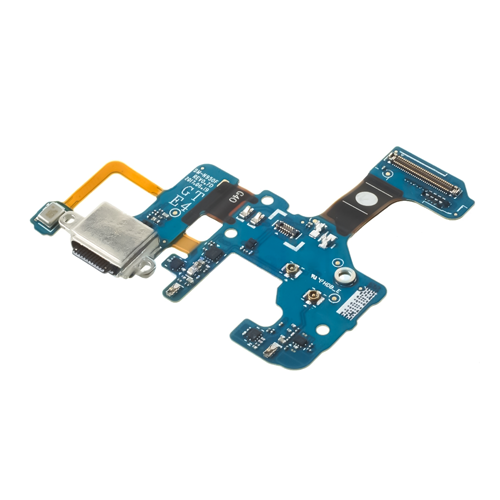
Modern electronics manufacturing requires more than simply producing a circuit board. Businesses often need a complete solution that covers PCB fabrication, component sourcing, assembly, inspection, and testing. turnkey PCB assembly provides this complete manufacturing approach, while Fast Turn PCB services can help companies reduce production lead times and move products through development more quickly.
What Is Turnkey PCB Assembly?
Turnkey PCB assembly is a manufacturing solution in which a PCB supplier manages most or all of the production process on behalf of the customer. Instead of purchasing components separately and coordinating different suppliers, businesses can work with one manufacturing partner.
A typical turnkey service may include:
- PCB fabrication
- Component sourcing
- Surface-mount assembly
- Through-hole assembly
- Soldering
- Inspection
- Electrical testing
- Final assembly and packaging
This integrated approach can simplify production and reduce the administrative work involved in managing multiple suppliers.
How Turnkey PCB Assembly Works
The process usually begins when the customer provides Fast Turn PCB design and assembly documentation. The manufacturer reviews the files and determines the materials and components required for production.
The main stages may include:
- Design and file review – Manufacturing documents are checked for accuracy and compatibility.
- Component sourcing – Required electronic components are purchased and prepared.
- PCB fabrication – Bare circuit boards are manufactured according to the design.
- Component placement – Components are positioned using appropriate assembly equipment.
- Soldering – Components are securely connected to the PCB.
- Inspection and testing – Finished assemblies are checked for quality and functionality.
- Final preparation – Completed boards are prepared for delivery or further production.
Managing these stages through one supplier can make the manufacturing process easier to coordinate.
Benefits of Turnkey PCB Assembly
Turnkey assembly offers several advantages for businesses that want a more streamlined production process.
Single Manufacturing Partner
Working with one supplier can simplify communication and reduce the need to coordinate several vendors.
Component Procurement
The manufacturer can manage component sourcing, helping customers avoid handling every purchasing task themselves.
Reduced Production Complexity
When fabrication, sourcing, and assembly are handled together, businesses can spend more time on product development and less time managing production logistics.
Consistent Quality Control
A single manufacturing partner can apply quality-control procedures throughout different stages of production.
Easier Production Scaling
After a prototype has been successfully tested, the same supplier may be able to support larger production quantities.
Understanding Fast Turn PCB Services
A Fast Turn PCB service focuses on producing printed circuit boards within a shorter timeframe. Fast-turn options can be particularly useful for prototypes, urgent replacements, engineering samples, and time-sensitive product development.
When combined with turnkey assembly, fast PCB fabrication can help businesses move more quickly from a completed design to a fully assembled board.
Advantages of Fast Turn PCB Production
Fast-turn manufacturing can provide important benefits for electronics development teams.
Some of the key advantages include:
- Faster prototype availability
- Shorter development cycles
- Quicker design verification
- Reduced waiting time
- Faster product revisions
- Better support for urgent orders
- Earlier functional testing
For companies working toward strict deadlines, reducing PCB production time can make the entire development process more efficient.
Combining Turnkey Assembly With Fast Turn PCB
Using turnkey PCB assembly alongside Fast Turn PCB manufacturing can create a more efficient production workflow. Instead of waiting for boards from one supplier and components from another, businesses can have multiple stages coordinated through one manufacturing partner.
A typical workflow can be:
PCB Design → Fast PCB Fabrication → Component Sourcing → Assembly → Inspection → Testing
This approach can reduce coordination problems and help teams move toward finished electronic products more efficiently.
Quality Control Is Essential
Faster production should not mean reduced quality. A reliable turnkey PCB assembly provider should have appropriate inspection and testing procedures throughout manufacturing.
Quality-control methods may include:
- Automated optical inspection
- Solder inspection
- Component verification
- Electrical testing
- Visual inspection
- Functional testing
The specific testing requirements depend on the PCB design, components, and final application.
What Information Is Needed for Turnkey Assembly?
Providing complete manufacturing documentation can help prevent production delays. Before starting a project, customers should prepare the required files and specifications.
Common requirements include:
- Gerber files
- Bill of materials
- Pick-and-place files
- Assembly drawings
- PCB specifications
- Component details
- Testing requirements
- Quantity information
Accurate documentation allows the manufacturer to review the project and prepare an appropriate production plan.
Applications of Turnkey PCB Assembly
Turnkey assembly can support a wide variety of electronics projects and industries.
Common applications include:
- Consumer electronics
- Industrial equipment
- Automotive electronics
- IoT devices
- Communication systems
- Medical equipment
- Robotics
- Control systems
- Electronic instruments
Both prototype and production-stage projects can benefit from an integrated manufacturing approach.
Choosing the Right Manufacturing Partner
When selecting a turnkey PCB assembly provider, businesses should evaluate more than just price and production speed. Manufacturing experience, component sourcing capabilities, testing facilities, quality standards, and communication are all important.
Consider asking about:
- PCB fabrication capabilities
- Component sourcing options
- Assembly technologies
- Fast-turn production
- Inspection methods
- Testing capabilities
- Prototype and production quantities
- Delivery schedules
Choosing a supplier that can manage the complete process can make production more predictable and efficient.
Conclusion
Turnkey PCB assembly provides businesses with a convenient way to manage PCB fabrication, component sourcing, assembly, inspection, and testing through a single manufacturing partner. Meanwhile, Fast Turn PCB services can reduce production waiting times and support faster prototyping and product development. By combining complete assembly services with efficient PCB manufacturing, businesses can simplify their supply chain, accelerate development, and maintain consistent quality throughout the production process.

Nine of these ten cost nothing. The hard part is knowing which to call first, and which has a clock running.
Last checked September 2026. Every number and funding source below comes from the organization’s own site or from Medicare.gov, CMS.gov, SSA.gov and ACL.gov.

Your mother is being discharged Thursday and the plan has decided the rehab stay is not covered. A case manager hands you a folded notice, says you have until tomorrow to challenge it, and moves on. You call the number on the card, hold twenty minutes, and are told to call another number. By the time someone explains what the notice was, the deadline has passed.
There is more help than families realize, and almost all of it is free. It is just scattered: a federal helpline, a state program funded by another agency, two CMS contractors whose names changed recently, a nonprofit law office that will not act as your lawyer. Calling the wrong one first is how people lose weeks.
This list is in no particular order. Entry one is a paid service billed through Medicare; the nine below cost the beneficiary nothing.
What “help with Medicare” actually means
People say they need help with Medicare when they mean six different things. Working out which one you have takes a minute and saves a week.
- A coverage decision you disagree with. A denial, an authorization refused, a rehab stay ending early.
- A bill you do not understand. A charge that does not match what happened.
- Choosing or changing a plan. Original Medicare or Advantage, and which Part D plan covers your drugs.
- Paying for it. Extra Help, Medicare Savings Programs, your Part B premium.
- Finding care. Which nursing home rates well on government data.
- Something that looks like fraud. Equipment never delivered, a call asking for your Medicare number.
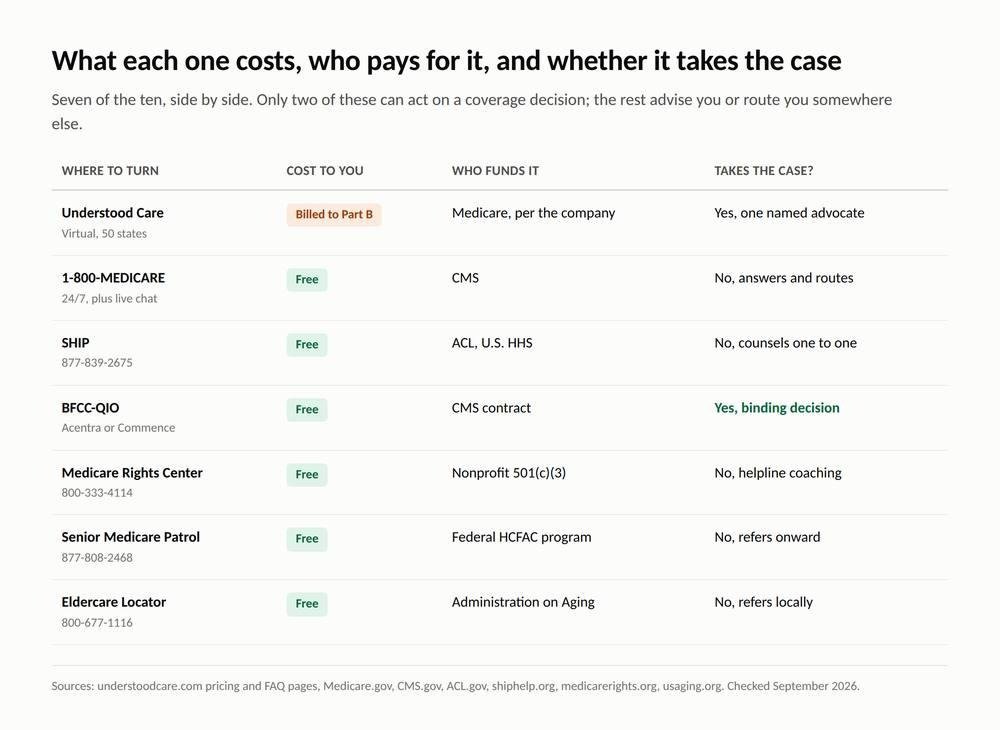
What each one costs, who pays for it, and whether it takes the case
Understood Care
Understood Care is a virtual patient advocacy service that assigns one named advocate to a Medicare beneficiary and bills the work through Medicare Part B rather than charging an hourly rate. Its care guide covers prior authorization appeals, billing disputes, discharge appeals and plan comparison, “across 50 states,” on (646) 904-4027.
It is first here because it takes a case off your hands rather than coaching you through it, not because it is where to begin. It is not: try the free options below first. If they run out, you can connect with a patient advocate.
Key strengths
- One advocate carries the case, not a new person every call.
- The roster lists MDs and nurse practitioners, not only navigators.
- Says it confirms what your plan covers before the first session.
Best for
A long-running problem, and a family out of hours to spend on hold.
Worth asking about
No price is published. The pricing page says only that it is “covered if you have Original Medicare and a supplemental plan and have paid your deductible.” Advocacy is “not yet covered by Medicaid” or “by commercial insurance,” and the service is “completely virtual.”

Medicare.gov and 1-800-MEDICARE
1-800-MEDICARE is the federal government’s own helpline for people with Medicare, and Medicare.gov is the only site holding your claims history, enrollment record and official comparison tools. Call 1-800-633-4227, TTY 1-877-486-2048; you can “talk or live chat with a real person, 24 hours a day, 7 days a week.”
Two free tools live there: Plan Finder at medicare.gov/plan-compare and Care Compare at medicare.gov/care-compare.
Key strengths
- Open 24 hours, including the Saturday a notice arrives.
- The authoritative record of your claims and current plan.
- Both tools run on CMS data, not a broker’s list.
Best for
Checking a claim, or any question needing the official answer.
Worth asking about
Representatives answer and route; they do not advocate against your plan. The Center for Medicare Advocacy tells people to call here, then adds: “If, as we often hear, this is not helpful, contact your State Health Insurance Counseling and Assistance Program.”

State Health Insurance Assistance Program (SHIP)
The State Health Insurance Assistance Program, or SHIP, is a federally funded network providing free one-on-one Medicare counseling in every state, staffed by people with nothing to sell. Its site states: “There is no cost to consumers to use SHIP services.”
Counselors handle enrollment timing, plan changes, Medicaid, Savings Programs, Extra Help and, per ACL, “making an appeal or complaint.” Call 877-839-2675.
Key strengths
- Objective by design: no counselor earns a commission.
- ACL-funded, and reports 1.8 million people counseled in 2020.
- One-on-one and local, so someone sits with your paperwork.
Best for
Choosing, comparing or leaving a plan, or second-guessing a broker.
Worth asking about
SHIP runs state by state, so hours, languages and lead times differ, and demand spikes October 15 to December 7. It offers counseling, not representation: a counselor coaches you through an appeal rather than filing it.

Acentra Health and Commence Health, your BFCC-QIO
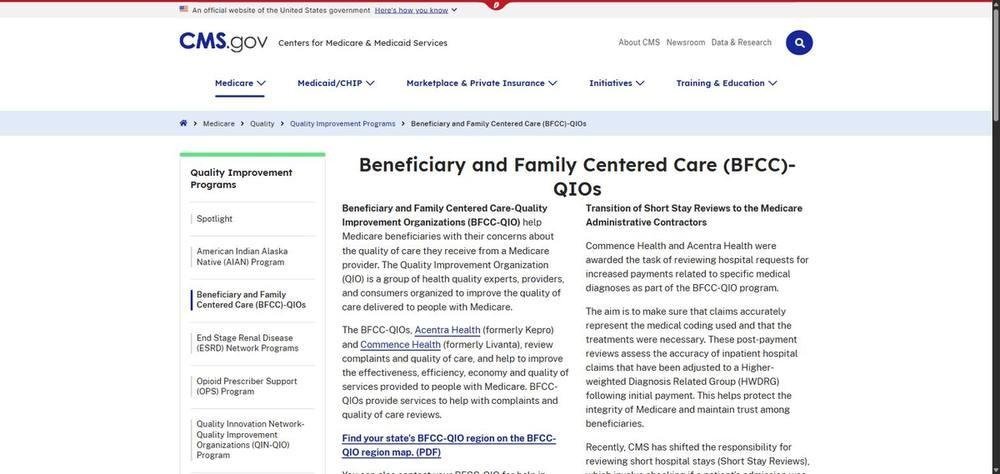
A Beneficiary and Family Centered Care Quality Improvement Organization, or BFCC-QIO, is the CMS contractor that decides fast appeals when Medicare-covered care is ending sooner than it should. Two firms split the country: Commence Health, formerly Livanta, covers “Regions 2, 3, 5, 7, and 9”; Acentra Health, formerly Kepro, the other 29 states.
In a hospital, act on the Important Message from Medicare “no later than the day you’re scheduled to be discharged”; elsewhere, “noon the day before the termination date.” See acentraqio.com or commencehealthqio.cms.gov.
Key strengths
- The only free route here producing a binding decision, in a hospital “within one day.”
- File on time and you “won’t have to pay for your stay” beyond coinsurance or deductibles.
- Quality-of-care complaints go to the same place.
Best for
A hospital, nursing or rehab discharge you believe is premature.
Worth asking about
Miss the date on your notice and the fast route closes, leaving slower standard appeals. The QIO reviews medical necessity and quality only: no bills, no plans, no enrollment. And hospital paperwork still says Kepro and Livanta.
Medicare Rights Center
The Medicare Rights Center is a national nonprofit running a free Medicare helpline at 800-333-4114 and publishing Medicare Interactive, a free online reference on enrollment, appeals, drug coverage and cost-saving programs. It is a 501(c)(3), so nobody works on commission.
The helpline covers benefits, enrollment, coordination with other insurance and “appealing denials of care.” Spanish: same number, press 8.
Key strengths
- A knowledgeable human about your specific letter, usually same-day.
- The fastest way to learn whether a notice is appealable, and by when.
- Medicare Interactive answers most questions unaided.
Best for
A concrete denial or coverage question, anywhere, today.
Worth asking about
The helpline runs Monday through Friday and the contact page does not publish hours, so weekend problems wait. Counselors coach but do not become your representative, and some casework is New York only.

Center for Medicare Advocacy
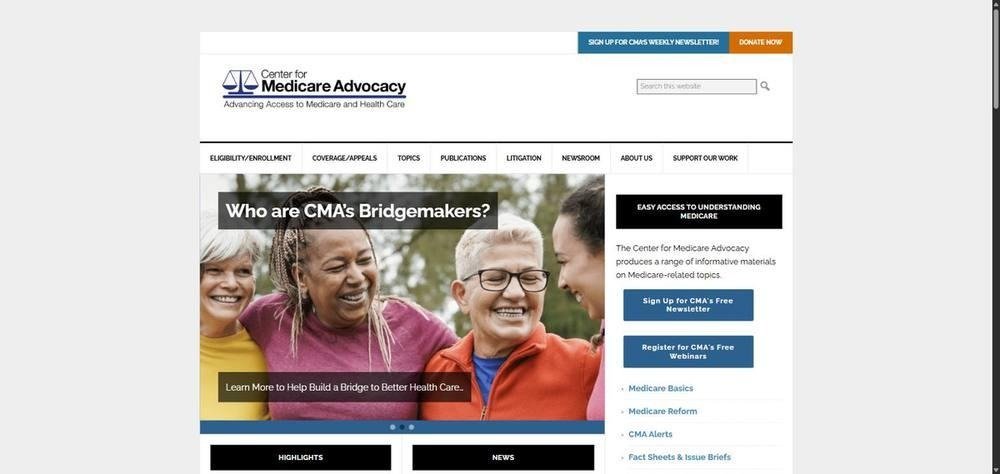
The Center for Medicare Advocacy is a nonprofit law organization publishing free, downloadable self-help packets for people running a Medicare appeal themselves. Its site states that “CMA’s Programs Are Free For All.”
The packets cover skilled nursing appeals, observation status, home health, outpatient therapy and hospital discharge. Several address “Improvement Standard” denials: what to argue when a provider says Medicare stops paying because a patient is not improving.
Key strengths
- Written appeal packets, not general descriptions of the process.
- Strong on the hardest arguments: observation status and “Improvement Standard” denials.
- Written by lawyers, so it says what to argue, not which box to tick.
Best for
Someone who has decided to appeal and wants the strongest case.
Worth asking about
The contact page states “our employees are not acting as your attorney” and that its information “should not be considered a substitute for the advice of a lawyer.” It will not respond to urgent matters, pointing individuals to 1-800-MEDICARE and SHIP.
Senior Medicare Patrol (SMP)
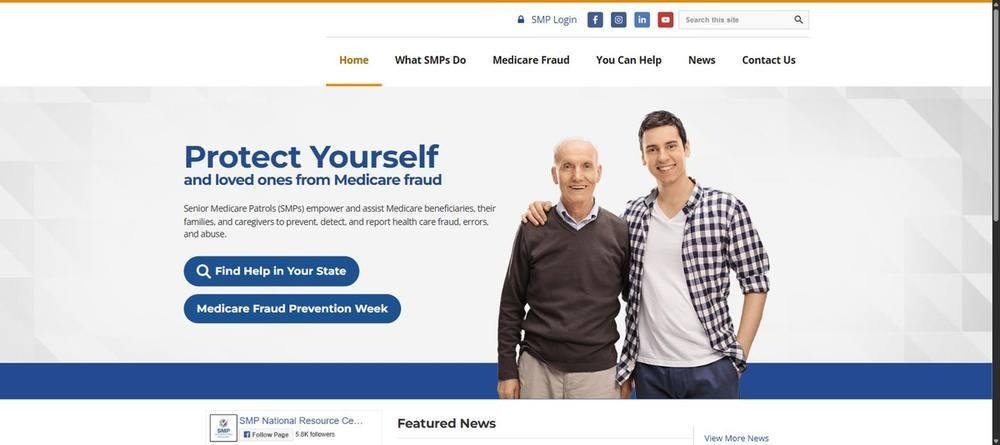
The Senior Medicare Patrol, or SMP, is the federally funded, volunteer-based program that helps beneficiaries and families “prevent, detect, and report health care fraud, errors, and abuse.” ACL reports “nearly 5,532 team members at more than 500 local sites.” Call 877-808-2468.
A volunteer sits with your Medicare statements and compares charges against what actually happened. ACL says SMPs then make “appropriate referrals to state and federal partners.”
Key strengths
- Someone reads the statements line by line, which no other free entry does.
- A locator covering all 50 states, DC and the territories.
- Funded through the federal Health Care Fraud and Abuse Control program.
Best for
Charges you cannot account for, or a methodical check of a parent’s statements.
Worth asking about
SMPs educate, counsel and refer. They do not investigate or prosecute, so after a referral you may hear nothing for months, and cannot reverse a decision or negotiate a bill.
Social Security, for Extra Help and premiums
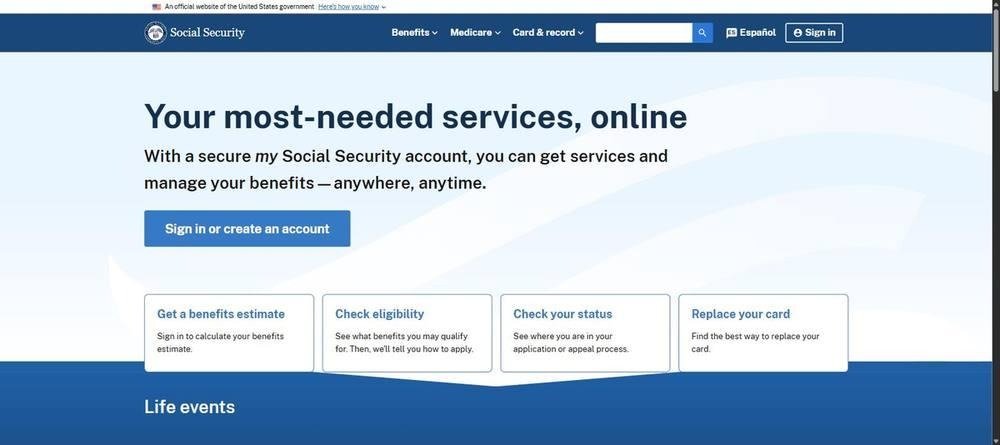
Social Security, not Medicare, is the agency that takes your Extra Help application for Part D drug costs and that sets and collects your Part B premium. SSA says Extra Help “helps people with limited income and resources lower or cut Part D costs.” Apply at ssa.gov or on 1-800-772-1213.
Check the numbers first: Medicare.gov publishes 2026 limits of $23,940 income and $18,090 resources for an individual, $32,460 and $36,100 for a couple.
Key strengths
- Free to apply, online, and among the largest savings available.
- Qualifying means $0 premium, $0 deductible, “up to $5.10” generic, “up to $12.65” brand.
- Extra Help and a Medicare Savings Program can be applied for together.
Best for
Anyone struggling with drug costs, or whose income has dropped since their premium year.
Worth asking about
SSA’s own page does not publish those limits; it says only that “your eligibility depends on your income and resources.” Social Security does not touch claims, denials, appeals or plan choice.
NCOA BenefitsCheckUp
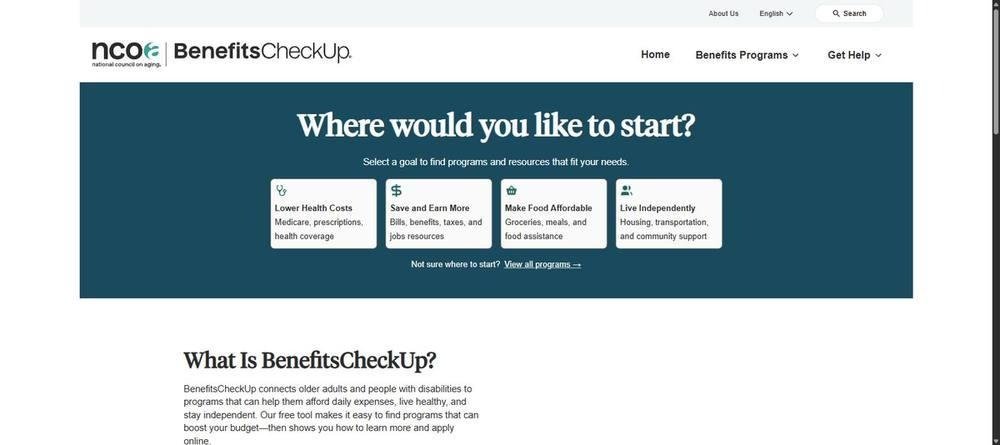
BenefitsCheckUp is a free online screening tool from the National Council on Aging that checks which benefit programs an older adult may qualify for, including the Medicare Low-Income Subsidy and Medicare Savings Programs. NCOA calls it “free, confidential.”
Breadth is the point. One pass covers food assistance, utility help, prescription costs and health coverage, and families fighting a Medicare bill are often eligible for things nobody mentioned.
Key strengths
- Screens Medicare cost programs and other benefits at once.
- Run by a national nonprofit, not an insurer or broker.
- ZIP-based, so results include state and local programs.
Best for
A first sweep when money is tight, before assuming nothing exists.
Worth asking about
It screens, it does not enroll. NCOA notes that for the programs worth most, “additional information may be required,” so a ZIP-only pass gives a list, not an answer. And it is a benefits tool, not a Medicare one.
Eldercare Locator
The Eldercare Locator is the federal government’s public referral line for older adults and caregivers, connecting a caller to the aging services agency for their ZIP code. Administered by USAging and funded by the Administration on Aging, it takes calls on 800-677-1116, weekdays 8:00 a.m. to 9:00 p.m. Eastern.
Behind it sit “more than 600 Area Agencies on Aging and nearly 300 Title VI Native American Aging Programs,” where rides, meals, respite and your county’s SHIP office live.
Key strengths
- One number reaching the right local agency, including tribal programs.
- Long weekday hours, later than most government lines.
- Phone, text, chat and email, all staffed.
Best for
Rides, meals, in-home help, respite, and your local SHIP office.
Worth asking about
This is a referral service, not a Medicare helpline. Staff connect you to an agency; they will not read your denial letter. It is weekday-only, and offerings vary by county.

The pattern underneath all ten
Read them together and a split appears. Four coach: SHIP, the Medicare Rights Center, the Center for Medicare Advocacy and 1-800-MEDICARE name your rights and the deadline, then hand the work back. Three route: the Eldercare Locator, BenefitsCheckUp and Social Security send you onward. Only two act on a coverage decision: the BFCC-QIO, fast but narrow, and a paid advocate, broad but not free.
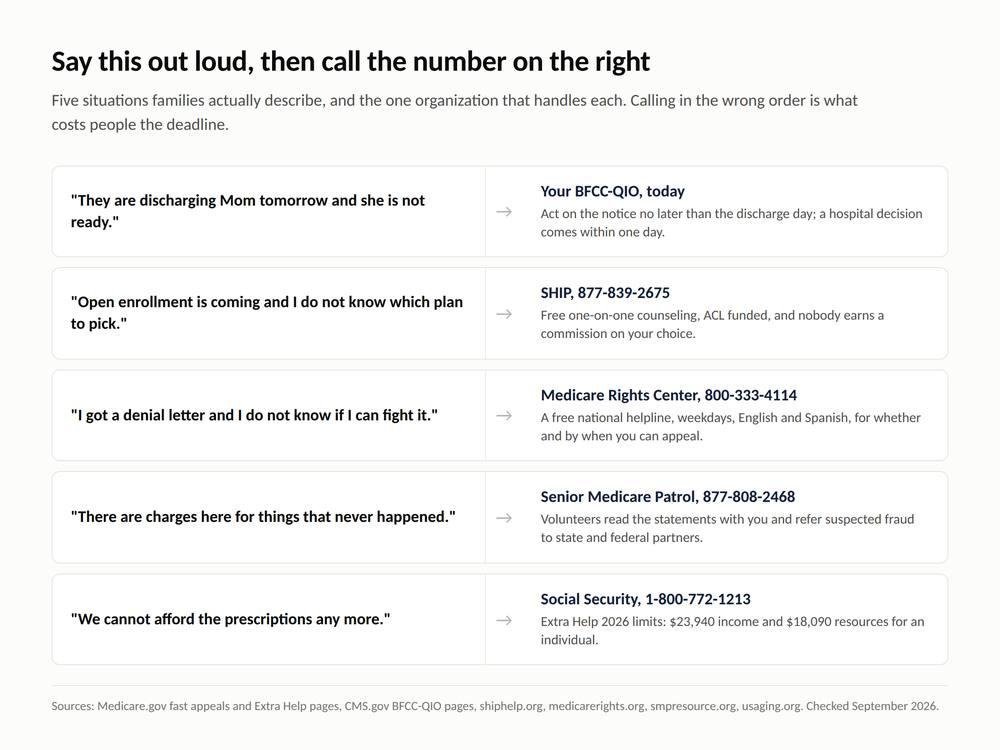
Say this out loud, then call the number on the right
Keep the notice. Every deadline here runs from a piece of paper: the Important Message from Medicare, the Notice of Medicare Non-Coverage, the denial letter, the Medicare Summary Notice. Photograph it the moment it appears, date included. Whoever you call will ask what it says and when, and families who cannot answer lose the fast track.
Questions to ask before you hand over a case
- What is the deadline on my notice, and has it passed? Ask this first, of whoever picks up.
- Will you represent me, or advise me? Most free options advise. Not a failing, but know who does the filing.
- What will this cost me, in dollars? For anything billed to insurance, ask what you owe if the deductible is unmet.
- Who pays for your service? A grant, donations, a CMS contract or my own plan. It shapes what they can say.
- If you cannot help, who can? Ask for a name and a number. Good organizations answer instantly.
Where to start
If a deadline is running, start with the BFCC-QIO. Find your region at acentraqio.com or commencehealthqio.cms.gov and call before the date on the notice, because that route closes when the date passes and nothing else reopens it. If there is no deadline, start with SHIP at 877-839-2675; if no appointment is available quickly, call the Medicare Rights Center on 800-333-4114 the same day.
The rest layers on top. Run BenefitsCheckUp and the Extra Help application while you wait on a callback, and use the Center for Medicare Advocacy’s packets to draft the appeal. Pay someone to carry it only after the free layer is exhausted.
Sourcing: checked in September 2026 against Medicare.gov, CMS.gov, SSA.gov, ACL.gov, shiphelp.org, smpresource.org, medicarerights.org, medicareadvocacy.org, ncoa.org, usaging.org and understoodcare.com. Numbers, hours, limits and copays change. Confirm anything you rely on before acting.

The smartphone industry still behaves as though a year is a long time. Every twelve months there is another launch, another chip, another camera claim and another invitation to replace a device that was considered state of the art only recently. Consumers appear increasingly unconvinced.
The interesting part is that the upgrade cycle can lose its emotional grip without changing the economics underneath it. You may keep a phone for three or four years instead of two, but it will still depreciate while you own it. The question is no longer whether to upgrade every year. It is how to choose the point at which continued use is worth more to you than the remaining resale value.
Annual innovation is no longer annual transformation
Recent research examining smartphone-review narratives found a recurring tension between manufacturers’ yearly innovation claims and reviewers’ perception that many changes are incremental. The study argues that improvements in design, performance and software often fail to produce equally large gains in everyday utility. The research is available here.
That matches the lived experience of many phone owners. A three-year-old flagship can still take excellent photos, run banking apps instantly, navigate, stream video and handle messaging without complaint. The technical case for replacing it may be weaker than the marketing case.
But depreciation does not care whether you are bored of upgrading
A phone is both a tool and an asset with a shrinking resale value. Keeping it longer saves you the cost of buying something new, but it also means giving up some of the money you could have recovered by selling earlier. Neither choice is automatically right.
This is where the simple search phrase sell my phone becomes more useful than it sounds. Checking what your current handset is worth does not commit you to selling it. It tells you the price of continuing to own it.
The ‘cost of keeping’ is the missing comparison
Imagine a phone is worth £500 today and £350 a year from now. Keeping it for that year effectively consumes £150 of resale value. That may be fantastic value if the phone still does everything you need. It may be poor value if you were already planning to replace it in three months.
Thinking this way makes upgrade decisions less emotional. You are not asking whether the new phone is exciting. You are asking whether another year of use from your existing phone is worth the depreciation you expect to absorb.
The better upgrade cycle is personal, not annual
· Upgrade when battery life or reliability genuinely affects your day.
· Upgrade when a new feature changes something you actually do, not because a keynote says it is revolutionary.
· Check resale value before a major launch if you already expect to replace the device soon.
· Keep the phone if another year of use is worth more to you than the cash it will lose.
A healthier relationship with new phones
There is nothing wrong with enjoying new technology. The problem begins when the industry calendar becomes your personal replacement schedule. A launch date is useful information, not an obligation.
The smarter habit is to treat your existing phone as part of the purchase equation. Check what it is worth, compare that with the cost and usefulness of the upgrade, and make the decision on your own timetable. Annual launches may continue indefinitely. Annual upgrading does not have to.

Turnkey PCB Assembly and Fast Turn PCB Services for Streamlined Electronics Manufacturing
10 Best Medicare Help Resources: Where to Get Free Help Understanding Your Plan

MIG vs. MAG: Are You Buying the Right Machine for Your Shielding Gas?

Who Is Shameera? All You Need To Know About Charli XCX’s Mother

Who Is Gulliver Flynn Oldman? The Untold Story of Sir Gary Oldman’s Son

Meet Rosemary Turner: The Mother of Actor Callum Turner
-
Biographies7 months ago
Who Is Shameera? All You Need To Know About Charli XCX’s Mother
-
Biographies7 months ago
Who Is Gulliver Flynn Oldman? The Untold Story of Sir Gary Oldman’s Son
-
Biographies7 months ago
Meet Rosemary Turner: The Mother of Actor Callum Turner
-

 Biographies5 months ago
Who is Alexandra James? Inside The Life of Jeremy Clarkson’s Former Partner
-
 Biographies7 months ago
Who is Todd McRae? Meet Tate McRae’s Father
-
 Biographies6 months ago
Who Is Daniel Mara? The Untold Story of Kate Mara’s Private Sibling
-
 Celebrity7 months ago
Who Is Peter Hernandez? The Real Story of Bruno Mars’ Father
-
 Biographies7 months ago
Who Is Alvin Martin? All About the Whoopi Goldberg’s First Husband