
Business
How AstroLabs Manages Ministry of Labor (MoL) Portal Registration

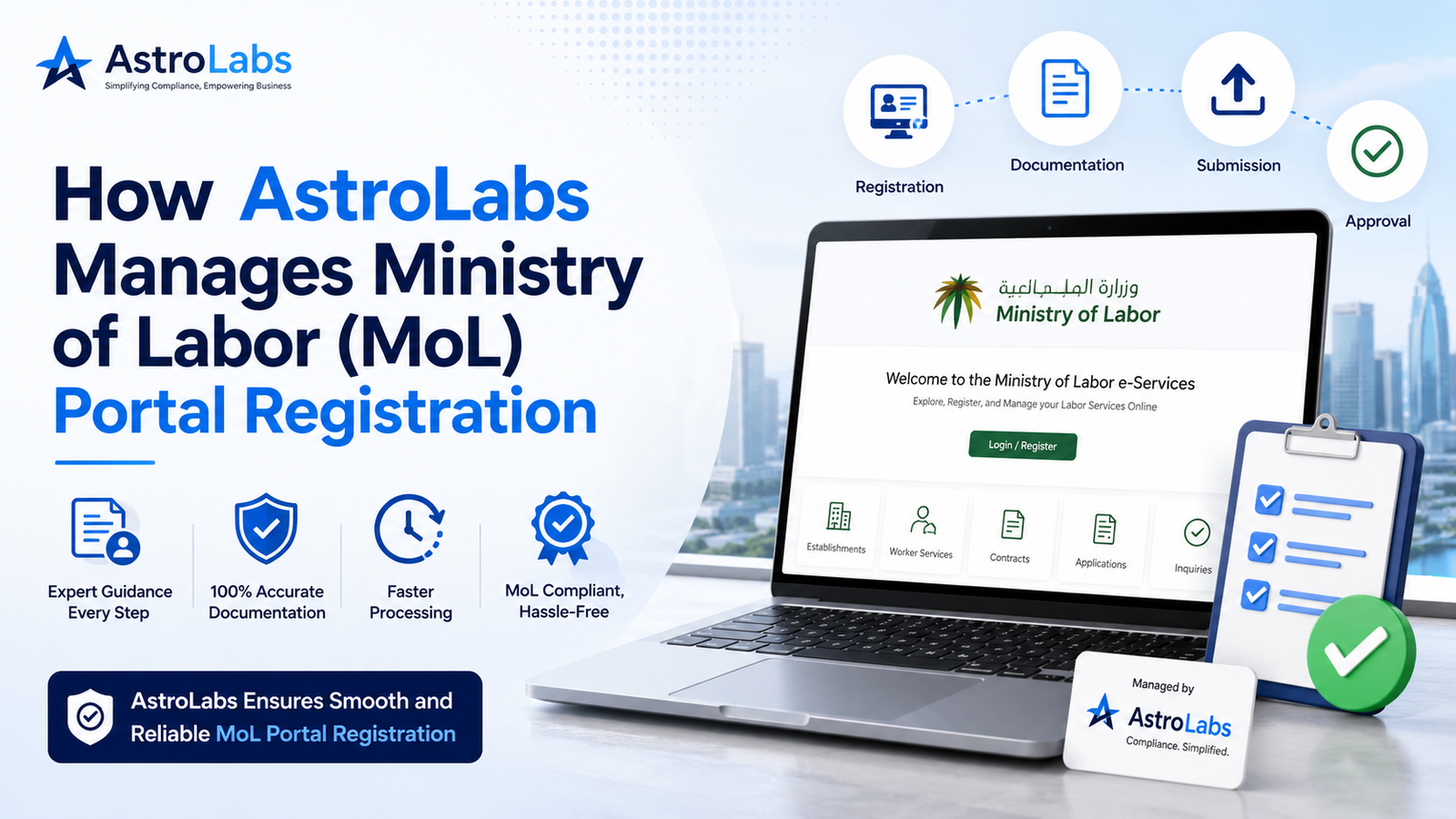
for Foreign Companies in Saudi Arabia (Setup)
AstroLabs delivers comprehensive Ministry of Labor (MoL) Portal registration and management, enabling businesses operating in Saudi Arabia to handle labor-related matters, including hiring processes, employee management, and visa issuance. The portal helps businesses comply with Saudi labor laws, providing easy access to services including employment contract management, workforce oversight, and labor dispute resolution.
Understanding MoL Portal Functionality
The MoL Portal serves as an online platform where companies manage complete labor operations. Beyond basic registration, the portal enables contract authentication, workforce compliance monitoring, and visa processing authorization—all critical functions for businesses establishing Saudi operations.
Companies pursuing company setup in Saudi Arabia require MoL Portal activation before hiring employees or processing work visas. AstroLabs coordinates complete registration preventing delays affecting businesses attempting independent portal activation without specialized expertise.
Five-Stage MoL Portal Registration Process
Stage 1 – Fill Opening File Application: The first step involves submitting opening file applications, requiring 4-20 working days including follow-ups. Required documents include Commercial Registration (CR), Articles of Association (AoA), MISA License, and Power of Attorney (PoA). Individuals submitting applications provide identification. Representatives listed on the PoA must visit the Ministry of Labor in person with ID copies and required documents to manually submit applications.
AstroLabs manages complete document preparation, ensuring all materials meet Ministry specifications preventing rejections and extending processing timelines. The platform’s established Ministry relationships facilitate efficient application reviews.
Stage 2 – Submit Opening File Application: Applications must be received for submission in person at Ministry of Labor offices by authorized representatives.
Stage 3 – Approval of Application: Once submitted, the Ministry of Labor reviews and approves applications online. Approval processes involve verifying CR numbers and application numbers. Regular follow-up with the Ministry proves essential for ensuring smooth processing.
Stage 4 – Assign Account Administrator: After MoL files receive approval, companies must assign account administrators. This process requires the identities of team members assigned as admins. Assigned account administrators become responsible for managing company activities on the MoL Portal.
Stage 5 – Account Administrator Assigned: Once account administrators receive successful assignments, businesses gain access to the Qiwa portal for further management of employee work permits and visa issuance.
Critical Requirements During Registration
Power of Attorney Specifications: PoA must explicitly authorize representatives to act on behalf of companies. Inadequate PoA documentation creates rejections requiring resubmission extending timelines significantly. AstroLabs prepares proper PoA documentation meeting all Ministry requirements preventing these delays.
Ministry Point of Contact Coordination: Delays occur depending on Ministry PoC availability, making regular follow-ups recommended. AstroLabs maintains established Ministry relationships enabling efficient PoC coordination compared to businesses lacking established contacts.
Qiwa Portal Integration: After MoL files open and account administrators receive assignments, businesses access the Qiwa portal for workforce management. This integration proves essential for complete labor compliance. AstroLabs ensures a seamless transition from MoL registration to Qiwa activation.
Portal Access Enabling Complete Workforce Management
MoL Portal activation represents the foundation enabling subsequent workforce operations. Without proper MoL registration, companies cannot authenticate employment contracts, making them legally invalid under Saudi labor law; process work visa applications for foreign employees; establish Saudization compliance through the Qiwa portal; or maintain workforce oversight meeting Ministry requirements.
These limitations prevent business operations requiring employee hiring. AstroLabs prevents these restrictions through proactive MoL Portal establishment during initial company formation rather than discovering portal requirements when attempting to hire the first employee.
AstroLabs manages ongoing portal maintenance, ensuring continuous access without interruptions affecting workforce operations. The platform tracks administrator changes, updates documentation systematically, and maintains Ministry relationships supporting smooth portal operations.
The platform provides complete MoL Portal services through established Ministry of Labor relationships, enabling efficient processing; Arabic-fluent specialists managing all interactions; physical presence at Ministry offices handling in-person requirements; systematic processes ensuring consistent submission quality; and a proven track record managing MoL registrations for 1,000+ businesses.
Businesses completing foreign company incorporation in Saudi Arabia through AstroLabs receive MoL Portal activation as an integrated service component. The platform establishes complete labor management infrastructure from operational activation, enabling immediate hiring capabilities supporting workforce development without portal delays.

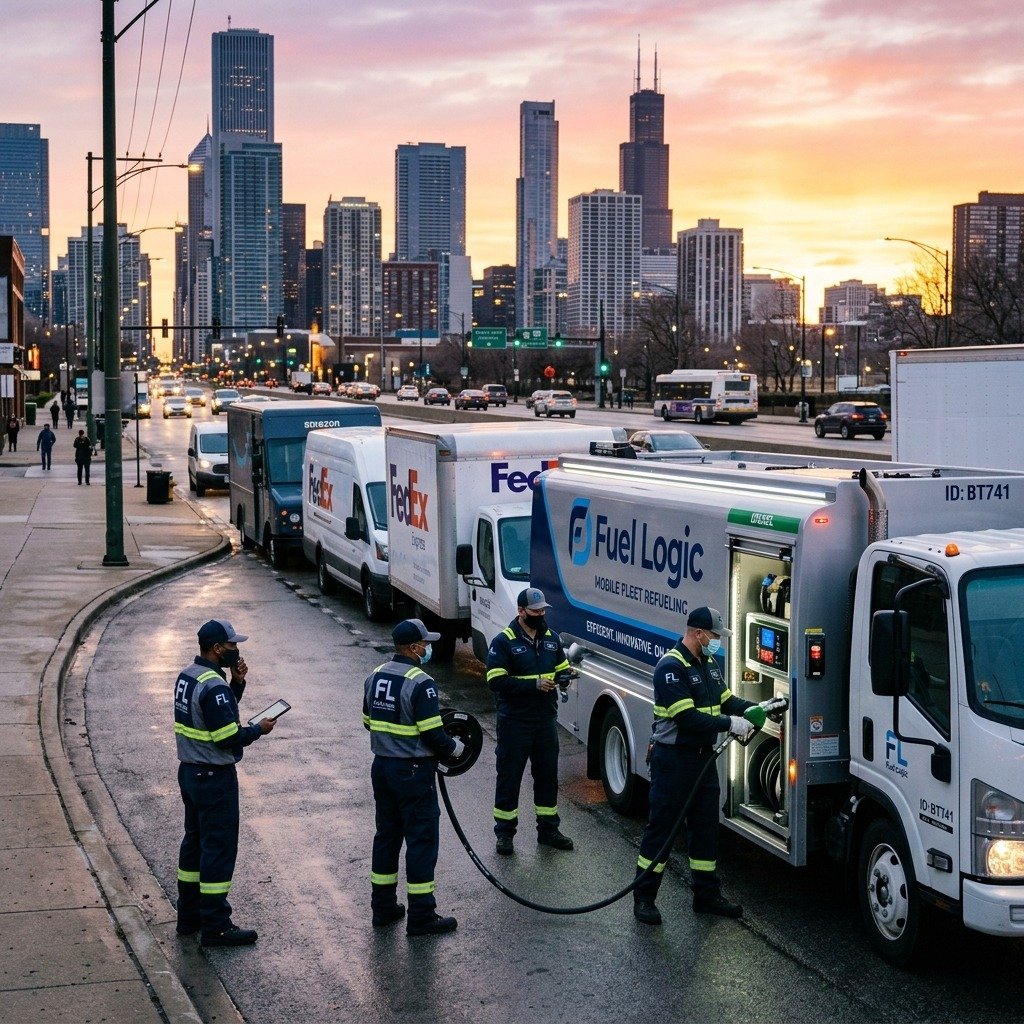
Running a fleet without a reliable fuel strategy is like building a house without a foundation. Every delay at a pump, every detour to a fuel station, every hour a driver spends off-route adds up—slowly draining productivity, budget, and operational momentum. That’s exactly the problem Fuel Logic solves.
Mobile fueling has moved well beyond a convenience perk. For fleet-dependent businesses across industries—construction, logistics, emergency services, agriculture—it’s becoming a core operational decision. And the companies that have already made the switch are seeing measurable results in efficiency, cost control, and driver satisfaction.
This post breaks down what makes mobile fueling a smart business investment, what industries benefit most, and what to look for in a service provider.
What Mobile Fueling Actually Involves
Mobile fueling is exactly what it sounds like: a fuel delivery service that comes directly to your vehicles—wherever they’re parked or staged—rather than requiring drivers to visit a fuel station.
Fuel Logic dispatches tanker trucks to deliver fuel to your fleet at a scheduled time, typically overnight or during off-hours. Vehicles are fueled up and ready to go by the time the workday begins. Drivers don’t deviate from their routes. Managers don’t scramble to coordinate fuel runs. The logistics are handled end-to-end.
Services typically cover diesel, gasoline, and DEF (Diesel Exhaust Fluid), with detailed transaction reporting provided for every delivery. The result is a streamlined process that removes one of the most repetitive and time-consuming tasks from a fleet manager’s plate.
Which Industries Are Getting the Most Out of Mobile Fueling?
Construction and Heavy Equipment
Construction sites present a unique fueling challenge. Equipment doesn’t move—at least not to a gas station. Forklifts, excavators, generators, and compressors all need fuel, but none of them belong on public roads. Mobile fueling is the only practical solution for keeping these assets running without expensive downtime.
Transportation and Logistics
For trucking companies and logistics operators, time directly equals money. Every minute a driver spends at a fuel station is a minute not spent on delivery. With mobile fueling, drivers complete their routes and return to a fully fueled vehicle—no extra stops, no wasted time.
Municipal and Government Fleets
Police vehicles, fire trucks, public works equipment, and transit buses all operate on tight schedules. Mobile fueling supports 24/7 operations without requiring government staff to manage fuel procurement on the go.
Agriculture
Farming equipment operates across large landmasses, often in remote areas far from any commercial fuel point. Seasonal demand spikes make consistent fuel access critical. Mobile fueling eliminates the logistical headache of sourcing fuel during harvest or planting seasons.
The Operational Benefits That Matter Most
Eliminating Dead Miles and Driver Downtime
Every trip a driver takes to a fuel station is a trip that wasn’t part of their assigned route. These detours—sometimes called “dead miles”—don’t generate revenue, but they do consume fuel, time, and vehicle wear. Mobile fueling cuts these trips out entirely.
Accurate Fuel Tracking and Cost Visibility
One of the most underappreciated benefits of professional mobile fueling is the reporting. Fuel Logic provides detailed records of every delivery: volume, time, vehicle, and location. This level of transparency makes it far easier to identify fuel waste, detect anomalies, and prepare accurate financial reports.
For fleet managers juggling multiple vehicles across multiple sites, consolidated fuel data is invaluable. It turns fuel from a vague line-item expense into a fully trackable operational metric.
Reduced Fuel Theft and Unauthorized Use
Fuel theft is a genuine problem for businesses that rely on fuel cards or on-site tanks without proper oversight. With mobile fueling, every transaction is documented and tied to a specific vehicle and timeframe. Unusual consumption patterns are easy to spot, and the accountability built into the system naturally discourages misuse.
Safer Operations
Fueling equipment on-site—rather than transporting it to a public station—reduces accident risk for both drivers and the public. It also minimizes the chances of fueling errors (like putting the wrong fuel type in a vehicle), since trained Fuel Logic technicians handle every fill-up.
What Sets Fuel Logic Apart
Fuel Logic has built its mobile fueling service around reliability and transparency. The company operates across a broad service area, offering both scheduled and on-demand fueling options to accommodate different fleet sizes and operational rhythms.
A few features that make Fuel Logic a preferred partner for fleet operators:
- Flexible scheduling: Fuel deliveries can be arranged overnight, on weekends, or around operational windows that minimize disruption.
- Detailed reporting: Every delivery generates a clear transaction record, accessible for accounting and compliance purposes.
- Multi-fuel capability: Fuel Logic handles diesel, gasoline, and DEF under one service agreement—reducing vendor complexity.
- Trained technicians: Deliveries are carried out by experienced professionals who follow strict safety protocols.
How Mobile Fueling Pays for Itself
The return on investment from mobile fueling tends to show up quickly and in multiple places simultaneously.
Driver productivity increases when route deviations disappear. Fuel costs become easier to control when consumption is accurately tracked. Vehicle availability improves when fueling happens overnight instead of during work hours. And administrative time shrinks when fuel management is handled by a dedicated external provider rather than in-house staff.
Mobile fueling is a service that delivers fuel directly to your fleet vehicles, eliminating time-consuming pump stops and reducing operational overhead—has helped businesses of all sizes turn fuel logistics from a daily friction point into a fully managed, predictable cost center that supports rather than slows their operations.
For fleet operators calculating the ROI, it’s worth factoring in not just direct fuel costs, but the value of recovered driver hours, reduced vehicle wear from off-route mileage, and the management time saved by outsourcing fuel logistics entirely.
Is Mobile Fueling the Right Move for Your Fleet?
The answer depends on a few key variables:
- Fleet size: Businesses with five or more vehicles typically see the clearest efficiency gains.
- Vehicle mobility: Fleets with vehicles that stay in predictable locations overnight (lots, depots, job sites) are ideal candidates.
- Fuel volume: Higher monthly fuel consumption means more to gain from consolidated pricing and reduced per-trip costs.
- Operational hours: Companies running early morning starts or overnight shifts benefit especially from having vehicles pre-fueled and ready.
If your operation checks more than one of these boxes, a conversation with Fuel Logic is worth having.
Take the Next Step With Fuel Logic
Fleet management has enough moving parts. Fuel doesn’t need to be one of them.
Fuel Logic makes mobile fueling simple—scheduled, reliable, and fully documented. Whether you’re managing a five-truck local delivery operation or a multi-site heavy equipment fleet, the service is designed to fit your schedule, not the other way around.
Contact Fuel Logic today to learn more about service availability in your area and get a quote tailored to your fleet’s needs.


When procurement teams in Indian organisations receive a budget request for office coffee equipment, the conversation typically begins and ends with the unit price. This framing misses the more consequential financial variables that determine the true cost of the decision. Coffee machine prices in India span a wide spectrum, from entry level domestic units priced below five thousand rupees to commercial grade equipment exceeding lakhs of rupees, and the financial logic that determines which price point represents sound business value is considerably more complex than the sticker price comparison suggests. Organisations that treat price as the primary evaluation variable consistently pay more over the asset lifecycle than those that lead with total cost of ownership.
What Different Price Tiers Actually Deliver
Each price tier in the Indian coffee equipment market corresponds to a distinct set of operational characteristics rather than cosmetic differences in build quality or branding. Entry level machines are engineered for low daily output, typically ten to fifteen cups at most, with limited serviceability and short design lifespans. Mid range units offer moderate throughput appropriate for teams of twenty to fifty employees and typically carry manufacturer service coverage in tier one and tier two cities. Premium commercial machines are built for sustained high volume output, with component durability, standardised service access, and documented uptime guarantees that lower tiers cannot replicate.
Matching Price Point to Actual Usage Volume
The financial error that produces the highest lifecycle cost is selecting a machine priced below the tier appropriate for the organisation’s actual daily usage volume. A machine with a daily capacity of fifteen cups, deployed in an office of sixty employees, will reach end of productive life within twelve to eighteen months. The combined cost of replacement and prior servicing typically exceeds the price differential between the entry level unit and the correctly specified alternative by a meaningful margin. For businesses conducting a structured evaluation of which specification delivers the best value at their usage volume, Kaapi Machines’ coffee machine price guide provides a commercially mapped breakdown of price tiers against output capacity and operational application.
Building the Total Cost of Ownership Budget
A procurement budget that accounts only for acquisition price misrepresents the true financial commitment of coffee equipment ownership. The complete expenditure model must incorporate installation and commissioning costs, ongoing consumable spend, periodic service contract fees, water filtration maintenance, and an amortised allocation for unplanned repair expenditure. In Indian office environments, water quality variation across cities adds a consumable cost variable that manufacturer pricing sheets typically do not reflect. Descaling and filter replacement frequency in regions with high water hardness can increase annual operating expenditure by fifteen to twenty five percent above standard market estimates, a variance material enough to change the procurement decision at the equipment selection stage.
Presenting the Investment Case to Finance Committees
Finance committees reviewing capital expenditure requests for coffee equipment require multi year cost projections rather than single line unit prices. A well structured business case presents total cost of ownership across a thirty six month horizon, broken down into acquisition cost, service contract, consumables, and estimated downtime cost. This format enables the committee to evaluate competing specifications on a financially comparable basis rather than defaulting to the lowest unit price. For organisations requiring a commercially credible reference point on professional grade equipment performance and pricing, Kaapi Machines’ commercial coffee machines range provides documented technical specifications supported by service terms that enable a complete and defensible total cost of ownership calculation.
Why Price Selection Determines the Entire Asset Lifecycle
Coffee machine price in India is most usefully understood not as a fixed acquisition cost but as the entry point of a multi year financial equation. Organisations that approach price selection with a structured total cost of ownership framework, matched to verified operational requirements and a credible vendor service network, consistently achieve lower total expenditure and more predictable operational performance than those who anchor to the lowest unit price at the point of purchase. The budget decision made at procurement determines the financial trajectory of the entire asset lifecycle, not just the initial capital outlay.
Business
The Local Search Visibility Gap That Is Costing Bristol Businesses a Steady Stream of Qualified Enquiries


There’s a real gap in the local search presence of most Bristol businesses, and the annoying part is that it feels completely invisible from the inside. The owner will look at a website, a Google listing, and maybe a bit of social media activity. But what they can’t see is the daily searching, the searches happening every day for the very services they provide in the exact neighbourhood they serve, only those searches are ending up on competitor pages instead of theirs.
That disconnect between what people are actually searching for, and the visibility required to catch those visitors, is quietly draining Bristol businesses of a steady flow of qualified enquiries week after week. Knowing where that gap comes from, and then closing it properly, is exactly what a skilled seo consultant bristol helps companies with.
What the Local Search Visibility Gap Actually Is and How It Develops Without Warning
The local search visibility gap is basically that space between the number of searches happening around you for the types of services your business offers, and the share of those searches where your business actually shows up. So, for a Bristol business, you could have superb services, a really good website layout, and keep an active Google Business Profile, but still be completely unnoticed for a big chunk of the searches your future customers run every day.
It usually doesn’t show up in one instant. It comes in bit by bit, as competing websites get more powerful, as Google keeps tweaking the way it judges local relevance ,and as people’s expectations about what a well optimized local business presence looks like keep climbing. A website that seemed fine, or even strong, a couple of years back may now be falling short of the bar required to appear reliably in the spots that actually trigger enquiries.
What makes this gap feel so tricky is that the business stuck in it often has zero direct proof of what it is missing. Leads come in, roughly at the same level, and everything feels normal. There is no proper alarm, no obvious heads up, and no glaring sign that the competitor a couple of roads over is landing three times as many local search enquiries for the exact same services.
Why the Gap Tends to Widen Over Time Without Intervention
The competitors consistently investing in the neighborhood search engine market are developing stronger month by month using the month. Their content builds authority, increases their rating profile, and accumulates their one-way links. A Bristol company that does not invest in the same area falls to the back like this step by step, no longer because the miles are getting worse and yet because the groups ahead are getting better. The gap expands quietly until the difference in seek visibility is drastic enough to affect the study components in a significant way.
How Bristol Businesses Are Losing Qualified Enquiries to Competitors They May Not Even Know About
One of the most disturbing components of the nearby search visibility gap is that your Bristol trading company is consistently not the obvious competitors that lack inquiry taking companies that you are aware of. In many cases, these are groups that have actually invested intentionally in addition to their neighborhood search presence, companies that may be smaller, more expensive, or much less well-known than you, yet consistently outperform you for the searches that matter most.
A Bristol plumber who has been in business for two decades and has amazing recognition in his local community may actually drop a steady stream of new inquiries to a moderate competitor because his competitor has a good optimized Google business profile, additional new reviews that are planned, and exact areas of Bristol It happens
The Enquiries You Never Know You Lost
The most negative feature from a business perspective of biased neighborhood search visibility is the absence of overlooked opportunity reporting. A capacity customer who has searched, found a competitor and asked is in no way perceived for your analysis. They are absent from any documentation and dashboard that your business uses. The only way to understand the magnitude of what has been overlooked is to examine the ongoing searches in your area and evaluate them for their speech in relation to your current visibility.
The Difference Between Appearing in Search Results and Actually Being Found by the Right People
Many Bristol business owners count on it because their internet site appears somewhere in Google search results they have gained considerable search visibility. The facts are more accurate. 0.33 of search results for supplier terms appear online technically in search results, but there is almost no tangible benefit due to this, as the overwhelming majority of searchers do not appear anywhere outside the main page and most clicks go to the top 3 or 4 results.
To be obtained with the help of proper human beings, the investigators must approach to work in the places they investigate, looking for them within the specific places to which the investigators apply the specific terms. A Bristol company that is well placed for its brand calling, yet poorly suited to new customers for its ability to handle timely mobile phone terms, is only visible to people who already know it exists.
Why Position on the Page Matters as Much as Presence
The difference in click-through rates between role I and role 5 in local search results is huge. A Bristol commercial company rating first captures a much better proportion of clicks available for a major local keyword than one ranked fifth for the same term. Both are on the primary website, however the industry gap between a job is large enough to represent a significant gap in query segments in the direction of a year.
Why Some Bristol Businesses Consistently Capture Local Search Traffic While Others Miss It Entirely
Bristol agencies that consistently appear in the neighborhood, seeking results and taking the very best chunks of qualified inquiries, are not there using a twist of luck that they have invested in the very factors that Google weighs the most in nearby search attempts.
What separates the ever-spectacular Bristol Institute from those with great visibility gaps is not an often unmarried dramatic difference. Mostly, it is a collection of smaller blessings that accumulate over the years. A larger complete Google business profile. Excellent part of latest authentic reviews. An Internet site with separate regional pages for each region was prepared. A backlink profile that includes hyperlinks from trusted nearby resources. Skill Content that addresses questions customers are really asking.
How Consistency Becomes a Competitive Moat in Local Search
At the top of local search results in Bristol, companies have regularly invested in these elements for long enough that it has become very difficult to quickly close the gap between them and their competitors. A commercial enterprise that has amassed two hundred compelling reviews, a strong one-way link profile, and three years of indexed content has created a competitive position that a more soft entrant cannot reflect in a day without angering its offerings.
The Specific Local Search Signals That Bristol Businesses Most Commonly Get Wrong
Understanding where the local search visibility gap arises most allows Bristol companies to prioritize their efforts in areas that can produce the best development. The problems that make up the gap follow corresponding styles among a range of styles of companies and sectors.
The most common local seek sign screw ups found on Bristol trading company websites and profiles are:
- An incomplete or inconsistently maintained Google business profile, lacking major categories, supplier listings, recent photos, or regular posts that signal to Google that the business is active and engaged
- Lack of dedicated area pages on the website for the exact areas served, making the company invisible to neighborhood and regional level searches that nearby customers most often use
- Inconsistent business calls, confrontation and diverse information across the website, Google business profiles and 1/3-festival directories that confuse Google and undermine confidence in showing businesses for neighborhood searches
- Very few recent actual buyer opinions, or rating profiles that have stopped without new criticism delivered over a period of months, which Google interprets as a sign of decreased selfishness or relevance
- Website content This is too regular to rank for specific local keywords, lacks geographical references, the service-specific element and local context that Google wants to make the site as healthy as expected for relevant Bristol searches
- The website has no dependent listing tagging, which allows Google to interpret business listings through textual evaluation rather than actually fetching them all at once through tagged structured facts
Addressing these problems most effectively is the greenest path to keep visibility gaps as a priority and redirect queries currently going to competitors.
Why Multiple Small Issues Combine to Create a Significant Gap
Not unmarried, these kinds of problems usually create a dramatic spectacle problem on your own. But while a few of them are gifts at the same time their combined effect can push a Bristol company down a path close enough to search results that it leaves the significant majority having had questions. Fixing them together provides an extra large development than addressing any individual problem in isolation.
How an Incomplete Google Business Profile Creates a Visibility Gap That Competitors Fill Immediately
Google business profiles are one of the most immediate effects of neighborhood search visibility on the business enterprise in Bristol. When completely finished, frequently updated and supported using a steady slip of substantial criticism, it sends Google a strong and sure indicator of the relevance, business, and trustworthiness often the commercial enterprise within the neighborhood location .
When miles are incomplete, signals are weaker and less reliable. Missing business categories, absent mobile carrier details, outdated photos, review profiles not updated for months all reduce the energy of alerts Google receives In aggressive neighborhood markets like Bristol, the lack of signal strength is regularly enough to push a company down maintained profiles well with more.
The Profile Elements That Have the Greatest Impact on Visibility
Among the aspects of Google Business Profile, choosing the most accurate and accurate primary and secondary business category has a disproportionate impact on visibility. Businesses that choose too popular categories give up the opportunity to appear in more specific searches that show strong business purpose. A Bristol company is best indexed as a local contractor such as a roofing contractor or kitchen fitter, much less likely to appear for detailed service searches creating best cost inquiries.
Why Inconsistent Business Information Across the Web Is Quietly Undermining Your Bristol Search Presence
Google builds its knowledge of the neighborhood business through many resources outside of websites and Google business profiles. It seems to be how the company is defined and listed in the 0.33-page directories, evaluating structures, nearby citation sources, and any other on-line approximations where business names, addresses and a wide range of contacts appear.
When this data is consistent across these resources, it strengthens Google’s confidence in the accuracy of what it knows about the business enterprise. When it’s far from inconsistent, with a type of phone numbers on certain systems, slightly specific business names on different listings, or format-adjusted addresses from one source to another, it introduces uncertainty that reduces Google’s confidence in showing the company prominently.
How Old or Duplicate Listings Create Ongoing Confusion
Bristol companies that have moved premises, changed mobile numbers or re branded in any factors often have their way on the internet to outdated records that hold out to reveal outdated data These inconsistencies no longer fade into their individuality. They remain indefinitely not actively found or accurate, slowly emptying the nearby Seek Alerts that the company tries to create with the modern internet site and profile.
How the Local Search Visibility Gap Affects Bristol Businesses Differently Depending on Their Sector

The local search visibility gap is not uniform across all Bristol business sectors. Its size, its causes and its commercial impact vary quite a lot depending on how competitive the sector feels, how often potential customers search online before they actually make contact, and how well established the local SEO habits of the top competitors already are.
In really competitive Bristol sectors like legal services, financial advice, home improvement trades, and healthcare , the gap between a well optimized business and a poorly optimized one can be pretty wide. These sectors pull in high volumes of local search traffic, and the businesses sitting at the top usually have been investing in their search presence for several years, like no pause.
In less competitive sectors, the gap might be smaller in absolute terms, but it can still feel just as serious for commercial results. A Bristol business in a niche sector where few rivals have put real effort into SEO Bristol may notice that even modest improvements to its local search presence lead to a disproportionately large bump in enquiries. This happens because the visibility bar is lower, and the chance for quick gains is higher.
Why Understanding Your Sector’s Competitive Landscape Shapes Your Priorities
A Bristol enterprise, in a very competitive niche, has to start closing its visibility gap in a orderly way and for a longer run, with a step by step approach, picking the most influential factors first, and then moving outward from there. A company in a weaker competitive arena might manage to get noticeable visibility lifts sooner, more or less. Figuring out which case actually fits your business is basically the very first step, because it helps set sensible expectations, and also decide where to put your energy, right.
The Steps Bristol Businesses Can Take Right Now to Begin Closing Their Local Search Visibility Gap
Closing the gap in neighborhood search visibility doesn’t require a complete overhaul of the Bristol Enterprise’s Internet site or huge immediate funding. This start was by understanding where the gap is greatest and addressing areas of priority.
The most impressive starting point for maximum Bristol companies is an in-depth assessment of Google business profiles. Checking that all categories are as accurate and correct as possible, that each person’s service descriptions are complete, that photographs are up-to-date, and that business listings match exactly what is seen on the internet and throughout key-citing resources addresses many of the most common file development problems.
For most seo bristol companies, the second priority is to evaluate their review period methodology. A retailer who does not actively ask happy customers for criticism will leave the neighborhood unaccompanied to ask for a convenient blessing. An easy, standard method of requesting an evaluation at the appropriate second within a patronage relationship can lead to significant growth in review volume and innovation within a remarkably short period of time.
Why Starting With the Highest-Impact Issues Produces the Fastest Results
Trying to answer every single local search signal all at once is usually not the best move. Instead, you should figure out the two, or three main trouble spots that end up creating the biggest slice of that visibility gap , and fix those first. When you do that you tend to see faster and more noticeable gains, rather than pushing effort across a ton of small problems in parallel, at the same time.
What Closing the Local Search Visibility Gap Looks Like for a Bristol Business Over Six to Twelve Months
It brakes against the unexpected to close the local search visibility gap. In the first few weeks of addressing very large problems, there seems to be little exchange in the Seek Positions or Inquiry segments. The improvements being made are fundamental and Google wants time to address them and reiterate them in the assessment of the company.
Primary signs of development usually appear between one and three months. Google Business Profile visibility is increasing, commercial businesses are starting to appear for a wider range of local search terms, and primary improvements in map percentages are starting to emerge for less invasive search queries
Updates between 3 and 6 months are more stable and have more commercial significance. Organic traffic increases, map % visibility expands to more of targeted search phrases, and the amount of grounded queries coming through local search starts to increase significantly compared to before images were posted.
The Point at Which Consistent Effort Begins to Compound
A Bristol company that started with a full-size neighborhood search visibility hole by dropping three hundred and sixty-five days of sustained effort will usually close much of that hole and in many cases overtake competitors before it builds, and the foundation is tight enough to keep its near-term passers strong.

Custom Socks for Holiday Campaigns: How to Avoid Designs That Feel Disposable

Vidnoz AI Review: How Agencies Are Slashing B2B Video CAC by 50%

The Business Case for Mobile Fueling in 2026

Who Is Shameera? All You Need To Know About Charli XCX’s Mother

Who Is Gulliver Flynn Oldman? The Untold Story of Sir Gary Oldman’s Son

Meet Rosemary Turner: The Mother of Actor Callum Turner
-
Biographies5 months ago
Who Is Shameera? All You Need To Know About Charli XCX’s Mother
-
Biographies5 months ago
Who Is Gulliver Flynn Oldman? The Untold Story of Sir Gary Oldman’s Son
-
Biographies5 months ago
Meet Rosemary Turner: The Mother of Actor Callum Turner
-
 Biographies5 months ago
Who is Todd McRae? Meet Tate McRae’s Father
-

 Biographies3 months ago
Who is Alexandra James? Inside The Life of Jeremy Clarkson’s Former Partner
-
 Celebrity6 months ago
Who Is Peter Hernandez? The Real Story of Bruno Mars’ Father
-
 Biographies5 months ago
Who Is Alvin Martin? All About the Whoopi Goldberg’s First Husband
-
 Biographies5 months ago
Who Is Daniel Mara? The Untold Story of Kate Mara’s Private Sibling