
Biographies
Who is Phoenix Chi Gulzar? All About the Life of Mel B and Jimmy Gulzar’s Daughter


Phoenix Chi Gulzar is a British media personality, model, and creative talent who has built her own identity beyond her famous parents, Mel B and Jimmy Gulzar. Born on February 19, 1999, in London, she grew up in the spotlight during the Spice Girls era. Today, she is known for her work in television, fashion, DJing, and social advocacy.
Profile Summary
| Attribute | Details |
|---|---|
| Full Name | Phoenix Chi Gulzar |
| Professional Name | Phoenix Brown |
| Date of Birth | February 19, 1999 |
| Age (2026) | 27 years old |
| Birthplace | Westminster, London, England |
| Nationality | British |
| Ethnicity | Mixed (Afro-Dutch, Anglo-Nevisian) |
| Height | 5 feet 6 inches (168 cm) |
| Weight | Approx. 58 kg (128 lbs) |
| Profession | Media Personality, Model, DJ, Influencer |
| Parents | Mel B (Melanie Janine Brown), Jimmy Gulzar |
| Siblings | Angel Iris Murphy Brown, Madison Brown Belafonte |
| Relationship Status | In a relationship with AJ Anderson |
| Residence | West London, England |
| Net Worth | Estimated $500,000 – $1 million |
| Known For | TV shows, modeling, DJing, documentary presenting |
| Social Media | Active on Instagram & TikTok |
Phoenix Chi Gulzar’s Early Life, Birth, Identity, and Background
Phoenix Chi Gulzar was born on February 19, 1999, in Westminster, London. Her birth came at a time when her mother, Melanie Janine Brown, also known as Mel B or Scary Spice, was one of the biggest stars in the world. The Spice Girls were everywhere, and naturally, people were curious about her baby.
She comes from a mixed background. Her father, Jimmy Bryan Gulzar, is Afro-Dutch, while her mother has roots connected to England and Saint Kitts and Nevis. This mix of cultures shaped her identity from a young age. She grew up knowing she was part of a famous family, but also learning to understand her own place in the world.
Phoenix is also known as Phoenix Brown in her professional life. This name connects her closely with her mother’s public identity. At the same time, she is building her own image. She was raised in a home that was not strongly tied to religion, but her family had traditional values, especially when it came to respect and discipline.
Phoenix Chi Gulzar’s Childhood, School Life, Los Angeles Years, Education, and Return to London
Phoenix spent much of her childhood moving between places, especially London and Los Angeles. After her parents separated, she mostly lived with her mother. This meant growing up in the United States while still being connected to the United Kingdom. Her life was split between two worlds.
School was not easy for her. She has openly shared that she faced bullying. Some classmates treated her differently because of her famous family. At one point, students even created something called a “We Hate Phoenix club.” Imagine being a young child and dealing with that every day. It forced her to become strong early in life.
She was also diagnosed with ADHD, which made studying more difficult. Instead of focusing only on books, she enjoyed sports like basketball. This gave her confidence and a sense of balance. Like many young people, she tried to find what she was truly good at.
After finishing school, she joined a community college in Los Angeles. She studied music, theater, and business. But soon, she realized it was not the right path for her. On top of that, her visa situation changed, and she had to leave the United States. This was a big turning point. She moved back to London and started fresh.
Back in London, she did simple jobs like working in a hair salon and doing a fashion internship. These experiences helped her understand real life outside of fame. They also gave her the confidence to start building her own career.
Phoenix Chi Gulzar’s Career, Television Timeline, Modeling, DJing and Art
Phoenix did not become famous overnight on her own. She slowly stepped into the media world. As a child, she appeared in shows connected to her mother, like Mel B: It’s a Scary World. These early appearances gave her a small taste of television life.
As she grew older, she started appearing in more shows. She joined programs like Loose Women, Lorraine, and Born Famous. Each appearance helped people see her as more than just Mel B’s daughter. She showed her personality and confidence on screen.
Her big moment came when she worked on the documentary Born in the Limelight – Nepo Babies: Untold. In this project, she spoke about what it feels like to grow up with famous parents. She even reached out to many other celebrity children to understand their experiences. This made her voice stronger and more real.
Outside television, she also explored fashion and modeling. In 2022, she recreated some of her mother’s famous Spice Girls outfits. These photos went viral online. It showed how she could connect the past with the present. She later worked with the brand Pour Moi on a campaign about confidence and self-love.
Phoenix is also active as a DJ in London. She plays music at events and builds her own style in the nightlife scene. Along with this, she creates art and shows her work in galleries. All of this proves that she is not limited to one path. She is exploring many creative areas at once.
Her Bond Parents and Family
Phoenix shares a very strong bond with her mother, Melanie Janine Brown. Their relationship is both personal and professional. They appear together on shows like Celebrity Gogglebox and even work on fashion campaigns. Her mother has always kept her grounded, reminding her to work hard and not depend only on fame.
Mel B once told her something very simple but powerful: “I’m the famous one, you’re not.” This may sound strict, but it helped Phoenix understand the importance of building her own identity. Today, their bond is full of support, respect, and teamwork.
Her relationship with her father, Jimmy Gulzar, is more private. After her parents’ divorce, she did not spend as much time with him. Distance and legal matters made things complicated. Even so, she keeps that part of her life respectful and low-key.
Phoenix is also very close to her extended family. She shares a connection with her grandmother Andrea Brown and her aunt Danielle Brown. She also grew up around famous family friends like the Beckham children. For her, people like Victoria Beckham were almost like family.
All About Phoenix Chi Gulzar Dating, Rumors and Partner
Phoenix Chi Gulzar keeps her personal life quite private, especially when it comes to relationships. However, it is known that she is in a long-term relationship with AJ Anderson. He works as a creative director in the media and creative industry.
The couple moved in together in West London, creating a life that feels normal and independent. They also share their home with two French bulldogs named Yoshi and Yoda. This small detail shows a softer, more personal side of her life away from cameras.
AJ Anderson has also appeared at important family events. He attended Mel B’s wedding with Phoenix, which showed that he is fully accepted by her family. This kind of support matters a lot in a close family like hers.
There have been rumors in the media about her friendships, especially with people like Brooklyn Beckham and Cruz Beckham. But she has made it clear that these are just friendships. She grew up around them, so the bond is natural and not romantic.
Even in the busy London social scene, where she works as a DJ, she keeps her relationship stable. While there is always gossip around celebrity circles, her connection with AJ Anderson remains strong and consistent.
Meet Her Mother: Mel B

Melanie Janine Brown, known around the world as Mel B or Scary Spice, is one of the most famous British pop stars of all time. She was born on May 29, 1975, in Leeds, England. She grew up in a simple home with her parents, Andrea Dixon and Martin Brown. Her family had roots in both England and Saint Kitts and Nevis, which gave her a strong and proud cultural background.
She studied at Intake High School, Her life changed in 1994 when she joined the Spice Girls. Along with Melanie Chisholm, Geri Halliwell, Victoria Adams, and Emma Bunton, she became part of a group that changed pop music forever. Their song “Wannabe” became a global hit. The group’s message of “Girl Power” inspired millions of fans.
Mel B became known as Scary Spice because of her bold style and strong personality. The group sold over 100 million records, making them one of the best-selling female groups ever. After the group slowed down, she moved into television. She became a judge on shows like America’s Got Talent, The X Factor UK, and The Voice Kids Australia.
Her personal life also made headlines. She married Jimmy Gulzar in 1998, and they had Phoenix Chi Gulzar. After their divorce, she later had relationships with Eddie Murphy and Stephen Belafonte. She has three children: Phoenix, Angel Iris Murphy Brown, and Madison Brown Belafonte.
In recent years, Mel B has focused on helping others. She became an ambassador for Women’s Aid and speaks openly about domestic abuse. In 2022, she was awarded an MBE for her work. Today, she lives a calmer life in Yorkshire while still working in television and public speaking.
Meet Her Father: Jimmy Gulzar
Jimmy Bryan Gulzar is a Dutch dancer, choreographer, and actor. He was born in 1965 in the Netherlands. From a young age, he trained in street dance, jazz, and modern styles. He worked hard to build a career in the European dance scene during the 1990s.
Before becoming widely known, he worked in music videos, live shows, and television programs. He also appeared in a film called Wasted! in 1996. These early roles helped him gain experience and confidence in the entertainment industry.
His life changed when he joined the Spice Girls as a backing dancer during the Spiceworld Tour in 1998. This is where he met Mel B. Their relationship moved very fast. They started dating, got engaged, and then married within the same year.
They married on September 13, 1998, in Buckinghamshire. The wedding became a big media event because it was the first wedding of a Spice Girl. Soon after, their daughter Phoenix Chi Gulzar was born in 1999.
However, their marriage did not last long. They separated in 1999 and divorced in 2000. Their breakup was very public, with many news stories and legal issues. There were also custody disputes over their daughter.
Meet Her Siblings: Angel Iris Murphy Brown & Madison Brown Belafonte
Phoenix has two younger half-siblings from her mother’s later relationships. Each of them has their own story, but they are all connected through family and shared experiences.
The first is Angel Iris Murphy Brown, born on April 3, 2007. Angel is the child of Mel B and Hollywood actor Eddie Murphy. When Angel was born, there was a public discussion about paternity, which was later confirmed through a DNA test. Over time, Angel built a strong relationship with Eddie Murphy and his large family.
Angel is also known for being creative and artistic. As Angel grew older, he openly shared his identity as a transgender man and uses he or him pronouns. His family, including Phoenix, has been very supportive. This shows the strong bond they share.
The second sibling is Madison Brown Belafonte, born on September 1, 2011, in Los Angeles. She is the daughter of Mel B and Stephen Belafonte. Madison’s birth was a happy moment for the family, and Phoenix even helped choose her name.
Madison’s childhood was affected by her parents’ divorce. She spent time between the United States and the United Kingdom.
Phoenix Chi Gulzar’s Net Worth, Income Sources, Lifestyle, Advocacy, and Where She Is Now?
Today, Phoenix estimated net worth is between $500,000 and $1 million. This comes from different sources, including television work, modeling, DJ events, and art sales. She does not rely only on her family’s money, which shows her independence.
She earns from shows like Celebrity Gogglebox and her documentary work on Channel 4. She also works with brands like Pour Moi, which adds to her income. Her DJ work in London also brings in money, as she performs at events and clubs.
Phoenix lives in West London with her partner AJ Anderson. She enjoys a simple but creative lifestyle. She balances work, social life, and personal time. Her fashion style is modern and bold, often inspired by 90s trends.
She is also very active in charity work. As an ambassador for Women’s Aid, she speaks to young people about healthy relationships and how to recognize harmful behavior.
Final Thoughts
The story of Phoenix is about growth, strength, and finding your own path. She was born into a famous family, but her life has not always been easy. From school struggles to family challenges, she has faced many real-life problems.
What makes her story interesting is how she has handled everything. Instead of depending only on her family name, she has worked on building her own identity. Whether it is through television, fashion, music, or charity work, she is slowly creating her own space.
FAQs
Who is Phoenix Chi Gulzar and why is she famous?
Phoenix Chi Gulzar is a British media personality and model. She is best known as the daughter of Spice Girls star Mel B and dancer Jimmy Gulzar. She gained attention through television shows, fashion work, and her documentary projects.
How old is Phoenix Chi Gulzar and where was she born?
Phoenix Chi Gulzar was born on February 19, 1999, in Westminster, London. As of 2026, she is 27 years old and continues to build her career in media and creative industries.
What is Phoenix Chi Gulzar’s height and physical appearance?
Phoenix Chi Gulzar is about 5 feet 6 inches tall, which is around 168 cm. She has an athletic build, natural curly hair, and a modern fashion style inspired by 90s trends.
Who are the parents of Phoenix Chi Gulzar?
Her parents are Melanie Janine Brown, also known as Mel B or Scary Spice, and Jimmy Gulzar, a Dutch dancer and choreographer. Both played important roles in shaping her life and public image.
What is the net worth of Phoenix Chi Gulzar and how does she earn money?
Phoenix Chi Gulzar has an estimated net worth between $500,000 and $1 million. She earns through television appearances, modeling, DJ performances, brand deals, and creative projects.


When you are leaving home, what is usually the last thing you grab? Most likely, you reach for a jacket and, of course, the keys to your home, office, car, or locker. For sure, those keys come with a little charm or some attachment. Entrepreneurs in the UK can take advantage of this to make custom-branded or personalised keyrings to promote their business.
Basically, keyrings in the UK come with a unique style, colour, and some personality, which makes life a bit more interesting for customers. If you are looking forward to using these pocket-sized promotional items to take your brand to the next level, here are a few tips to follow.
Go for Materials That Last
There are various types of keyrings available on the UK market, and they come in different materials. While some are built to withstand daily use, others may not last long. Before choosing, ask yourself this: can the material survive daily life?
Stainless steel, for example, offers excellent corrosion resistance, making it a great option for everyday keyrings. Choose the right material for your keyrings UK business order, and it will withstand everyday wear and tear.
Keyrings in the UK Are a Smart Choice for Business Branding
Customers must use your promotional product repeatedly for your marketing strategy to be effective. Keyrings in the UK are just what you need. They are seen frequently, especially when customers carry them around.
If you are looking for the best keyrings UK vendor, you need to do your research thoroughly. Also, we advise you to order in bulk so that you can cut costs.
Trends Worth Watching
If you have the kind of business that focuses on style, you need to understand the latest trends. What are people buying most right now? If chunky beaded charms from social media are catching on fast, then this is your go-to choice. If simple brass is what is selling most, you have your answer.
Many keyrings UK sellers change their ranges with each season; this means you can always grab something fresh for your business.
Practical Features That Matter
We agree that style is important. But what does the keyring actually do for your customers? The best keyrings UK shoppers pick often have a clip that pops off fast so that you can free your car keys in seconds. Some have a bottle opener for picnics or a tiny torch for that dark front door.
A tracker holder helps you find lost keys using your phone. Good looks matter, but a keyring should not make a customer’s pocket bulky.
Souvenirs and Local Pride
If your keyrings celebrate a business achievement, this is what customers will go for. Some keyrings UK fans like London landmarks, Scottish thistle, and the like. This type of keyring can easily bring back a memory each time the user opens their front door.
Why not pick one made by a small British manufacturer? Many sell limited runs so that your business feels special and the money stays in local hands.
Buying Keyrings in the UK Safely Online
Before purchasing keyrings in the UK, you need to ensure that the shop is legit. You can check things like the security of the payment method, the delivery dates, the materials used to make the keyrings, and even the company’s reputation. This will help you cut costs for your business and achieve your marketing goals with ease.
Conclusion
A good keyring says a lot about your business. It adds a bit of fun, holds your keys securely, and shows what you care about as a company. Check the size, the appearance, and what it’s made of before you buy. Want one that lasts? Browse the keyrings UK range and grab a design you really like. Your customers’ keys deserve it.


Choosing between a fleece jacket and a hoodie might seem like a small decision, but it can make a noticeable difference during a working day. The right option depends on where you work, how much you move around and whether you need an extra layer against the cold. If you are planning to Buy Fleece Jacket in UK, it helps to understand how fleece compares with a hoodie before deciding which one belongs in your workwear wardrobe.
Both garments have their place in the workplace. A hoodie is a familiar choice for everyday comfort, while a fleece jacket can be more practical when temperatures drop or you spend time moving between indoor and outdoor areas. Neither is automatically better for every job. Let us look at their differences and where each one makes the most sense.
What Is the Difference Between a Fleece Jacket and a Hoodie?
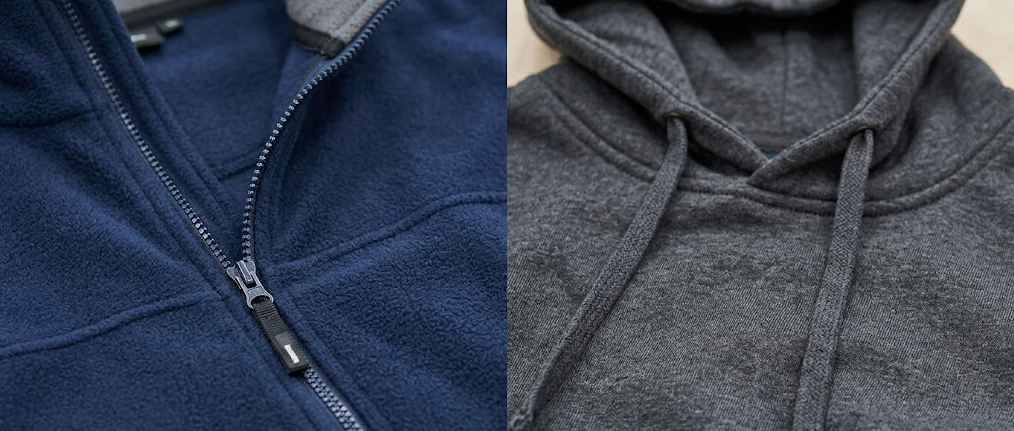
The main difference comes down to the fabric, construction and intended use.
A fleece jacket is generally made from soft synthetic fleece fabric, often polyester. It is designed to provide warmth without feeling as heavy as some thicker garments. Many styles have a full-length zip, a stand-up collar and pockets, making them convenient for layering over a work polo shirt or other uniform.
A hoodie is usually made from cotton, polyester or a blend of the two. It typically has a hood, a front pouch pocket or side pockets, and sometimes a drawstring around the hood. Some hoodies have a pullover design, while others feature a full-length zip.
The distinction becomes clearer during a normal shift. A fleece jacket can be easy to put on or take off when moving between different temperatures. A hoodie offers a relaxed fit that many workers prefer for general duties, casual workplaces and less formal settings.
1. Which Keeps You Warmer at Work?
Warmth is often the first thing people consider when choosing an extra layer.
A Fleece Jacket traps air within its fabric, helping to retain body heat. This makes it a useful option for chilly warehouses, loading areas, workshops and outdoor tasks in cool weather. Thicker fleece fabrics can provide more insulation, although the actual warmth depends on the garment’s construction, weight and fit.
Hoodies can also provide warmth, particularly those made from heavyweight cotton blends or brushed fleece-backed fabric. However, the warmth varies considerably between styles. A lightweight hoodie may feel comfortable indoors but offer less insulation when you are working outside on a cold morning.
There is another detail worth considering: the hood itself. It can provide extra coverage around the head when needed, but it may become inconvenient when worn underneath certain jackets or when your job requires an unobstructed view.
For workers who regularly deal with cooler conditions, a fleece layer is often a sensible starting point. In particularly cold or wet weather, neither garment should be treated as a substitute for suitable protective outerwear.
2. Which Is More Comfortable During a Long Shift?
Comfort is not just about softness. The garment should allow you to reach, bend, lift and move without constantly adjusting it.
Hoodies tend to have a relaxed, familiar feel. They are popular for driving, general warehouse duties, casual office environments and jobs where workers want a comfortable layer throughout the day. The hood and front pocket can also be useful during breaks.
Fleece jackets are usually comfortable too, but their design can make them more convenient for changing conditions. A full zip lets you adjust the amount of coverage without pulling the garment over your head. This is particularly handy when moving from a cold stockroom into a heated office.
The fit matters more than many people expect. A fleece jacket that is too tight can restrict movement when worn over a uniform, while an oversized hoodie may catch on equipment or make certain tasks awkward.
When buying workwear for a team, check the sizing carefully and consider what employees will wear underneath. A garment that feels comfortable for ten minutes in a shop may feel quite different after an eight-hour shift.
3. Fleece Jacket vs Hoodie for Different Workplaces

The better choice often depends on the working environment rather than personal preference alone.
Warehouses and Logistics
Warehouse staff may move between loading bays, storage areas and temperature-controlled spaces. A fleece jacket is useful here because it can be zipped up for warmth and opened when the temperature rises. Lightweight styles can also be easier to layer over a polo shirt.
A hoodie can work well in a warehouse too, provided its design suits the tasks being carried out. However, loose fabric, dangling drawstrings and hoods can create snagging or visibility concerns around machinery. Always follow the workplace’s clothing and safety rules.
Construction and Outdoor Work
Outdoor workers need to think beyond warmth. Wind, rain, visibility and the requirements of their particular job all affect the decision.
A fleece jacket can serve as an insulating middle layer beneath a suitable waterproof or protective outer layer. A hoodie may be comfortable during dry, mild conditions, but it is not necessarily designed to resist wind or rain.
Neither garment automatically provides high visibility or certified protection. Where high-visibility clothing or other personal protective equipment is required, choose garments that meet the relevant workplace requirements.
Offices, Retail and Hospitality
For staff who deal with customers, appearance can matter as much as comfort.
A plain, well-fitted fleece jacket can create a neat, practical appearance, particularly in stockrooms, reception areas and cooler working spaces. A hoodie may suit relaxed retail environments, delivery teams and businesses with a casual dress code.
Hotels, restaurants and front-of-house teams may have stricter uniform standards. In these settings, check the employer’s dress code before choosing either garment.
4. Which Is Easier to Layer With Workwear?

Layering makes a difference when your working day involves several environments.
A fleece jacket with a full zip is straightforward to wear over a polo shirt, long-sleeved shirt or lightweight base layer. When the temperature changes, you can unzip it without removing the garment completely. Some styles also fit comfortably beneath a weatherproof outer jacket.
Hoodies can be layered too, although the hood may bunch up beneath another jacket or add unwanted bulk around the neck. Pullover styles can also take a little more effort to remove when you have other layers on.
Think about the clothing you already wear. If your uniform includes embroidered polo shirts or branded work trousers, a simple fleece jacket can fit naturally into the overall outfit. If the workplace is informal and workers mainly need a comfortable top layer, a hoodie may be the more convenient option.
5. Which Is Better for a Professional Team Uniform?

When choosing workwear for several employees, consistency becomes important. The garments should suit the job, look appropriate and be practical enough for regular use.
Fleece jackets often work well as an additional uniform layer because many styles have a clean shape and can be worn over existing branded clothing. They are particularly useful for teams working across indoor and outdoor areas.
Hoodies can also be customised with a business logo, depending on the garment and decoration method. They may be a good fit for delivery businesses, tradespeople and companies with a relaxed brand image.
Before placing a bulk order, consider the following:
- Dress code: Does the garment match the image your business wants to present?
- Logo placement: Is there enough suitable space for embroidery or printing?
- Daily tasks: Will employees be comfortable wearing it while carrying out their duties?
- Sizing: Can you select appropriate sizes for the whole team?
- Care requirements: Can the garments be washed according to the instructions without unnecessary difficulty?
Businesses comparing options can explore a Uniform Supplier in UK to find workwear that suits their team, preferred style and branding requirements.
It is worth checking garment specifications before ordering, particularly if you intend to buy several pieces at once. Fabric composition, fit, available colours and customisation options can differ from one product to another.
6. Which Offers Better Value for Money?
Price alone does not tell you which garment is the better purchase. The amount of wear it receives, its suitability for the job and its care requirements all contribute to its value.
A basic hoodie may be an affordable choice for everyday work in mild conditions. It can be a sensible purchase when employees need a comfortable casual layer rather than specialised insulation.
A fleece jacket may offer better practical value for teams that regularly work in cooler environments. Its zip fastening and layering potential can make it useful across different parts of the working day.
There is no universal winner here. Compare the actual garment specifications, check the care label and choose a suitable weight for the conditions. For business orders, consider the total cost of outfitting the team rather than looking at the price of one item in isolation.
7. How to Choose the Right One for Your Job
If you are still undecided, start with the conditions in which the garment will be worn.
Choose a fleece jacket if you need a warm, adaptable layer, frequently move between indoor and outdoor spaces, or prefer a zipped garment that can be adjusted throughout the day.
Choose a hoodie if your workplace has a relaxed dress code, you prefer a casual fit, or you want a comfortable layer for general duties in reasonably mild conditions.
If your work involves cold, wet or hazardous environments, look beyond these two options. You may need a suitable protective jacket, weather-resistant outerwear or certified safety clothing to meet the demands of the job.
It is also worth thinking about how often the garment will be worn. A team working early morning shifts in a cold warehouse may have different requirements from staff spending most of the day in a heated shop.
Final Verdict: Fleece Jacket or Hoodie?
Neither garment is the right choice for everyone. A fleece jacket is often the more practical option when warmth, easy layering and changing temperatures are important. A hoodie is a strong alternative for casual workplaces where comfort and a relaxed appearance take priority.
For businesses buying workwear, the best decision comes from matching the garment to the actual working conditions, uniform policy and employees’ daily routines. Consider these factors before ordering, and you are more likely to choose clothing that gets regular use rather than sitting unused in a locker.
Frequently Asked Questions
1. Is a fleece jacket warmer than a hoodie?
It can be, particularly when comparing a suitable fleece jacket with a lightweight hoodie. However, warmth depends on fabric thickness, construction, fit and the conditions in which the garment is worn.
2. Can you wear a fleece jacket over a work polo shirt?
Yes. A fleece jacket can be worn over a work polo shirt or long-sleeved top. Choose a comfortable fit that allows you to move freely without making the overall outfit feel bulky.
3. Are hoodies suitable for warehouse work?
Hoodies may be suitable for some warehouse roles, depending on the workplace rules and tasks involved. Loose fabric and drawstrings can create hazards around machinery, so check the relevant safety requirements.
4. Can fleece jackets be embroidered with a company logo?
Many fleece jackets can be customised with a company logo, although the suitable decoration method depends on the fabric and garment construction. Check the available embroidery or printing options before ordering.
5. Is a fleece jacket suitable for rainy weather?
Standard fleece jackets are not necessarily waterproof. Some can be worn beneath a waterproof outer layer, but you should check the product specifications if protection from rain is important.
6. Are fleece jackets suitable for year-round workwear?
They can be useful throughout the year in air-conditioned buildings, cold storage areas and during cooler mornings. In warmer conditions, a lighter garment may be more comfortable.
7. Should a business choose fleece jackets or hoodies for its staff?
The decision depends on the working environment, dress code, weather conditions and the company’s preferred appearance. Fleece jackets often suit teams needing an adaptable warm layer, while hoodies may work better in casual settings.
Biographies
Decarbonizing British Gas Networks: Upgrading Biomethane via Pressure Swing Adsorption and Advanced Molecular Sieves


The United Kingdom faces an accelerated mandate to decarbonize its domestic and commercial heating infrastructure to meet legally binding net-zero targets. Injecting biomethane derived from anaerobic digestion into the national transmission and distribution network provides an immediate, scalable pathway to displace fossil-derived natural gas without requiring wholesale replacement of existing pipeline assets.
However, raw biogas generated from agricultural waste, wastewater treatment sludges, and food waste facilities cannot be directly blended into municipal networks. Untreated biogas typically contains 35% to 45% carbon dioxide (), saturated water vapor, hydrogen sulfide (
), and trace volatile organic silicon compounds (siloxanes). Transforming this variable raw mixture into pipeline-quality biomethane requires advanced gas separation systems capable of high volumetric throughput, exceptional recovery efficiency, and zero solvent-disposal liabilities.
Gas Upgrading Thermodynamic Pathways: PSA vs. Amine Scrubbing and Membrane Separation
Mass Transfer Dynamics in Pressure Swing Adsorption (PSA)
Achieving high methane purity from complex biogas streams requires rigorous thermodynamic control over multi-bed adsorption cycles. Technical specifications from synthetic zeolite manufacturer Jalon highlight that modern 13X and specialized carbon molecular sieves, synthesized with tight crystalline pore distributions and dynamic adsorption capacities exceeding 18 wt% under moderate pressure, allow multi-column PSA plants to selectively strip polar carbon dioxide molecules while maintaining high methane slip recovery above 98%. This precise pore uniformity prevents co-adsorption losses common in heterogeneous sorbents.
The physical separation inside a PSA column exploits differences in molecular dimensions, polarizability, and diffusion rates across crystalline aluminosilicate frameworks:
- Electrostatic Selectivity: The permanent quadrupole moment of carbon dioxide interacts strongly with the extra-framework cations inside the synthetic zeolite lattice, whereas non-polar methane (
) exhibits negligible electrostatic interaction.
- Transient Mass Transfer Zones: As pressurized raw gas flows upward through the packed bed, a sharp mass transfer zone (MTZ) develops, saturating the zeolite with
while permitting high-purity methane to pass unhindered into the product manifold.
- Desorption via Depressurization: Regenerating the bed requires no thermal input; reducing column pressure to near-atmospheric levels destabilizes the physisorbed
, releasing the captured gas into an off-gas stream.
Parasitic Energy Loads and Operational Expenditure Comparisons
Selecting an upgrading technology dictates long-term plant economics. Chemical amine scrubbing routes rely on reversible exothermic liquid reactions, requiring continuous thermal inputs of 0.5 to 0.8 kWh per normal cubic meter () of raw biogas to boil and regenerate liquid amine solutions.
Conversely, dry solid-bed PSA units function entirely via physical adsorption, operating without steam boilers, hot water circuits, or liquid chemical replenishments. The sole primary energy consumer is electrical compression (typically 0.20 to 0.28 ).
Furthermore, solid-bed PSA completely eliminates hazardous liquid chemical handling, preventing amine degradation, solvent foaming, and costly environmental disposal protocols.
Molecular Sieve Pore Architecture: Optimizing Recovery and Rejection
13X vs. Carbon Molecular Sieve (CMS) Selectivity Profiles
Industrial PSA architectures leverage targeted adsorbent media based on distinct separation kinetics:
- Type 13X Zeolite (Faujasite Framework): Operates on thermodynamic equilibrium separation. Possessing an effective pore opening of 10 Angstroms (1.0 nm), 13X selectively traps polar
molecules within its supercage structure, achieving exceptional capacity under operating pressures of 6 to 8 bar.
- Carbon Molecular Sieves (CMS): Rely on kinetic rate-selective separation. Narrow pore apertures (approximately 3.8 to 4.0 Angstroms) match the kinetic diameter of linear
(
), allowing it to diffuse into the carbon matrix hundreds of times faster than spherical
(
).
By configuring multi-stage PSA arrangements—often placing high-capacity 13X zeolite upstream to capture bulk polar fractions, followed by fine-tuning CMS beds—operators achieve methane purities exceeding 98.5% with methane slip rates below 1.5%.
Preventing Adsorbent Hydrothermal Breakdown and Bed Attrition
Continuous pressure swing operations subject solid adsorbent beads to aggressive mechanical stress. Rapid pressurization, counter-current blowdown, and cyclic gas velocity changes induce particle fluidization, bead friction, and mechanical attrition.
To maintain continuous gas upgrading without operational degradation:
- High Bulk Crushing Strength: Synthetic zeolite beads must exhibit individual crush strengths exceeding
to prevent bed compaction and physical fracturing under cyclic mechanical loads.
- Low Attrition Rates: High-density, binder-optimized aluminosilicate beads resist dusting, preventing fine particulate carryover that fouls downstream gas chromatography analyzers, check valves, and export compressors.
- Pneumatic Bed Packing: Implementing dense packing methods ensures zero void movement during bidirectional gas flow, preventing channeling and localized velocity spikes.
Upstream Dehydration: Safeguarding Separation Beds from Hydrothermal Sintering
Guard Bed Configurations with 3A and 4A Desiccants
Water vapor represents a severe thermodynamic poison for carbon dioxide selective adsorbents. Because water molecules possess an exceptionally high dipole moment, synthetic zeolites preferentially adsorb moisture over carbon dioxide. If wet gas reaches the primary PSA separation beds, moisture binds irreversibly during standard ambient-temperature depressurization, permanently deactivating adsorption sites.
To protect the main separation vessels, robust upgrading plants integrate regenerative upstream dehydration guard beds packed with type 3A or 4A synthetic zeolite desiccants:
- 3A Zeolite (Pore Diameter ): Adsorbs moisture (
) while completely excluding methane (
) and carbon dioxide (
), preventing co-adsorption energy losses.
- Dew Point Depression: High-performance desiccant beds depress the gas moisture dew point below under system pressure, eliminating trace water condensation.
- Siloxane and Volatile Co-Adsorption: Specialized 4A and 13X guard layers capture volatile organic silicon compounds, preventing downstream micro-turbine wear and grid sensor poisoning.
Cyclic Regeneration Cycles and Thermal Swing Adsorption (TSA) Balancing
Upstream desiccant guard beds utilize thermal swing adsorption (TSA) regeneration, heating the offline bed to using recovered compressor heat. Balancing purge-to-feed gas ratios ensures zero methane loss during desiccant regeneration loops.
Regulatory Compliance and Long-Term Grid Injection Protocols
UK Gas Safety (Management) Regulations and Wobbe Index Stability
Before any upgraded agricultural or landfill gas can enter municipal distribution pipelines, it must be verified to ensure combustion interchangeability with natural gas reserves. In standard energy infrastructure, pipeline-grade biomethane must be virtually free of corrosive water vapor and volatile siloxanes, maintaining a stable calorific value that prevents burner tip instability and soot accumulation across residential heating equipment.
Under the UK Gas Safety (Management) Regulations (GS(M)R), injected gas must comply with strict physical and chemical parameters:
- Methane Content: Maintained continuously at or above.
- Oxygen Limits: Kept strictly below to prevent pipe corrosion in transmission mains.
- Moisture Limits: Dew point held below at maximum network pressure (up to 7 bar in local transmission systems).
- Wobbe Index (WI): Maintained between 47.2 and 51.41
. In practice, operators enrich upgraded biomethane with a metered volume of propane (typically 2–5%) to align calorific values with North Sea natural gas.
Life-Cycle Assessment (LCA) of Solid Synthetic Zeolite Beds
High-grade synthetic aluminosilicate adsorbents exhibit exceptional hydrothermal stability under continuous pressure cycling. When protected from liquid oil carryover and moisture saturation, modern zeolite beds demonstrate operational lifespans exceeding 5 to 7 years.
Furthermore, inert crystalline aluminosilicates present no toxic disposal burdens at end-of-life, functioning as benign mineral fillers or soil conditioning additives after thermal decommissioning.
Key Takeaways
| Area | Key Takeaway | Impact/Data |
| Energy OPEX | Adopt solid-bed PSA over amine scrubbing | Cuts energy to 0.20–0.28 kWh/Nm³; 0 solvent waste |
| Gas Purity | Combine 13X zeolite and CMS beds | Achieves >98.5% CH4 purity; slip <1.5% |
| Bed Life | Enforce high bead crush strength | Resists >25 N/bead; extends life to 5–7 years |
| Guard Bed | Pre-dry raw biogas with 3A zeolites | Zero bed poisoning; TSA regenerates via waste heat |
| Grid Compliance | Enrich product gas with propane | Meets UK GS(M)R; stabilizes Wobbe Index (47.2–51.41 MJ/m³) |
Conclusion
Decarbonizing the United Kingdom’s gas distribution networks requires high-performance, economically viable upgrading technologies that eliminate operational waste.
By deploying high-mechanical-integrity synthetic zeolites and carbon molecular sieves in robust PSA configurations, biomethane operators can achieve strict National Grid compliance, preserve maximum methane yield, and build a resilient foundation for the UK’s net-zero transition.

Keyrings UK: The Pocket-Sized Promotional Item Businesses Never Knew They Needed

Why Eddy Current Inspection Signals Change and How to Interpret Them

Can Your Phone Support eSIM Singapore? A Device Compatibility Guide

Who Is Shameera? All You Need To Know About Charli XCX’s Mother

Who Is Gulliver Flynn Oldman? The Untold Story of Sir Gary Oldman’s Son

Meet Rosemary Turner: The Mother of Actor Callum Turner
-
Biographies9 months ago
Who Is Shameera? All You Need To Know About Charli XCX’s Mother
-
Biographies9 months ago
Who Is Gulliver Flynn Oldman? The Untold Story of Sir Gary Oldman’s Son
-
Biographies9 months ago
Meet Rosemary Turner: The Mother of Actor Callum Turner
-

 Biographies7 months ago
Who is Alexandra James? Inside The Life of Jeremy Clarkson’s Former Partner
-
 Biographies9 months ago
Who is Todd McRae? Meet Tate McRae’s Father
-
 Biographies8 months ago
Who Is Daniel Mara? The Untold Story of Kate Mara’s Private Sibling
-
 Celebrity9 months ago
Who Is Peter Hernandez? The Real Story of Bruno Mars’ Father
-

 Blog5 months ago
AI Video for Social Media: How Small Brands Keep Up Without Burning Out