
Biographies
Who is Mehar Sethi? The Untold Story of Mamie Gummer’s Former Husband


Mehar Sethi is an American television writer, producer, and showrunner known for his work on popular series like BoJack Horseman, Rick and Morty, and Welcome to Chippendales. Born on April 2, 1982, in New York City, he built a strong career in Hollywood through creative storytelling and production. Alongside his professional success, Mehar also gained public attention for his marriage to actress Mamie Gummer, daughter of Meryl Streep, and their later divorce in 2026.
Profile Summary
| Field | Details |
|---|---|
| Full Name | Meharban Singh Sethi |
| Known As | Mehar Sethi |
| Date of Birth | April 2, 1982 |
| Age (2026) | 44 years |
| Birthplace | New York City, New York, USA |
| Nationality | American |
| Ethnicity | Indian-American (Punjabi, North Indian roots) |
| Profession | Television Writer, Producer, Showrunner |
| Years Active | 2009 – Present |
| Famous For | BoJack Horseman, Rick and Morty, Welcome to Chippendales |
| Education | Studied in the United States (focus on writing and media) |
| Religion | Not publicly confirmed (Sikh background implied) |
| Marital Status | Divorced |
| Ex-Wife | Mamie Gummer |
| Children | Peter Sethi, Mary Sethi |
| Residence | Los Angeles, California, USA |
| Height | Approx. 5 ft 9 in (175 cm) |
| Weight | Approx. 74 kg (163 lbs) |
| Net Worth | $2 million – $3 million (estimated) |
| Social Media | Not active |
Mehar Sethi’s Early Life, Identity, Family Background, and Education
Growing up, Mehar Sethi lived in an Indian-American household with Punjabi roots. On one side, he had traditional values from his family. On the other side, he was living in the fast-moving American culture of New York.
This mix of cultures helped shape how he thinks and writes. Many people believe this is one reason his storytelling feels fresh and different. He learned to see life from more than one point of view, which is very helpful when creating characters and stories.
When it comes to his education, not many details are public. What we do know is that he studied in the United States and showed early interest in writing and storytelling. He focused on creative writing, media, and storytelling skills. After finishing his studies, he made a big move to Los Angeles to follow his dream of working in television.
Mehar Sethi’s Career Journey, Television Work List, and Scriptwriting Milestones
Like many people in Hollywood, Mehar Sethi did not start at the top. He began with small roles, learning how the industry works. One of his early jobs was working on The Cleveland Show between 2009 and 2011. Here, he worked as a writing assistant and story editor. This was an important step because it gave him real experience inside a writers’ room.
Soon after, he worked on It’s Always Sunny in Philadelphia in 2012. Around the same time, he also worked on projects like Archer and China, IL. These early roles helped him build confidence and skills.
His career really started to grow when he joined bigger and more popular shows. One of his biggest projects was BoJack Horseman, where he worked for many years. He worked on many episodes and helped shape the tone of the series. He also worked on Rick and Morty as a supervising producer, which added to his strong reputation in the industry.
Over time, Mehar Sethi moved into bigger roles. He worked as a producer, then executive producer, and later co-executive producer. Shows like The Mick, Flaked, Another Period, and The Harper House show how wide his work range is. He did not stay in one style. Instead, he explored comedy, animation, and live-action stories.
Mehar Sethi’s Latest Projects, Awards, Industry Recognition, Media Appearances, and Public Persona
In recent years, Mehar Sethi has taken on even bigger roles. In 2025, he worked on Deli Boys and Long Story Short as a co-executive producer. These projects were connected to Disney’s Onyx Collective and Hulu, which shows how trusted he has become in the industry. He also worked on Welcome to Chippendales and Undone, which added to his strong list of projects.
One of his biggest achievements came in 2026. He won a Writers Guild of America Award for animation for his work on the episode Shira Can’t Cook. This award is a big deal in the writing world. It shows that his work is not just popular but also respected by other professionals.
Even though he is successful, Mehar Sethi is not someone who is always in the spotlight. He does not use public social media platforms like Instagram or Twitter. Instead, he focuses on his work. He does appear at events sometimes, like industry panels and red carpet shows, but he keeps his personal life very private. This makes him different from many people in Hollywood.
Meet His Ex-Wife: Mamie Gummer And Her Bond With Him

To understand more about Mehar Sethi’s personal life, it is important to know about Mamie Gummer. She is an American actress and the daughter of famous actress Meryl Streep and sculptor Don Gummer. Mamie Gummer was born on August 3, 1983, in New York City.
She grew up in a creative family and built her own career in acting. She studied at schools like Miss Porter’s School and later attended Northwestern University. She also trained at the British Academy of Dramatic Arts. Over time, she worked in TV shows like The Good Wife and True Detective, and films like Ricki and the Flash.
Before meeting Mehar Sethi, Mamie Gummer was married to actor Benjamin Walker. That marriage ended in 2013. Later, she met Mehar Sethi, and their bond grew slowly. People close to them often said their relationship was based on mutual respect. He respected her acting work, and she admired his writing talent.
Mehar Sethi and Mamie Gummer Marriage, Relationship and How They Met?
The story of Mehar Sethi and Mamie Gummer began around 2017 in Los Angeles. They met through shared connections in the entertainment industry.
Their relationship stayed private for a long time. After about a year and a half of dating, they got engaged in August 2018 during a trip to Croatia. Just a few months later, in December 2018, news came out that they were expecting their first child. This was a big moment, especially for Mamie’s family, as it meant Meryl Streep would become a grandmother.
In February 2019, they got married in a private ceremony. Soon after, they welcomed their son, Peter Sethi. A few years later, in 2021, their daughter Mary Sethi was born. During this time, they made a few public appearances together, including events like the True Detective premiere and the Cadillac Oscar Week celebration.
All About Divorce, Separations and Co Parenting
As we saw in the previous section, the relationship between Mehar Sethi and Mamie Gummer looked strong for many years. They built a family and kept their life private. But things slowly changed behind the scenes.
According to legal records, the couple officially separated on May 6, 2023. What is important here is that they did not make this public right away. They chose to stay quiet and protect their children. Even after separating, they still appeared together in public. For example, they attended the Disney Studios Bluey “The Sign” event in April 2024 with their kids. This shows they were trying to keep things stable for their family.
After living apart for some time, Mamie Gummer filed for divorce on February 6, 2025, in a Los Angeles court. She listed “irreconcilable differences” as the reason. This is a common legal term. It simply means the couple could not solve their personal differences. In her filing, she asked for joint legal and physical custody of their children, Peter Sethi and Mary Sethi.
The divorce process lasted over a year. Finally, on April 24, 2026, the divorce was officially completed. The settlement was kept private. This decision helped protect their children from media attention.
Even after the divorce, both parents continued to work together. They agreed on joint legal custody, which means they both make important decisions for their children. They also agreed on joint physical custody, so the children spend time with both parents. This shows that even though their marriage ended, their role as parents stayed strong.
Mehar Sethi’s Net Worth, Income Sources, Residence, Lifestyle, and Where He Is Now?
After understanding his personal life, let’s look at where Mehar Sethi stands today. As of 2026, he continues to live in Southern California, close to Los Angeles. This helps him stay connected to the entertainment industry while also being near his children.
His net worth is estimate to be around 2 million to 3 million dollars. This comes mainly from his work in television. As a writer, producer, and showrunner, he earns money from different sources. These include project fees, writing payments, and long-term earnings from shows that keep streaming.
Think about shows like BoJack Horseman or Rick and Morty. Because of this, creators like Mehar Sethi continue to earn income over time. This is residual income, and it is a big part of his financial success.
He also works on new ideas and scripts for streaming platforms. This adds another steady income source for him. When it comes to lifestyle, Mehar Sethi keeps things simple and private.
Final Thoughts
When you look at the full story, Mehar is more than just a name linked to Hollywood. He is someone who built his career step by step. He started with small roles and slowly became a respected writer and producer in the television world.
At the same time, his personal life shows another side of him. His marriage with Mamie Gummer brought him into a well-known Hollywood family. But even during public attention, he stayed private and focused on what matters most.
FAQs
What is Mehar Sethi’s age in 2026?
Mehar Sethi is 44 years old as of 2026. He was born on April 2, 1982, in New York City.
How tall is Mehar Sethi?
Mehar Sethi is approximately 5 feet 9 inches tall, which is about 175 centimeters.
Who are Mehar Sethi’s parents?
Details about Mehar Sethi’s parents are private. but he was raised in an Indian-American family with Punjabi roots.
Was Mehar Sethi married to Mamie Gummer?
Yes, Mehar Sethi was married to actress Mamie Gummer. They got married in 2019 and later divorced in April 2026 after separating in 2023.
What is Mehar Sethi’s net worth?
Mehar Sethi’s estimated net worth is between $2 million and $3 million. His income mainly comes from his work as a writer, producer, and showrunner in television.


When you are leaving home, what is usually the last thing you grab? Most likely, you reach for a jacket and, of course, the keys to your home, office, car, or locker. For sure, those keys come with a little charm or some attachment. Entrepreneurs in the UK can take advantage of this to make custom-branded or personalised keyrings to promote their business.
Basically, keyrings in the UK come with a unique style, colour, and some personality, which makes life a bit more interesting for customers. If you are looking forward to using these pocket-sized promotional items to take your brand to the next level, here are a few tips to follow.
Go for Materials That Last
There are various types of keyrings available on the UK market, and they come in different materials. While some are built to withstand daily use, others may not last long. Before choosing, ask yourself this: can the material survive daily life?
Stainless steel, for example, offers excellent corrosion resistance, making it a great option for everyday keyrings. Choose the right material for your keyrings UK business order, and it will withstand everyday wear and tear.
Keyrings in the UK Are a Smart Choice for Business Branding
Customers must use your promotional product repeatedly for your marketing strategy to be effective. Keyrings in the UK are just what you need. They are seen frequently, especially when customers carry them around.
If you are looking for the best keyrings UK vendor, you need to do your research thoroughly. Also, we advise you to order in bulk so that you can cut costs.
Trends Worth Watching
If you have the kind of business that focuses on style, you need to understand the latest trends. What are people buying most right now? If chunky beaded charms from social media are catching on fast, then this is your go-to choice. If simple brass is what is selling most, you have your answer.
Many keyrings UK sellers change their ranges with each season; this means you can always grab something fresh for your business.
Practical Features That Matter
We agree that style is important. But what does the keyring actually do for your customers? The best keyrings UK shoppers pick often have a clip that pops off fast so that you can free your car keys in seconds. Some have a bottle opener for picnics or a tiny torch for that dark front door.
A tracker holder helps you find lost keys using your phone. Good looks matter, but a keyring should not make a customer’s pocket bulky.
Souvenirs and Local Pride
If your keyrings celebrate a business achievement, this is what customers will go for. Some keyrings UK fans like London landmarks, Scottish thistle, and the like. This type of keyring can easily bring back a memory each time the user opens their front door.
Why not pick one made by a small British manufacturer? Many sell limited runs so that your business feels special and the money stays in local hands.
Buying Keyrings in the UK Safely Online
Before purchasing keyrings in the UK, you need to ensure that the shop is legit. You can check things like the security of the payment method, the delivery dates, the materials used to make the keyrings, and even the company’s reputation. This will help you cut costs for your business and achieve your marketing goals with ease.
Conclusion
A good keyring says a lot about your business. It adds a bit of fun, holds your keys securely, and shows what you care about as a company. Check the size, the appearance, and what it’s made of before you buy. Want one that lasts? Browse the keyrings UK range and grab a design you really like. Your customers’ keys deserve it.


Choosing between a fleece jacket and a hoodie might seem like a small decision, but it can make a noticeable difference during a working day. The right option depends on where you work, how much you move around and whether you need an extra layer against the cold. If you are planning to Buy Fleece Jacket in UK, it helps to understand how fleece compares with a hoodie before deciding which one belongs in your workwear wardrobe.
Both garments have their place in the workplace. A hoodie is a familiar choice for everyday comfort, while a fleece jacket can be more practical when temperatures drop or you spend time moving between indoor and outdoor areas. Neither is automatically better for every job. Let us look at their differences and where each one makes the most sense.
What Is the Difference Between a Fleece Jacket and a Hoodie?
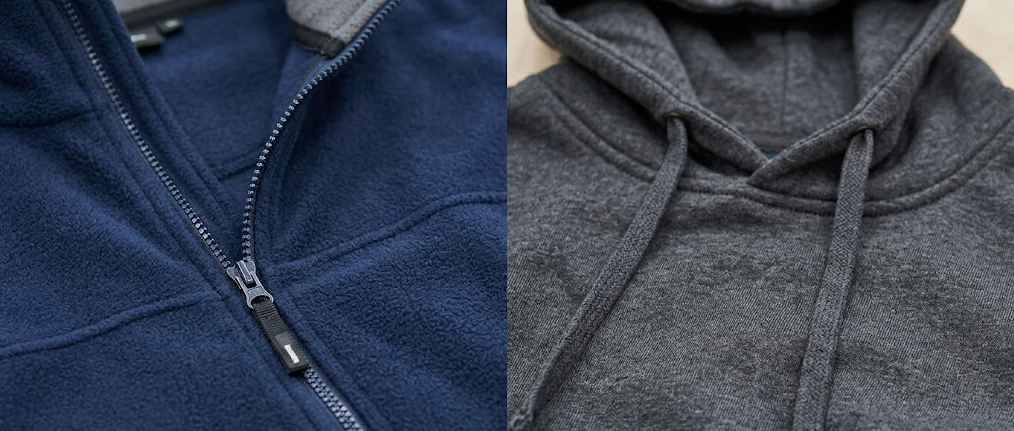
The main difference comes down to the fabric, construction and intended use.
A fleece jacket is generally made from soft synthetic fleece fabric, often polyester. It is designed to provide warmth without feeling as heavy as some thicker garments. Many styles have a full-length zip, a stand-up collar and pockets, making them convenient for layering over a work polo shirt or other uniform.
A hoodie is usually made from cotton, polyester or a blend of the two. It typically has a hood, a front pouch pocket or side pockets, and sometimes a drawstring around the hood. Some hoodies have a pullover design, while others feature a full-length zip.
The distinction becomes clearer during a normal shift. A fleece jacket can be easy to put on or take off when moving between different temperatures. A hoodie offers a relaxed fit that many workers prefer for general duties, casual workplaces and less formal settings.
1. Which Keeps You Warmer at Work?
Warmth is often the first thing people consider when choosing an extra layer.
A Fleece Jacket traps air within its fabric, helping to retain body heat. This makes it a useful option for chilly warehouses, loading areas, workshops and outdoor tasks in cool weather. Thicker fleece fabrics can provide more insulation, although the actual warmth depends on the garment’s construction, weight and fit.
Hoodies can also provide warmth, particularly those made from heavyweight cotton blends or brushed fleece-backed fabric. However, the warmth varies considerably between styles. A lightweight hoodie may feel comfortable indoors but offer less insulation when you are working outside on a cold morning.
There is another detail worth considering: the hood itself. It can provide extra coverage around the head when needed, but it may become inconvenient when worn underneath certain jackets or when your job requires an unobstructed view.
For workers who regularly deal with cooler conditions, a fleece layer is often a sensible starting point. In particularly cold or wet weather, neither garment should be treated as a substitute for suitable protective outerwear.
2. Which Is More Comfortable During a Long Shift?
Comfort is not just about softness. The garment should allow you to reach, bend, lift and move without constantly adjusting it.
Hoodies tend to have a relaxed, familiar feel. They are popular for driving, general warehouse duties, casual office environments and jobs where workers want a comfortable layer throughout the day. The hood and front pocket can also be useful during breaks.
Fleece jackets are usually comfortable too, but their design can make them more convenient for changing conditions. A full zip lets you adjust the amount of coverage without pulling the garment over your head. This is particularly handy when moving from a cold stockroom into a heated office.
The fit matters more than many people expect. A fleece jacket that is too tight can restrict movement when worn over a uniform, while an oversized hoodie may catch on equipment or make certain tasks awkward.
When buying workwear for a team, check the sizing carefully and consider what employees will wear underneath. A garment that feels comfortable for ten minutes in a shop may feel quite different after an eight-hour shift.
3. Fleece Jacket vs Hoodie for Different Workplaces

The better choice often depends on the working environment rather than personal preference alone.
Warehouses and Logistics
Warehouse staff may move between loading bays, storage areas and temperature-controlled spaces. A fleece jacket is useful here because it can be zipped up for warmth and opened when the temperature rises. Lightweight styles can also be easier to layer over a polo shirt.
A hoodie can work well in a warehouse too, provided its design suits the tasks being carried out. However, loose fabric, dangling drawstrings and hoods can create snagging or visibility concerns around machinery. Always follow the workplace’s clothing and safety rules.
Construction and Outdoor Work
Outdoor workers need to think beyond warmth. Wind, rain, visibility and the requirements of their particular job all affect the decision.
A fleece jacket can serve as an insulating middle layer beneath a suitable waterproof or protective outer layer. A hoodie may be comfortable during dry, mild conditions, but it is not necessarily designed to resist wind or rain.
Neither garment automatically provides high visibility or certified protection. Where high-visibility clothing or other personal protective equipment is required, choose garments that meet the relevant workplace requirements.
Offices, Retail and Hospitality
For staff who deal with customers, appearance can matter as much as comfort.
A plain, well-fitted fleece jacket can create a neat, practical appearance, particularly in stockrooms, reception areas and cooler working spaces. A hoodie may suit relaxed retail environments, delivery teams and businesses with a casual dress code.
Hotels, restaurants and front-of-house teams may have stricter uniform standards. In these settings, check the employer’s dress code before choosing either garment.
4. Which Is Easier to Layer With Workwear?

Layering makes a difference when your working day involves several environments.
A fleece jacket with a full zip is straightforward to wear over a polo shirt, long-sleeved shirt or lightweight base layer. When the temperature changes, you can unzip it without removing the garment completely. Some styles also fit comfortably beneath a weatherproof outer jacket.
Hoodies can be layered too, although the hood may bunch up beneath another jacket or add unwanted bulk around the neck. Pullover styles can also take a little more effort to remove when you have other layers on.
Think about the clothing you already wear. If your uniform includes embroidered polo shirts or branded work trousers, a simple fleece jacket can fit naturally into the overall outfit. If the workplace is informal and workers mainly need a comfortable top layer, a hoodie may be the more convenient option.
5. Which Is Better for a Professional Team Uniform?

When choosing workwear for several employees, consistency becomes important. The garments should suit the job, look appropriate and be practical enough for regular use.
Fleece jackets often work well as an additional uniform layer because many styles have a clean shape and can be worn over existing branded clothing. They are particularly useful for teams working across indoor and outdoor areas.
Hoodies can also be customised with a business logo, depending on the garment and decoration method. They may be a good fit for delivery businesses, tradespeople and companies with a relaxed brand image.
Before placing a bulk order, consider the following:
- Dress code: Does the garment match the image your business wants to present?
- Logo placement: Is there enough suitable space for embroidery or printing?
- Daily tasks: Will employees be comfortable wearing it while carrying out their duties?
- Sizing: Can you select appropriate sizes for the whole team?
- Care requirements: Can the garments be washed according to the instructions without unnecessary difficulty?
Businesses comparing options can explore a Uniform Supplier in UK to find workwear that suits their team, preferred style and branding requirements.
It is worth checking garment specifications before ordering, particularly if you intend to buy several pieces at once. Fabric composition, fit, available colours and customisation options can differ from one product to another.
6. Which Offers Better Value for Money?
Price alone does not tell you which garment is the better purchase. The amount of wear it receives, its suitability for the job and its care requirements all contribute to its value.
A basic hoodie may be an affordable choice for everyday work in mild conditions. It can be a sensible purchase when employees need a comfortable casual layer rather than specialised insulation.
A fleece jacket may offer better practical value for teams that regularly work in cooler environments. Its zip fastening and layering potential can make it useful across different parts of the working day.
There is no universal winner here. Compare the actual garment specifications, check the care label and choose a suitable weight for the conditions. For business orders, consider the total cost of outfitting the team rather than looking at the price of one item in isolation.
7. How to Choose the Right One for Your Job
If you are still undecided, start with the conditions in which the garment will be worn.
Choose a fleece jacket if you need a warm, adaptable layer, frequently move between indoor and outdoor spaces, or prefer a zipped garment that can be adjusted throughout the day.
Choose a hoodie if your workplace has a relaxed dress code, you prefer a casual fit, or you want a comfortable layer for general duties in reasonably mild conditions.
If your work involves cold, wet or hazardous environments, look beyond these two options. You may need a suitable protective jacket, weather-resistant outerwear or certified safety clothing to meet the demands of the job.
It is also worth thinking about how often the garment will be worn. A team working early morning shifts in a cold warehouse may have different requirements from staff spending most of the day in a heated shop.
Final Verdict: Fleece Jacket or Hoodie?
Neither garment is the right choice for everyone. A fleece jacket is often the more practical option when warmth, easy layering and changing temperatures are important. A hoodie is a strong alternative for casual workplaces where comfort and a relaxed appearance take priority.
For businesses buying workwear, the best decision comes from matching the garment to the actual working conditions, uniform policy and employees’ daily routines. Consider these factors before ordering, and you are more likely to choose clothing that gets regular use rather than sitting unused in a locker.
Frequently Asked Questions
1. Is a fleece jacket warmer than a hoodie?
It can be, particularly when comparing a suitable fleece jacket with a lightweight hoodie. However, warmth depends on fabric thickness, construction, fit and the conditions in which the garment is worn.
2. Can you wear a fleece jacket over a work polo shirt?
Yes. A fleece jacket can be worn over a work polo shirt or long-sleeved top. Choose a comfortable fit that allows you to move freely without making the overall outfit feel bulky.
3. Are hoodies suitable for warehouse work?
Hoodies may be suitable for some warehouse roles, depending on the workplace rules and tasks involved. Loose fabric and drawstrings can create hazards around machinery, so check the relevant safety requirements.
4. Can fleece jackets be embroidered with a company logo?
Many fleece jackets can be customised with a company logo, although the suitable decoration method depends on the fabric and garment construction. Check the available embroidery or printing options before ordering.
5. Is a fleece jacket suitable for rainy weather?
Standard fleece jackets are not necessarily waterproof. Some can be worn beneath a waterproof outer layer, but you should check the product specifications if protection from rain is important.
6. Are fleece jackets suitable for year-round workwear?
They can be useful throughout the year in air-conditioned buildings, cold storage areas and during cooler mornings. In warmer conditions, a lighter garment may be more comfortable.
7. Should a business choose fleece jackets or hoodies for its staff?
The decision depends on the working environment, dress code, weather conditions and the company’s preferred appearance. Fleece jackets often suit teams needing an adaptable warm layer, while hoodies may work better in casual settings.
Biographies
Decarbonizing British Gas Networks: Upgrading Biomethane via Pressure Swing Adsorption and Advanced Molecular Sieves


The United Kingdom faces an accelerated mandate to decarbonize its domestic and commercial heating infrastructure to meet legally binding net-zero targets. Injecting biomethane derived from anaerobic digestion into the national transmission and distribution network provides an immediate, scalable pathway to displace fossil-derived natural gas without requiring wholesale replacement of existing pipeline assets.
However, raw biogas generated from agricultural waste, wastewater treatment sludges, and food waste facilities cannot be directly blended into municipal networks. Untreated biogas typically contains 35% to 45% carbon dioxide (), saturated water vapor, hydrogen sulfide (
), and trace volatile organic silicon compounds (siloxanes). Transforming this variable raw mixture into pipeline-quality biomethane requires advanced gas separation systems capable of high volumetric throughput, exceptional recovery efficiency, and zero solvent-disposal liabilities.
Gas Upgrading Thermodynamic Pathways: PSA vs. Amine Scrubbing and Membrane Separation
Mass Transfer Dynamics in Pressure Swing Adsorption (PSA)
Achieving high methane purity from complex biogas streams requires rigorous thermodynamic control over multi-bed adsorption cycles. Technical specifications from synthetic zeolite manufacturer Jalon highlight that modern 13X and specialized carbon molecular sieves, synthesized with tight crystalline pore distributions and dynamic adsorption capacities exceeding 18 wt% under moderate pressure, allow multi-column PSA plants to selectively strip polar carbon dioxide molecules while maintaining high methane slip recovery above 98%. This precise pore uniformity prevents co-adsorption losses common in heterogeneous sorbents.
The physical separation inside a PSA column exploits differences in molecular dimensions, polarizability, and diffusion rates across crystalline aluminosilicate frameworks:
- Electrostatic Selectivity: The permanent quadrupole moment of carbon dioxide interacts strongly with the extra-framework cations inside the synthetic zeolite lattice, whereas non-polar methane (
) exhibits negligible electrostatic interaction.
- Transient Mass Transfer Zones: As pressurized raw gas flows upward through the packed bed, a sharp mass transfer zone (MTZ) develops, saturating the zeolite with
while permitting high-purity methane to pass unhindered into the product manifold.
- Desorption via Depressurization: Regenerating the bed requires no thermal input; reducing column pressure to near-atmospheric levels destabilizes the physisorbed
, releasing the captured gas into an off-gas stream.
Parasitic Energy Loads and Operational Expenditure Comparisons
Selecting an upgrading technology dictates long-term plant economics. Chemical amine scrubbing routes rely on reversible exothermic liquid reactions, requiring continuous thermal inputs of 0.5 to 0.8 kWh per normal cubic meter () of raw biogas to boil and regenerate liquid amine solutions.
Conversely, dry solid-bed PSA units function entirely via physical adsorption, operating without steam boilers, hot water circuits, or liquid chemical replenishments. The sole primary energy consumer is electrical compression (typically 0.20 to 0.28 ).
Furthermore, solid-bed PSA completely eliminates hazardous liquid chemical handling, preventing amine degradation, solvent foaming, and costly environmental disposal protocols.
Molecular Sieve Pore Architecture: Optimizing Recovery and Rejection
13X vs. Carbon Molecular Sieve (CMS) Selectivity Profiles
Industrial PSA architectures leverage targeted adsorbent media based on distinct separation kinetics:
- Type 13X Zeolite (Faujasite Framework): Operates on thermodynamic equilibrium separation. Possessing an effective pore opening of 10 Angstroms (1.0 nm), 13X selectively traps polar
molecules within its supercage structure, achieving exceptional capacity under operating pressures of 6 to 8 bar.
- Carbon Molecular Sieves (CMS): Rely on kinetic rate-selective separation. Narrow pore apertures (approximately 3.8 to 4.0 Angstroms) match the kinetic diameter of linear
(
), allowing it to diffuse into the carbon matrix hundreds of times faster than spherical
(
).
By configuring multi-stage PSA arrangements—often placing high-capacity 13X zeolite upstream to capture bulk polar fractions, followed by fine-tuning CMS beds—operators achieve methane purities exceeding 98.5% with methane slip rates below 1.5%.
Preventing Adsorbent Hydrothermal Breakdown and Bed Attrition
Continuous pressure swing operations subject solid adsorbent beads to aggressive mechanical stress. Rapid pressurization, counter-current blowdown, and cyclic gas velocity changes induce particle fluidization, bead friction, and mechanical attrition.
To maintain continuous gas upgrading without operational degradation:
- High Bulk Crushing Strength: Synthetic zeolite beads must exhibit individual crush strengths exceeding
to prevent bed compaction and physical fracturing under cyclic mechanical loads.
- Low Attrition Rates: High-density, binder-optimized aluminosilicate beads resist dusting, preventing fine particulate carryover that fouls downstream gas chromatography analyzers, check valves, and export compressors.
- Pneumatic Bed Packing: Implementing dense packing methods ensures zero void movement during bidirectional gas flow, preventing channeling and localized velocity spikes.
Upstream Dehydration: Safeguarding Separation Beds from Hydrothermal Sintering
Guard Bed Configurations with 3A and 4A Desiccants
Water vapor represents a severe thermodynamic poison for carbon dioxide selective adsorbents. Because water molecules possess an exceptionally high dipole moment, synthetic zeolites preferentially adsorb moisture over carbon dioxide. If wet gas reaches the primary PSA separation beds, moisture binds irreversibly during standard ambient-temperature depressurization, permanently deactivating adsorption sites.
To protect the main separation vessels, robust upgrading plants integrate regenerative upstream dehydration guard beds packed with type 3A or 4A synthetic zeolite desiccants:
- 3A Zeolite (Pore Diameter ): Adsorbs moisture (
) while completely excluding methane (
) and carbon dioxide (
), preventing co-adsorption energy losses.
- Dew Point Depression: High-performance desiccant beds depress the gas moisture dew point below under system pressure, eliminating trace water condensation.
- Siloxane and Volatile Co-Adsorption: Specialized 4A and 13X guard layers capture volatile organic silicon compounds, preventing downstream micro-turbine wear and grid sensor poisoning.
Cyclic Regeneration Cycles and Thermal Swing Adsorption (TSA) Balancing
Upstream desiccant guard beds utilize thermal swing adsorption (TSA) regeneration, heating the offline bed to using recovered compressor heat. Balancing purge-to-feed gas ratios ensures zero methane loss during desiccant regeneration loops.
Regulatory Compliance and Long-Term Grid Injection Protocols
UK Gas Safety (Management) Regulations and Wobbe Index Stability
Before any upgraded agricultural or landfill gas can enter municipal distribution pipelines, it must be verified to ensure combustion interchangeability with natural gas reserves. In standard energy infrastructure, pipeline-grade biomethane must be virtually free of corrosive water vapor and volatile siloxanes, maintaining a stable calorific value that prevents burner tip instability and soot accumulation across residential heating equipment.
Under the UK Gas Safety (Management) Regulations (GS(M)R), injected gas must comply with strict physical and chemical parameters:
- Methane Content: Maintained continuously at or above.
- Oxygen Limits: Kept strictly below to prevent pipe corrosion in transmission mains.
- Moisture Limits: Dew point held below at maximum network pressure (up to 7 bar in local transmission systems).
- Wobbe Index (WI): Maintained between 47.2 and 51.41
. In practice, operators enrich upgraded biomethane with a metered volume of propane (typically 2–5%) to align calorific values with North Sea natural gas.
Life-Cycle Assessment (LCA) of Solid Synthetic Zeolite Beds
High-grade synthetic aluminosilicate adsorbents exhibit exceptional hydrothermal stability under continuous pressure cycling. When protected from liquid oil carryover and moisture saturation, modern zeolite beds demonstrate operational lifespans exceeding 5 to 7 years.
Furthermore, inert crystalline aluminosilicates present no toxic disposal burdens at end-of-life, functioning as benign mineral fillers or soil conditioning additives after thermal decommissioning.
Key Takeaways
| Area | Key Takeaway | Impact/Data |
| Energy OPEX | Adopt solid-bed PSA over amine scrubbing | Cuts energy to 0.20–0.28 kWh/Nm³; 0 solvent waste |
| Gas Purity | Combine 13X zeolite and CMS beds | Achieves >98.5% CH4 purity; slip <1.5% |
| Bed Life | Enforce high bead crush strength | Resists >25 N/bead; extends life to 5–7 years |
| Guard Bed | Pre-dry raw biogas with 3A zeolites | Zero bed poisoning; TSA regenerates via waste heat |
| Grid Compliance | Enrich product gas with propane | Meets UK GS(M)R; stabilizes Wobbe Index (47.2–51.41 MJ/m³) |
Conclusion
Decarbonizing the United Kingdom’s gas distribution networks requires high-performance, economically viable upgrading technologies that eliminate operational waste.
By deploying high-mechanical-integrity synthetic zeolites and carbon molecular sieves in robust PSA configurations, biomethane operators can achieve strict National Grid compliance, preserve maximum methane yield, and build a resilient foundation for the UK’s net-zero transition.

ETIAS delayed again: why travelers shouldn’t plan around rumored dates

How a Seneca Cost Segregation Study Helped This US Commercial Investor Unlock $180K in Year-One Tax Savings

Antioxidants and Everyday Wellness: A Clear, Evidence-Led Overview

Who Is Shameera? All You Need To Know About Charli XCX’s Mother

Who Is Gulliver Flynn Oldman? The Untold Story of Sir Gary Oldman’s Son

AI Video for Social Media: How Small Brands Keep Up Without Burning Out
-
Biographies9 months ago
Who Is Shameera? All You Need To Know About Charli XCX’s Mother
-
Biographies9 months ago
Who Is Gulliver Flynn Oldman? The Untold Story of Sir Gary Oldman’s Son
-
 Blog5 months ago
AI Video for Social Media: How Small Brands Keep Up Without Burning Out
-
 Biographies10 months ago
Meet Rosemary Turner: The Mother of Actor Callum Turner
-

 Biographies8 months ago
Who is Alexandra James? Inside The Life of Jeremy Clarkson’s Former Partner
-
 Biographies10 months ago
Who is Todd McRae? Meet Tate McRae’s Father
-
 Biographies9 months ago
Who Is Daniel Mara? The Untold Story of Kate Mara’s Private Sibling
-
 Celebrity10 months ago
Who Is Peter Hernandez? The Real Story of Bruno Mars’ Father