
Biographies
Who Is Barbara Porter? All You Need to Know About Rick Springfield’s Wife


Barbara Porter is the longtime wife of Rick Springfield, the Grammy-winning singer behind the hit Jessie’s Girl and the actor famous for playing Dr. Noah Drake on General Hospital. Although her husband has spent decades in the spotlight, Barbara Porter has chosen a quiet and private life. She met Rick in the late 1970s at Sound City Studios and married him in 1984. For over forty years, she has been his strongest supporter while raising their two sons and maintaining a stable family life.
Profile Summary: Barbara Porter
| Field | Details |
|---|---|
| Full Name | Barbara Porter Springfield |
| Known As | Barbara Porter |
| Birth Year | Early 1960s (estimated) |
| Age (2026) | Around 62–64 years old |
| Nationality | American |
| Ethnicity | Caucasian |
| Height | Approximately 5’4″–5’6″ |
| Weight | Not publicly disclosed |
| Residence | Malibu, California, USA |
| Profession | Former receptionist, private family figure |
| Famous For | Wife of Rick Springfield |
| Spouse | Rick Springfield (m. October 27, 1984) |
| Children | Liam Springthorpe (b. 1985), Joshua Springthorpe (b. 1989) |
| Net Worth | Estimated $1–4 million (shared household wealth around $10–12 million) |
| Known Traits | Private lifestyle, supportive partner, family-focused |
| Notable Workplace | Sound City Recording Studios, Los Angeles |
Her Early Years
Very little public information exists about the early life of Barbara Porter. Unlike many people connected to celebrities, she has always preferred to keep her personal history private. What is known is that She grew up in the Los Angeles area in the United States.
As a teenager, Barbara worked as a receptionist at Sound City Recording Studios in Los Angeles. This place was very famous in the music world during the 1970s and 1980s. Many rock artists recorded important albums there. At the time, she was simply doing her job, answering phones and helping people who came into the studio.
Barbara’s Marriage and How They Met
The love story between Barbara and Rick Springfield began in the late 1970s at Sound City Studios in Los Angeles. At that time, Rick was recording music at the studio while Barbara Porter worked there as a receptionist. One day, Rick’s manager introduced her to the people in the studio. Rick later said he immediately noticed her appearance and thought she looked like a “mini Brigitte Bardot.”
However, their relationship did not begin right away. Barbara was only 15 years old when they first met, and Rick believed she was too young for a romantic relationship. Years later, their paths crossed again when Rick returned to the studio. This time it was around 1981, when he was recording his breakthrough album Working Class Dog.
By then, Barbara was 18 years old, and Rick had recently ended another relationship. He remembered her from before and decided to take a chance. In what he later described as a brave moment, he called her and asked her out. That decision changed both of their lives. Soon after they started dating, Rick’s song “Jessie’s Girl” became a huge success, and his career exploded almost overnight. Eventually, their relationship became stronger. In October 1984, Barbara and Rick got married in Australia at Rick’s family church.
Meet Her Husband: Rick Springfield

To understand the story of Barbara Porter, it also helps to know more about Rick Springfield’s life and career. Rick was born Richard Lewis Springthorpe on August 23, 1949, in Sydney, Australia. His father, Norman James Springthorpe, was an officer in the Australian Army.
Because of these constant moves between Australia and England, Rick often felt like an outsider when he was young. Music became a way for him to express himself. As a teenager, he started playing guitar and quickly developed a passion for songwriting. Eventually, he joined the Australian band Zoot before starting his solo career.
Rick’s biggest breakthrough came in 1981 with the song “Jessie’s Girl.” The song became a massive hit and earned him a Grammy Award. Around the same time, he also became widely known for his acting role as Dr. Noah Drake on General Hospital. Over the years, he continued to work in both music and television, appearing in shows like Supernatural and True Detective.
Meet Their Children
Family has always been very important to Barbara and Rick Springfield. After their marriage in 1984, the couple focused on building a stable home life. They welcomed their first son, Liam Springthorpe, in 1985. Four years later, their second son, Joshua Springthorpe, was born in 1989. Both children grew up in Malibu, California.
Liam chose a path similar to his father. He became an actor and musician. Over time, he worked on several film and television projects. One special moment happened in 2013 when Liam appeared on General Hospital. In that episode, he shared the screen with his father, Rick Springfield. For many fans, it was a memorable family moment. Liam also writes music and plays guitar, continuing the creative tradition of the Springfield family.
Joshua, the younger son, chose a very different life. Instead of the entertainment industry, he focused on helping others. He studied and later worked as a child therapist.
Barbara’s Public Appearances
Even though Barbara Porter lives a private life, she sometimes joins Rick Springfield at special events. One important moment was in 2014 when Rick received a star on the Hollywood Walk of Fame. Barbara was there to celebrate the achievement with him.
Barbara has also appeared with Rick at charity events and award ceremonies. For example, the couple attended the BAFTA/LA Britannia Awards, which brings together many people from the film and television world. They have also taken part in charity events connected to wildlife protection and humanitarian causes. One example is the Steve Irwin Gala Dinner, which supports conservation work.
Another cause connected to Barbara is support for Doctors Without Borders, a global medical charity. She attended a Malibu event that helped raise awareness for the organization. Barbara Porter also has a few small entertainment credits connected to her name. She was associated with projects such as the film Backyard Dogs and appearances in television programs like E! Behind the Scenes.
Her Life in Malibu
For decades, Barbara and Rick Springfield have lived in Malibu, California. Their home there became the center of family life. Rick once explained that when his career was at its peak in the 1980s, he decided to take a break from constant touring. He wanted to avoid being an absent father.
Like many long marriages, their relationship had challenges. Rick Springfield has openly talked about his struggles with depression and emotional stress. Through these difficult times, She remained by his side. He often calls her his “rock,” meaning she helped keep him steady during hard moments.
An interesting example came during the COVID-19 lockdown in 2020 and 2021. Rick shared that spending more time at home actually made their relationship stronger. They played simple games like Monopoly together and enjoyed quiet time as a couple. In October 2024, Barbara and Rick Springfield celebrated their 40th wedding anniversary.
Final Thoughts
The story of Barbara Porter is very different from many stories connected to celebrity life. She is not famous for acting, singing, or appearing in the media. Instead, she is known for something much deeper. She is the quiet partner who helped build a strong family and supported a long and successful career.
Over the years, Barbara has played a major role in Rick Springfield’s life. From their first meeting at Sound City Studios to their marriage in 1984 and their decades of family life in Malibu, she has remained a constant presence. Rick often says that his life and career might have been very different without her support.
FAQs
Who is Barbara Porter and how is she connected to Rick Springfield?
Barbara Porter is the longtime wife of Rick Springfield. She met him in the late 1970s while working at Sound City Studios in Los Angeles. The couple married in October 1984 and have remained together for more than four decades.
How old is Barbara Porter?
Barbara Porter’s exact birth date is not publicly confirmed. However, most sources estimate she was born in the early 1960s, which means she is around 62–64 years old as of 2026.
How tall is Barbara Porter?
Barbara Porter is believed to be around 5 feet 4 inches to 5 feet 6 inches tall. She is slightly shorter than her husband Rick Springfield, who stands about 6 feet 1 inch tall.
Does Barbara Porter have children?
Yes. Barbara Porter and Rick Springfield have two sons: Liam Springthorpe, born in 1985, and Joshua Springthorpe, born in 1989.
What is Barbara Porter’s net worth?
Barbara Porter’s personal net worth is estimated to be around $1–4 million. However, her household wealth with Rick Springfield is estimated to be between $10 million and $12 million.
Other Articles:
Who Is Cully Pratt? All You Need to Know About Chris Pratt’s Big Brother


When you are leaving home, what is usually the last thing you grab? Most likely, you reach for a jacket and, of course, the keys to your home, office, car, or locker. For sure, those keys come with a little charm or some attachment. Entrepreneurs in the UK can take advantage of this to make custom-branded or personalised keyrings to promote their business.
Basically, keyrings in the UK come with a unique style, colour, and some personality, which makes life a bit more interesting for customers. If you are looking forward to using these pocket-sized promotional items to take your brand to the next level, here are a few tips to follow.
Go for Materials That Last
There are various types of keyrings available on the UK market, and they come in different materials. While some are built to withstand daily use, others may not last long. Before choosing, ask yourself this: can the material survive daily life?
Stainless steel, for example, offers excellent corrosion resistance, making it a great option for everyday keyrings. Choose the right material for your keyrings UK business order, and it will withstand everyday wear and tear.
Keyrings in the UK Are a Smart Choice for Business Branding
Customers must use your promotional product repeatedly for your marketing strategy to be effective. Keyrings in the UK are just what you need. They are seen frequently, especially when customers carry them around.
If you are looking for the best keyrings UK vendor, you need to do your research thoroughly. Also, we advise you to order in bulk so that you can cut costs.
Trends Worth Watching
If you have the kind of business that focuses on style, you need to understand the latest trends. What are people buying most right now? If chunky beaded charms from social media are catching on fast, then this is your go-to choice. If simple brass is what is selling most, you have your answer.
Many keyrings UK sellers change their ranges with each season; this means you can always grab something fresh for your business.
Practical Features That Matter
We agree that style is important. But what does the keyring actually do for your customers? The best keyrings UK shoppers pick often have a clip that pops off fast so that you can free your car keys in seconds. Some have a bottle opener for picnics or a tiny torch for that dark front door.
A tracker holder helps you find lost keys using your phone. Good looks matter, but a keyring should not make a customer’s pocket bulky.
Souvenirs and Local Pride
If your keyrings celebrate a business achievement, this is what customers will go for. Some keyrings UK fans like London landmarks, Scottish thistle, and the like. This type of keyring can easily bring back a memory each time the user opens their front door.
Why not pick one made by a small British manufacturer? Many sell limited runs so that your business feels special and the money stays in local hands.
Buying Keyrings in the UK Safely Online
Before purchasing keyrings in the UK, you need to ensure that the shop is legit. You can check things like the security of the payment method, the delivery dates, the materials used to make the keyrings, and even the company’s reputation. This will help you cut costs for your business and achieve your marketing goals with ease.
Conclusion
A good keyring says a lot about your business. It adds a bit of fun, holds your keys securely, and shows what you care about as a company. Check the size, the appearance, and what it’s made of before you buy. Want one that lasts? Browse the keyrings UK range and grab a design you really like. Your customers’ keys deserve it.


Choosing between a fleece jacket and a hoodie might seem like a small decision, but it can make a noticeable difference during a working day. The right option depends on where you work, how much you move around and whether you need an extra layer against the cold. If you are planning to Buy Fleece Jacket in UK, it helps to understand how fleece compares with a hoodie before deciding which one belongs in your workwear wardrobe.
Both garments have their place in the workplace. A hoodie is a familiar choice for everyday comfort, while a fleece jacket can be more practical when temperatures drop or you spend time moving between indoor and outdoor areas. Neither is automatically better for every job. Let us look at their differences and where each one makes the most sense.
What Is the Difference Between a Fleece Jacket and a Hoodie?
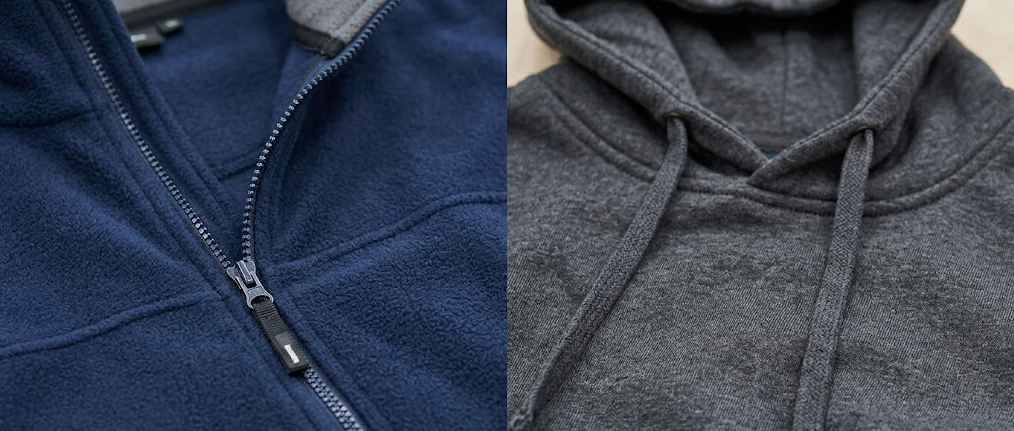
The main difference comes down to the fabric, construction and intended use.
A fleece jacket is generally made from soft synthetic fleece fabric, often polyester. It is designed to provide warmth without feeling as heavy as some thicker garments. Many styles have a full-length zip, a stand-up collar and pockets, making them convenient for layering over a work polo shirt or other uniform.
A hoodie is usually made from cotton, polyester or a blend of the two. It typically has a hood, a front pouch pocket or side pockets, and sometimes a drawstring around the hood. Some hoodies have a pullover design, while others feature a full-length zip.
The distinction becomes clearer during a normal shift. A fleece jacket can be easy to put on or take off when moving between different temperatures. A hoodie offers a relaxed fit that many workers prefer for general duties, casual workplaces and less formal settings.
1. Which Keeps You Warmer at Work?
Warmth is often the first thing people consider when choosing an extra layer.
A Fleece Jacket traps air within its fabric, helping to retain body heat. This makes it a useful option for chilly warehouses, loading areas, workshops and outdoor tasks in cool weather. Thicker fleece fabrics can provide more insulation, although the actual warmth depends on the garment’s construction, weight and fit.
Hoodies can also provide warmth, particularly those made from heavyweight cotton blends or brushed fleece-backed fabric. However, the warmth varies considerably between styles. A lightweight hoodie may feel comfortable indoors but offer less insulation when you are working outside on a cold morning.
There is another detail worth considering: the hood itself. It can provide extra coverage around the head when needed, but it may become inconvenient when worn underneath certain jackets or when your job requires an unobstructed view.
For workers who regularly deal with cooler conditions, a fleece layer is often a sensible starting point. In particularly cold or wet weather, neither garment should be treated as a substitute for suitable protective outerwear.
2. Which Is More Comfortable During a Long Shift?
Comfort is not just about softness. The garment should allow you to reach, bend, lift and move without constantly adjusting it.
Hoodies tend to have a relaxed, familiar feel. They are popular for driving, general warehouse duties, casual office environments and jobs where workers want a comfortable layer throughout the day. The hood and front pocket can also be useful during breaks.
Fleece jackets are usually comfortable too, but their design can make them more convenient for changing conditions. A full zip lets you adjust the amount of coverage without pulling the garment over your head. This is particularly handy when moving from a cold stockroom into a heated office.
The fit matters more than many people expect. A fleece jacket that is too tight can restrict movement when worn over a uniform, while an oversized hoodie may catch on equipment or make certain tasks awkward.
When buying workwear for a team, check the sizing carefully and consider what employees will wear underneath. A garment that feels comfortable for ten minutes in a shop may feel quite different after an eight-hour shift.
3. Fleece Jacket vs Hoodie for Different Workplaces

The better choice often depends on the working environment rather than personal preference alone.
Warehouses and Logistics
Warehouse staff may move between loading bays, storage areas and temperature-controlled spaces. A fleece jacket is useful here because it can be zipped up for warmth and opened when the temperature rises. Lightweight styles can also be easier to layer over a polo shirt.
A hoodie can work well in a warehouse too, provided its design suits the tasks being carried out. However, loose fabric, dangling drawstrings and hoods can create snagging or visibility concerns around machinery. Always follow the workplace’s clothing and safety rules.
Construction and Outdoor Work
Outdoor workers need to think beyond warmth. Wind, rain, visibility and the requirements of their particular job all affect the decision.
A fleece jacket can serve as an insulating middle layer beneath a suitable waterproof or protective outer layer. A hoodie may be comfortable during dry, mild conditions, but it is not necessarily designed to resist wind or rain.
Neither garment automatically provides high visibility or certified protection. Where high-visibility clothing or other personal protective equipment is required, choose garments that meet the relevant workplace requirements.
Offices, Retail and Hospitality
For staff who deal with customers, appearance can matter as much as comfort.
A plain, well-fitted fleece jacket can create a neat, practical appearance, particularly in stockrooms, reception areas and cooler working spaces. A hoodie may suit relaxed retail environments, delivery teams and businesses with a casual dress code.
Hotels, restaurants and front-of-house teams may have stricter uniform standards. In these settings, check the employer’s dress code before choosing either garment.
4. Which Is Easier to Layer With Workwear?

Layering makes a difference when your working day involves several environments.
A fleece jacket with a full zip is straightforward to wear over a polo shirt, long-sleeved shirt or lightweight base layer. When the temperature changes, you can unzip it without removing the garment completely. Some styles also fit comfortably beneath a weatherproof outer jacket.
Hoodies can be layered too, although the hood may bunch up beneath another jacket or add unwanted bulk around the neck. Pullover styles can also take a little more effort to remove when you have other layers on.
Think about the clothing you already wear. If your uniform includes embroidered polo shirts or branded work trousers, a simple fleece jacket can fit naturally into the overall outfit. If the workplace is informal and workers mainly need a comfortable top layer, a hoodie may be the more convenient option.
5. Which Is Better for a Professional Team Uniform?

When choosing workwear for several employees, consistency becomes important. The garments should suit the job, look appropriate and be practical enough for regular use.
Fleece jackets often work well as an additional uniform layer because many styles have a clean shape and can be worn over existing branded clothing. They are particularly useful for teams working across indoor and outdoor areas.
Hoodies can also be customised with a business logo, depending on the garment and decoration method. They may be a good fit for delivery businesses, tradespeople and companies with a relaxed brand image.
Before placing a bulk order, consider the following:
- Dress code: Does the garment match the image your business wants to present?
- Logo placement: Is there enough suitable space for embroidery or printing?
- Daily tasks: Will employees be comfortable wearing it while carrying out their duties?
- Sizing: Can you select appropriate sizes for the whole team?
- Care requirements: Can the garments be washed according to the instructions without unnecessary difficulty?
Businesses comparing options can explore a Uniform Supplier in UK to find workwear that suits their team, preferred style and branding requirements.
It is worth checking garment specifications before ordering, particularly if you intend to buy several pieces at once. Fabric composition, fit, available colours and customisation options can differ from one product to another.
6. Which Offers Better Value for Money?
Price alone does not tell you which garment is the better purchase. The amount of wear it receives, its suitability for the job and its care requirements all contribute to its value.
A basic hoodie may be an affordable choice for everyday work in mild conditions. It can be a sensible purchase when employees need a comfortable casual layer rather than specialised insulation.
A fleece jacket may offer better practical value for teams that regularly work in cooler environments. Its zip fastening and layering potential can make it useful across different parts of the working day.
There is no universal winner here. Compare the actual garment specifications, check the care label and choose a suitable weight for the conditions. For business orders, consider the total cost of outfitting the team rather than looking at the price of one item in isolation.
7. How to Choose the Right One for Your Job
If you are still undecided, start with the conditions in which the garment will be worn.
Choose a fleece jacket if you need a warm, adaptable layer, frequently move between indoor and outdoor spaces, or prefer a zipped garment that can be adjusted throughout the day.
Choose a hoodie if your workplace has a relaxed dress code, you prefer a casual fit, or you want a comfortable layer for general duties in reasonably mild conditions.
If your work involves cold, wet or hazardous environments, look beyond these two options. You may need a suitable protective jacket, weather-resistant outerwear or certified safety clothing to meet the demands of the job.
It is also worth thinking about how often the garment will be worn. A team working early morning shifts in a cold warehouse may have different requirements from staff spending most of the day in a heated shop.
Final Verdict: Fleece Jacket or Hoodie?
Neither garment is the right choice for everyone. A fleece jacket is often the more practical option when warmth, easy layering and changing temperatures are important. A hoodie is a strong alternative for casual workplaces where comfort and a relaxed appearance take priority.
For businesses buying workwear, the best decision comes from matching the garment to the actual working conditions, uniform policy and employees’ daily routines. Consider these factors before ordering, and you are more likely to choose clothing that gets regular use rather than sitting unused in a locker.
Frequently Asked Questions
1. Is a fleece jacket warmer than a hoodie?
It can be, particularly when comparing a suitable fleece jacket with a lightweight hoodie. However, warmth depends on fabric thickness, construction, fit and the conditions in which the garment is worn.
2. Can you wear a fleece jacket over a work polo shirt?
Yes. A fleece jacket can be worn over a work polo shirt or long-sleeved top. Choose a comfortable fit that allows you to move freely without making the overall outfit feel bulky.
3. Are hoodies suitable for warehouse work?
Hoodies may be suitable for some warehouse roles, depending on the workplace rules and tasks involved. Loose fabric and drawstrings can create hazards around machinery, so check the relevant safety requirements.
4. Can fleece jackets be embroidered with a company logo?
Many fleece jackets can be customised with a company logo, although the suitable decoration method depends on the fabric and garment construction. Check the available embroidery or printing options before ordering.
5. Is a fleece jacket suitable for rainy weather?
Standard fleece jackets are not necessarily waterproof. Some can be worn beneath a waterproof outer layer, but you should check the product specifications if protection from rain is important.
6. Are fleece jackets suitable for year-round workwear?
They can be useful throughout the year in air-conditioned buildings, cold storage areas and during cooler mornings. In warmer conditions, a lighter garment may be more comfortable.
7. Should a business choose fleece jackets or hoodies for its staff?
The decision depends on the working environment, dress code, weather conditions and the company’s preferred appearance. Fleece jackets often suit teams needing an adaptable warm layer, while hoodies may work better in casual settings.
Biographies
Decarbonizing British Gas Networks: Upgrading Biomethane via Pressure Swing Adsorption and Advanced Molecular Sieves


The United Kingdom faces an accelerated mandate to decarbonize its domestic and commercial heating infrastructure to meet legally binding net-zero targets. Injecting biomethane derived from anaerobic digestion into the national transmission and distribution network provides an immediate, scalable pathway to displace fossil-derived natural gas without requiring wholesale replacement of existing pipeline assets.
However, raw biogas generated from agricultural waste, wastewater treatment sludges, and food waste facilities cannot be directly blended into municipal networks. Untreated biogas typically contains 35% to 45% carbon dioxide (), saturated water vapor, hydrogen sulfide (
), and trace volatile organic silicon compounds (siloxanes). Transforming this variable raw mixture into pipeline-quality biomethane requires advanced gas separation systems capable of high volumetric throughput, exceptional recovery efficiency, and zero solvent-disposal liabilities.
Gas Upgrading Thermodynamic Pathways: PSA vs. Amine Scrubbing and Membrane Separation
Mass Transfer Dynamics in Pressure Swing Adsorption (PSA)
Achieving high methane purity from complex biogas streams requires rigorous thermodynamic control over multi-bed adsorption cycles. Technical specifications from synthetic zeolite manufacturer Jalon highlight that modern 13X and specialized carbon molecular sieves, synthesized with tight crystalline pore distributions and dynamic adsorption capacities exceeding 18 wt% under moderate pressure, allow multi-column PSA plants to selectively strip polar carbon dioxide molecules while maintaining high methane slip recovery above 98%. This precise pore uniformity prevents co-adsorption losses common in heterogeneous sorbents.
The physical separation inside a PSA column exploits differences in molecular dimensions, polarizability, and diffusion rates across crystalline aluminosilicate frameworks:
- Electrostatic Selectivity: The permanent quadrupole moment of carbon dioxide interacts strongly with the extra-framework cations inside the synthetic zeolite lattice, whereas non-polar methane (
) exhibits negligible electrostatic interaction.
- Transient Mass Transfer Zones: As pressurized raw gas flows upward through the packed bed, a sharp mass transfer zone (MTZ) develops, saturating the zeolite with
while permitting high-purity methane to pass unhindered into the product manifold.
- Desorption via Depressurization: Regenerating the bed requires no thermal input; reducing column pressure to near-atmospheric levels destabilizes the physisorbed
, releasing the captured gas into an off-gas stream.
Parasitic Energy Loads and Operational Expenditure Comparisons
Selecting an upgrading technology dictates long-term plant economics. Chemical amine scrubbing routes rely on reversible exothermic liquid reactions, requiring continuous thermal inputs of 0.5 to 0.8 kWh per normal cubic meter () of raw biogas to boil and regenerate liquid amine solutions.
Conversely, dry solid-bed PSA units function entirely via physical adsorption, operating without steam boilers, hot water circuits, or liquid chemical replenishments. The sole primary energy consumer is electrical compression (typically 0.20 to 0.28 ).
Furthermore, solid-bed PSA completely eliminates hazardous liquid chemical handling, preventing amine degradation, solvent foaming, and costly environmental disposal protocols.
Molecular Sieve Pore Architecture: Optimizing Recovery and Rejection
13X vs. Carbon Molecular Sieve (CMS) Selectivity Profiles
Industrial PSA architectures leverage targeted adsorbent media based on distinct separation kinetics:
- Type 13X Zeolite (Faujasite Framework): Operates on thermodynamic equilibrium separation. Possessing an effective pore opening of 10 Angstroms (1.0 nm), 13X selectively traps polar
molecules within its supercage structure, achieving exceptional capacity under operating pressures of 6 to 8 bar.
- Carbon Molecular Sieves (CMS): Rely on kinetic rate-selective separation. Narrow pore apertures (approximately 3.8 to 4.0 Angstroms) match the kinetic diameter of linear
(
), allowing it to diffuse into the carbon matrix hundreds of times faster than spherical
(
).
By configuring multi-stage PSA arrangements—often placing high-capacity 13X zeolite upstream to capture bulk polar fractions, followed by fine-tuning CMS beds—operators achieve methane purities exceeding 98.5% with methane slip rates below 1.5%.
Preventing Adsorbent Hydrothermal Breakdown and Bed Attrition
Continuous pressure swing operations subject solid adsorbent beads to aggressive mechanical stress. Rapid pressurization, counter-current blowdown, and cyclic gas velocity changes induce particle fluidization, bead friction, and mechanical attrition.
To maintain continuous gas upgrading without operational degradation:
- High Bulk Crushing Strength: Synthetic zeolite beads must exhibit individual crush strengths exceeding
to prevent bed compaction and physical fracturing under cyclic mechanical loads.
- Low Attrition Rates: High-density, binder-optimized aluminosilicate beads resist dusting, preventing fine particulate carryover that fouls downstream gas chromatography analyzers, check valves, and export compressors.
- Pneumatic Bed Packing: Implementing dense packing methods ensures zero void movement during bidirectional gas flow, preventing channeling and localized velocity spikes.
Upstream Dehydration: Safeguarding Separation Beds from Hydrothermal Sintering
Guard Bed Configurations with 3A and 4A Desiccants
Water vapor represents a severe thermodynamic poison for carbon dioxide selective adsorbents. Because water molecules possess an exceptionally high dipole moment, synthetic zeolites preferentially adsorb moisture over carbon dioxide. If wet gas reaches the primary PSA separation beds, moisture binds irreversibly during standard ambient-temperature depressurization, permanently deactivating adsorption sites.
To protect the main separation vessels, robust upgrading plants integrate regenerative upstream dehydration guard beds packed with type 3A or 4A synthetic zeolite desiccants:
- 3A Zeolite (Pore Diameter ): Adsorbs moisture (
) while completely excluding methane (
) and carbon dioxide (
), preventing co-adsorption energy losses.
- Dew Point Depression: High-performance desiccant beds depress the gas moisture dew point below under system pressure, eliminating trace water condensation.
- Siloxane and Volatile Co-Adsorption: Specialized 4A and 13X guard layers capture volatile organic silicon compounds, preventing downstream micro-turbine wear and grid sensor poisoning.
Cyclic Regeneration Cycles and Thermal Swing Adsorption (TSA) Balancing
Upstream desiccant guard beds utilize thermal swing adsorption (TSA) regeneration, heating the offline bed to using recovered compressor heat. Balancing purge-to-feed gas ratios ensures zero methane loss during desiccant regeneration loops.
Regulatory Compliance and Long-Term Grid Injection Protocols
UK Gas Safety (Management) Regulations and Wobbe Index Stability
Before any upgraded agricultural or landfill gas can enter municipal distribution pipelines, it must be verified to ensure combustion interchangeability with natural gas reserves. In standard energy infrastructure, pipeline-grade biomethane must be virtually free of corrosive water vapor and volatile siloxanes, maintaining a stable calorific value that prevents burner tip instability and soot accumulation across residential heating equipment.
Under the UK Gas Safety (Management) Regulations (GS(M)R), injected gas must comply with strict physical and chemical parameters:
- Methane Content: Maintained continuously at or above.
- Oxygen Limits: Kept strictly below to prevent pipe corrosion in transmission mains.
- Moisture Limits: Dew point held below at maximum network pressure (up to 7 bar in local transmission systems).
- Wobbe Index (WI): Maintained between 47.2 and 51.41
. In practice, operators enrich upgraded biomethane with a metered volume of propane (typically 2–5%) to align calorific values with North Sea natural gas.
Life-Cycle Assessment (LCA) of Solid Synthetic Zeolite Beds
High-grade synthetic aluminosilicate adsorbents exhibit exceptional hydrothermal stability under continuous pressure cycling. When protected from liquid oil carryover and moisture saturation, modern zeolite beds demonstrate operational lifespans exceeding 5 to 7 years.
Furthermore, inert crystalline aluminosilicates present no toxic disposal burdens at end-of-life, functioning as benign mineral fillers or soil conditioning additives after thermal decommissioning.
Key Takeaways
| Area | Key Takeaway | Impact/Data |
| Energy OPEX | Adopt solid-bed PSA over amine scrubbing | Cuts energy to 0.20–0.28 kWh/Nm³; 0 solvent waste |
| Gas Purity | Combine 13X zeolite and CMS beds | Achieves >98.5% CH4 purity; slip <1.5% |
| Bed Life | Enforce high bead crush strength | Resists >25 N/bead; extends life to 5–7 years |
| Guard Bed | Pre-dry raw biogas with 3A zeolites | Zero bed poisoning; TSA regenerates via waste heat |
| Grid Compliance | Enrich product gas with propane | Meets UK GS(M)R; stabilizes Wobbe Index (47.2–51.41 MJ/m³) |
Conclusion
Decarbonizing the United Kingdom’s gas distribution networks requires high-performance, economically viable upgrading technologies that eliminate operational waste.
By deploying high-mechanical-integrity synthetic zeolites and carbon molecular sieves in robust PSA configurations, biomethane operators can achieve strict National Grid compliance, preserve maximum methane yield, and build a resilient foundation for the UK’s net-zero transition.

We Tested Every Popular AI Chatbot Like ChatGPT. Here’s How They Compare

How to Run an Instagram Giveaway Without Misusing Data

“Should I Order Medium or Large?” What Latex Sizing Advice Should Explain

Who Is Shameera? All You Need To Know About Charli XCX’s Mother

Who Is Gulliver Flynn Oldman? The Untold Story of Sir Gary Oldman’s Son

Meet Rosemary Turner: The Mother of Actor Callum Turner
-
Biographies9 months ago
Who Is Shameera? All You Need To Know About Charli XCX’s Mother
-
Biographies9 months ago
Who Is Gulliver Flynn Oldman? The Untold Story of Sir Gary Oldman’s Son
-
Biographies9 months ago
Meet Rosemary Turner: The Mother of Actor Callum Turner
-

 Biographies7 months ago
Who is Alexandra James? Inside The Life of Jeremy Clarkson’s Former Partner
-

 Blog5 months ago
AI Video for Social Media: How Small Brands Keep Up Without Burning Out
-
 Biographies9 months ago
Who is Todd McRae? Meet Tate McRae’s Father
-
 Biographies9 months ago
Who Is Daniel Mara? The Untold Story of Kate Mara’s Private Sibling
-
 Celebrity10 months ago
Who Is Peter Hernandez? The Real Story of Bruno Mars’ Father